Related Posts
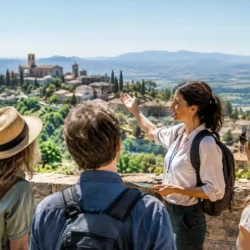
Perugia does not give up its story all at once. A Perugia walking tour begins among elegant squares and landmark buildings, but its real character emerges in the passages beneath the city, the overlooked Etruscan stones, and the steep lanes where daily life continues behind medieval facades. This is a city best understood at walking pace, with someone local to explain how its many layers fit together.
High above the Umbrian countryside, Perugia has been an important settlement since Etruscan times. It later became a powerful medieval commune, a papal stronghold, a university city, and a place where Renaissance art, civic pride, and modern life meet. The historic center is compact enough to explore on foot, yet complex enough that a guided visit can make every turn more meaningful.
Perugia is not a museum city arranged in a single, obvious route. Its streets climb, narrow, open unexpectedly onto views, and sometimes disappear into covered passageways. A map can take you to the main monuments, but it cannot easily reveal why a fortress became an underground district, why a Roman road still shapes the city plan, or where to look for the details that tell the story of Perugia’s medieval wealth.
An official local guide brings those connections to life. You may pause beneath the monumental Etruscan Arch, one of the finest surviving gates from ancient Perusia, then walk toward a piazza shaped by medieval civic ambition. Along the way, stories of noble families, popes, artists, and local rivalries give context to buildings that might otherwise seem simply beautiful.
This is especially valuable for visitors with limited time. A well-planned walk helps you see the essentials without spending the morning deciding which street leads where. It also leaves room for the unplanned pleasures of Perugia: a quiet courtyard, a bakery window, the sound of conversation from a small bar, or a long view across the green Umbrian hills.
Most walks through the historic center naturally gather around Piazza IV Novembre, Perugia’s great public stage. Here, the Fontana Maggiore stands at the center of the square, richly carved with biblical scenes, seasonal work, animals, and symbols of medieval knowledge. It is not merely a decorative fountain. It speaks of the city’s ambition, prosperity, and determination to bring water to its hilltop heart.
Beside it rises Perugia Cathedral, dedicated to San Lorenzo. Its unusual orientation faces the square, creating a powerful civic and religious setting. Across from the cathedral, the Palazzo dei Priori remains one of Italy’s most impressive medieval public palaces. Its severe stone exterior gives little hint of the artistic treasures and historic institutions associated with the building.
The Collegio del Cambio, within the Palazzo dei Priori complex, is a memorable stop for travelers interested in Renaissance art. Its audience hall was decorated by Pietro Perugino, the Umbrian master whose refined figures and clear, tranquil landscapes influenced a young Raphael. Seeing the frescoes in their original setting offers a more intimate experience than viewing them in a large museum gallery.
Depending on your interests and opening hours, a guide may also suggest places connected with Perugia’s artistic life, religious history, or university traditions. The city has many worthwhile interiors, but it is better to choose a few that suit your pace than to rush through every possible museum. Families may prefer a livelier route with stories and views, while art lovers may wish to allow more time for frescoes and collections.
Perugia’s Etruscan past is one of its greatest distinctions. The Etruscan Arch, also known as Porta Augusta, still marks an ancient entrance to the city, its massive blocks reminding visitors that Perugia was already a significant urban center long before Roman rule. Other traces are less immediately visible, which is precisely why a guide’s local knowledge matters.
The Rocca Paolina offers a striking encounter with a different chapter of history. Built in the 16th century by Pope Paul III after Perugia’s rebellion against papal authority, the fortress incorporated and buried parts of a medieval neighborhood. Today, escalators carry visitors through its atmospheric underground spaces. It is practical transport between levels of the city, but it is also an extraordinary passage through the political tensions that shaped Perugia.
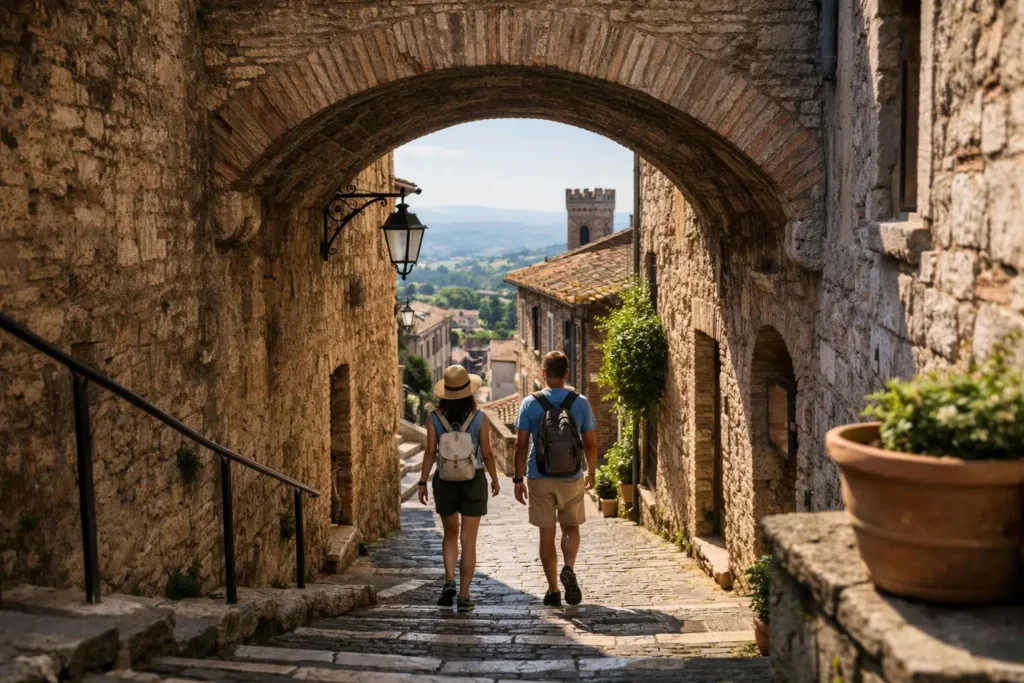
A walking route may include sections of the old aqueduct, now a peaceful pedestrian path, or small streets where the medieval city feels close at hand. These places are rarely about ticking off a famous sight. They are about recognizing the texture of Perugia: stone houses, arches, laundry above narrow lanes, and sudden openings toward the valley.
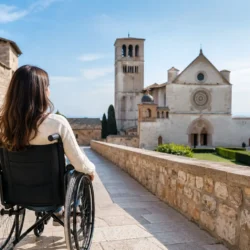
Perugia is rewarding, but it is hilly. Comfortable walking shoes are essential, and visitors should expect cobblestones, slopes, and occasional steps. The historic center has escalators and elevators in useful places, particularly around the Rocca Paolina, though not every lane is equally accessible. If mobility is a concern, it is wise to discuss the route in advance so the experience can focus on the most manageable areas.
For many visitors, two hours provides a satisfying introduction to the main monuments and central streets. A longer private visit allows more time for art, underground Perugia, the Etruscan heritage, or a relaxed stop for coffee and local specialties. The best option depends on whether Perugia is a day trip from elsewhere in Umbria or a city where you plan to linger.
Morning walks are often especially pleasant, when the streets are quieter and the light falls softly across the pale stone. Late afternoon has its own appeal, particularly in warmer months, as residents return to the center for an evening stroll. During the busiest travel periods, an early start can make the major sights more enjoyable.
A private tour is a strong choice for couples, families, and groups with specific interests. It gives you greater flexibility to focus on Etruscan archaeology, Renaissance art, religious landmarks, or the city’s food culture. A small-group tour can be ideal if you enjoy sharing the experience with other travelers while benefiting from a clear itinerary and an expert local voice.
Walking builds an appetite, and Perugia offers plenty of reasons to pause. Umbria is known for olive oil, cured meats, cheeses, legumes, truffles, and wines, while Perugia itself is closely associated with chocolate. A guided cultural walk can pair naturally with a tasting, a relaxed lunch, or time to browse local food shops after the tour.
Do not expect the same food experience in every season. Truffles are particularly associated with cooler months, while summer calls for lighter meals and time in shaded streets. If you are traveling through the region, Perugia can also be a useful starting point for wider Umbrian discoveries, from Assisi’s Franciscan heritage to the vineyards around Montefalco and the hill towns scattered across the countryside.
For visitors who want a thoughtful introduction rather than a hurried checklist, Umbria.tours can arrange guided experiences led by official local guides who know Perugia beyond its postcard views. The value lies not only in seeing the landmarks, but in understanding why they are there and how the city continues to live around them.
Leave a little unplanned time after your walk. Sit in Piazza IV Novembre, follow a lane your guide has pointed out, or take the escalators through the Rocca Paolina once more. Perugia is at its best when its grand history and ordinary daily rhythm have time to settle into the same afternoon.