Perugia Historic Centre Guide for First Visits
Perugia does not reveal itself all at once. The modern city spreads over the hills, but its oldest heart rises above it: a compact maze of Etruscan walls, medieval lanes, grand civic spaces, and surprisingly dramatic escalators. This Perugia historic centre guide helps you spend your time well, whether you have a few hours between Tuscan and Umbrian stops or a full day to look beyond the postcard views.
The center is wonderfully walkable, yet it is not flat. Expect steep streets, cobblestones, and occasional steps. That is part of its character, but it also means a little planning makes a real difference.
Start at Piazza IV Novembre
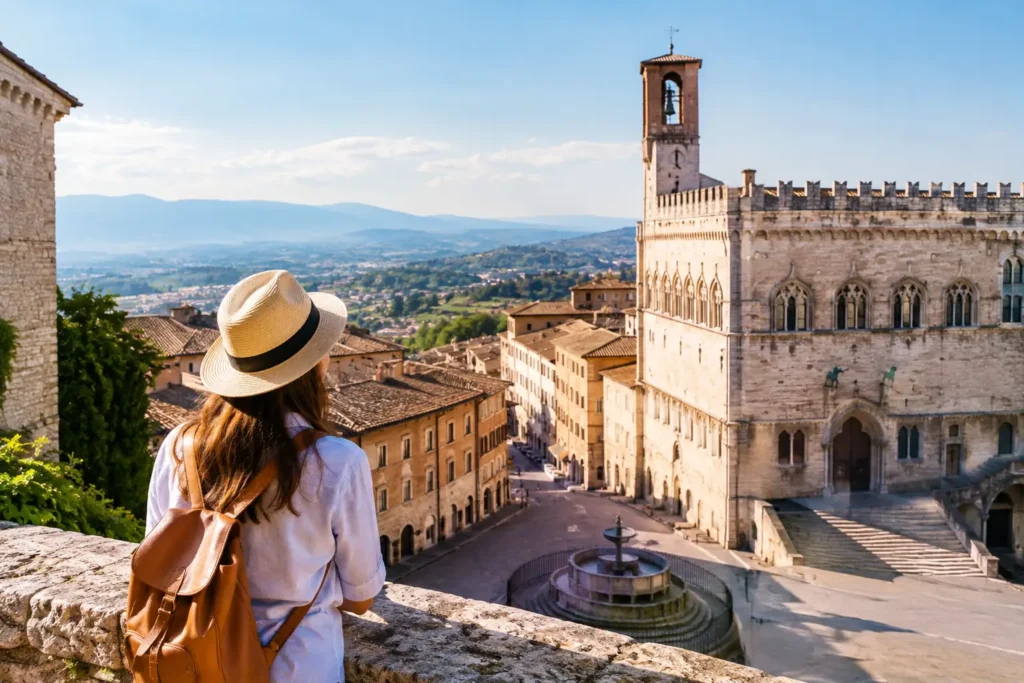
If Perugia has a living room, it is Piazza IV Novembre. This is the natural place to begin because the city’s major landmarks meet in one elegant, lively square. Take a moment before rushing onward. Students, residents, visitors, and street musicians all pass through here, and the square still works as Perugia’s social crossroads.
At its center stands the Fontana Maggiore, a 13th-century fountain designed by Nicola and Giovanni Pisano. Its carved panels are not mere decoration. Look closely and you will find references to the months, zodiac signs, biblical stories, trades, and everyday life. It was designed as a civic statement as much as a water source: Perugia was prosperous, ambitious, and proud of its independence.
The cathedral, formally dedicated to San Lorenzo, faces the side of the square rather than presenting a conventional grand façade. This slightly unexpected orientation is one of the details that makes Perugia feel less staged than many Italian cities. Inside, the atmosphere is quieter, with chapels, artworks, and centuries of local devotion.
Opposite stands the Palazzo dei Priori, Perugia’s great medieval civic palace. Its pointed arches and imposing entrance express the confidence of a powerful commune. The building houses the National Gallery of Umbria, an essential stop for travelers interested in Italian art. If your schedule is tight, choose between a quick exterior visit and a proper museum visit rather than trying to hurry through both.
A note on the National Gallery of Umbria
The gallery deserves at least 90 minutes, and longer if Renaissance painting is a priority. Its collection includes works by Perugino, Pinturicchio, Piero della Francesca, and other masters connected to central Italy. Perugino, born nearby, is especially important here. His lucid landscapes and calm figures offer a useful contrast to the dense, stone-built city outside.
For some visitors, art is the main reason to come to Perugia. For others, the pleasure lies in wandering. Both approaches work, but a guided visit can connect the museum’s paintings with the churches, politics, and families that shaped the city beyond its walls.
Walk Corso Vannucci, then leave it behind
From Piazza IV Novembre, Corso Vannucci runs south toward the Rocca Paolina. This broad pedestrian street is Perugia’s most polished promenade, lined with historic buildings, cafés, shops, and places to pause for an espresso. It is a good route for first-time visitors and a pleasant place for an early evening stroll.
Yet the most memorable parts of the historic center are often just beyond it. Turn into Via dei Priori, Via della Viola, or the smaller lanes around Piazza Piccinino. Here, stone houses lean close together, laundry may hang above the street, and a doorway can lead to a hidden courtyard or a small artisan workshop.
Do not try to follow every side street. Perugia rewards unplanned turns, but the slopes can become tiring. Choose one neighborhood to explore slowly, then return to the main route when you are ready. Comfortable shoes are more valuable than a tightly packed itinerary.
Go underground at Rocca Paolina
Rocca Paolina is one of Perugia’s most unusual and revealing experiences. It is part fortress, part underground passage, and part practical transport system connecting the lower city with the historic center.
In the 16th century, Pope Paul III ordered a vast fortress built after Perugia rebelled against papal power. The project required the demolition of an entire neighborhood, including the homes and towers of the Baglioni family, powerful local rivals of the papacy. Today, the fortress itself has mostly disappeared above ground, but its underground streets, arches, and spaces remain.
Enter from Piazza Partigiani or the lower level near the bus station and ride the escalators upward through the old quarter. The journey takes only a few minutes, but it provides a powerful sense of the city’s layered history. You are moving through a buried medieval district created by conquest and preserved by chance.
This is also the easiest way to reach the center if you arrive by bus or park below the hill. For travelers with limited mobility, it is a far better option than tackling the steepest streets on foot, although the old center itself still has uneven pavement.
Look for Etruscan Perugia
Perugia was an important Etruscan city centuries before Rome dominated Italy. Its ancient past is not confined to one museum room; it appears in gates, walls, wells, and the shape of the hilltop settlement.
The Etruscan Arch, also known as Porta Augusta, is among the most impressive surviving gateways. Its monumental stone blocks and inscription survive from the 3rd century BC, with later Roman additions. It is easy to pass through quickly, but pause beneath it and consider that this was once an entrance to a powerful Etruscan city.
Nearby, the Pozzo Etrusco, or Etruscan Well, descends deep beneath Palazzo Sorbello. This extraordinary engineering work supplied water to the ancient settlement and offers a different perspective on daily life in antiquity. It is a worthwhile stop for families and for anyone interested in what lies below Perugia’s familiar medieval surfaces.
You can also spot stretches of Etruscan wall around the center. These fragments may seem less dramatic than a cathedral or palace, but they explain why Perugia occupies this commanding position. The city was built for defense, trade, and control of the surrounding valleys.
Make time for San Michele Arcangelo and Porta Sole
A little north of the busiest streets, the church of San Michele Arcangelo is a rewarding detour. Often called the Tempietto, it is a rare circular church with early Christian origins, built on a site associated with an earlier pagan temple. Its columns, simple interior, and unusual plan give it a very different feeling from Perugia’s Gothic and Renaissance churches.
From this side of the center, continue toward Porta Sole, traditionally considered one of Perugia’s highest and most panoramic areas. The views open across Umbrian hills and rooftops, especially in late afternoon when the stone takes on warmer tones. It is not the only viewpoint, but it offers a calmer pause away from Corso Vannucci.
Eat and drink like a local, without overplanning it
Perugia is a university city, so its food scene ranges from traditional Umbrian cooking to casual wine bars and contemporary kitchens. For lunch, look for dishes that reflect the region: strangozzi pasta, lentils from nearby Castelluccio, cured meats, pecorino, truffles when in season, and roasted meats.
The city is also known for chocolate, particularly during the annual Eurochocolate festival. Outside festival dates, a quality chocolate stop still makes sense, but do not let it replace the region’s other flavors. Umbria is equally defined by olive oil, Sagrantino wine, porchetta, and seasonal produce.
For a simple, satisfying pause, order a glass of Umbrian wine with a small plate rather than committing to a long lunch at the busiest hour. If you want a fuller food experience, plan your main meal slightly away from the most obvious central square. You may find better value and a more relaxed atmosphere a few streets beyond the main flow of visitors.
Practical advice for your visit
A half-day allows you to see Piazza IV Novembre, Corso Vannucci, Rocca Paolina, and one or two additional landmarks. A full day gives you time for the National Gallery, Etruscan sites, a long lunch, and a slower walk through the side streets.
Morning is best for quieter streets and museum visits. Late afternoon is ideal for views and an aperitivo. In summer, the center can be hot despite its elevation, while winter brings a more local, contemplative mood. Rain makes the stone streets slippery, so take extra care on slopes.
If you are visiting Perugia for the first time, an official local guide can add real value. The city’s history is not always visible from the street: papal conflicts, noble families, underground districts, Etruscan engineering, and artistic connections are woven into details that are easy to miss. Umbria.tours offers guide-led experiences designed to make those details feel clear, personal, and connected to the wider region.
Perugia is at its best when you resist the urge to check every landmark off a list. Leave room for the unexpected: a view at the end of a lane, a quiet church interior, the sound of conversation from a café terrace, or an ancient arch that suddenly makes the city’s long history feel close enough to touch.