
Related Posts


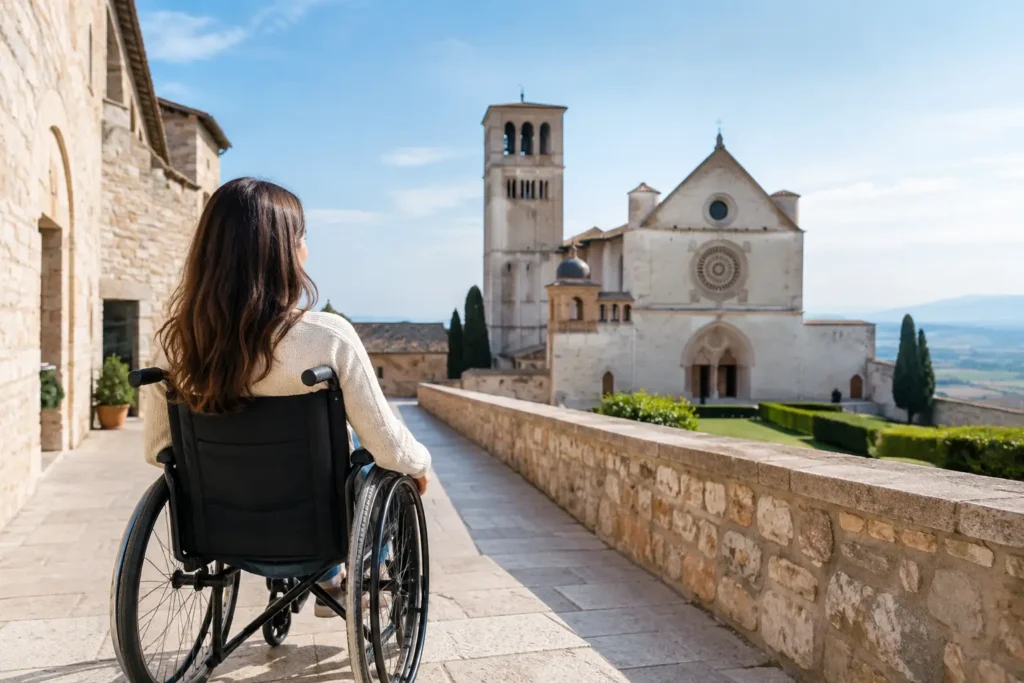
Assisi is a hill town, and that fact shapes every visit. Assisi wheelchair access is possible, especially around its major landmarks, but it is not a destination where every medieval lane is level, smooth, or easy to enter without planning. A thoughtful itinerary can make the difference between spending the day negotiating steep cobblestones and enjoying the art, views, and Franciscan history that bring travelers here.
The key is to treat Assisi as a series of accessible highlights rather than a town to cover street by street. Choose where to arrive, decide which monuments matter most, allow more time than a map suggests, and be willing to use the gentler routes even when they are less picturesque. Assisi rewards an unhurried pace.
The historic center rises along the side of Mount Subasio. Its character comes from stone streets, narrow passages, slopes, and buildings constructed many centuries before modern accessibility standards. This creates variation from one block to the next: a broad paved street may lead to a sharply inclined section, while an apparently short route can include uneven stones or a curb without a ramp.
Visitors using a manual wheelchair should expect some assistance on steeper sections, particularly if they venture beyond the central shopping streets and principal squares. A powered wheelchair or mobility scooter can make longer distances easier, although weight, battery range, turning radius, and the occasional rough surface all matter. Compact equipment is often more practical than a large model in Assisi’s tighter lanes.
Accessibility also varies inside churches, museums, shops, and restaurants. Main visitor areas are often more manageable than side entrances or smaller historic interiors, but a step at a doorway can still be common. It is wise to confirm the current arrangements directly with each venue before travel, especially if a lift, accessible restroom, companion entry, or particular seating arrangement is essential.
This is not a reason to skip Assisi. It is a reason to plan honestly. The town’s most meaningful experiences can be enjoyed without attempting every uphill detour.
For many travelers, the most practical approach is to begin near the Basilica of St. Francis, at the lower edge of the historic center, and work gradually through the more accessible central areas. The basilica complex is one of Italy’s great religious and artistic sites, and starting here avoids making an immediate climb from the valley below.
From this area, Via San Francesco leads toward Piazza del Comune. It is a lively route with shops, cafes, and changing gradients. Some stretches are manageable, while others are uneven or inclined, so it should be approached at a measured pace. A local driver can also reduce the walking or rolling distance by dropping guests as close as permitted to the agreed meeting point.
Piazza del Comune is a rewarding central stop. The square brings together the Temple of Minerva, the Palazzo dei Priori, and the everyday rhythm of Assisi. It is a good place to pause for coffee, use facilities when available, and decide whether the next uphill section is worthwhile that day.
The upper part of town, including the area around the Cathedral of San Rufino and Rocca Maggiore, is more demanding. The cathedral may be possible depending on your route and current entrance arrangements, but the climb is substantial. Rocca Maggiore is a wonderful viewpoint and fortress, yet it is generally not the best choice for wheelchair users because of its steep approach and historic structure. There is no loss in choosing the basilicas, the main square, and a relaxed lunch instead.
The Basilica of St. Francis is the heart of most visits to Assisi. It contains both the Upper and Lower Basilicas, with fresco cycles associated with artists including Giotto and Cimabue, as well as the tomb of St. Francis. The complex has distinct levels and controlled visitor flows, so accessibility arrangements can differ between entrances and areas.
Before visiting, check current information on accessible entry, elevator availability, security procedures, and whether companions may assist. Religious services, major feast days, restoration work, and crowd-management measures can affect the route. Staff are accustomed to welcoming international visitors, but advance preparation remains the safest choice.
Allow enough time here. Even a visitor who cannot access every corner of the complex can have a profound experience in the spaces that are available. A guide can help bring the basilica to life through its stories, symbols, and artistic details, rather than turning the visit into a race between thresholds.
Do not assume that driving into the historic center is possible. Assisi has limited-traffic zones, restricted streets, and parking arrangements that can change with events and season. Accessible parking may be available in designated areas, but eligibility, permits, shuttle access, and the distance to monuments should be checked in advance.
If you are arriving by car, ask your accommodation where it recommends unloading luggage and passengers. A hotel outside the walls may offer easier parking and room access, while a property inside the center can place you closer to restaurants and landmarks. Neither choice is automatically better. It depends on whether you value a simpler arrival or the ability to spend evenings in the historic town with minimal additional travel.
Assisi railway station is in Santa Maria degli Angeli, on the flat plain below the hill town. This is useful to know when booking rail travel: the station is not beside the Basilica of St. Francis. You will need an accessible taxi, private transfer, or suitable local transport connection to reach Assisi itself. Reserve any specialized vehicle well ahead in busy periods, particularly spring, early fall, Easter, and Christmas.
Santa Maria degli Angeli is worth considering as part of the itinerary. The Basilica of Santa Maria degli Angeli, which shelters the tiny Porziuncola chapel associated with St. Francis, stands on much flatter ground than Assisi’s historic center. For some visitors, it is one of the most comfortable and moving Franciscan sites in the area.
Trying to see every church, viewpoint, and museum in one day is difficult for anyone in Assisi. For wheelchair users and companions, a focused itinerary is both more comfortable and more rewarding. Plan around two major sites, a central square, and time for lunch or a quiet break.
A well-paced day might begin at the Basilica of St. Francis, continue along selected sections of Via San Francesco, and pause in Piazza del Comune before ending with a pre-arranged transfer. Another option is to visit Santa Maria degli Angeli first, then travel up to Assisi for the basilica and its immediate surroundings. The right order depends on your hotel, transport, energy level, and the weather.
Summer heat deserves special attention. Stone streets reflect the sun, shaded routes can be limited, and the physical effort of slopes increases quickly in high temperatures. Morning visits are usually more comfortable, while an afternoon break can be the difference between a pleasant day and an exhausting one. In wet weather, polished stone and cobbles may become slippery, so allow extra time and avoid ambitious downhill routes.
Restaurant choice also matters. A terrace with a beautiful view may be reached by steps, while a less dramatic entrance near the main streets may offer level access and an accessible restroom. Call ahead rather than relying only on photographs. Mention the width of the wheelchair if space between tables or at the doorway could be an issue.
An official local guide does more than explain frescoes and dates. In a town such as Assisi, a guide can shape the route around the realities of the day: crowds near the basilica, temporary access changes, a gentler street, a convenient stopping point, or a monument that is more suitable than the one originally planned.
For private visitors, this flexibility is particularly valuable. Tell the guide or tour operator about mobility needs before booking, including whether you use a manual or powered wheelchair, travel with a companion, need step-free restroom access, or prefer to minimize slopes. Specific information helps create a realistic plan. It is better to promise a meaningful route that works well than an overambitious itinerary that leaves everyone tired.
Umbria.tours can arrange guided experiences rooted in Assisi’s history and local character, with the route discussed in advance for guests who need a more considered pace. The goal is not to make medieval Assisi pretend to be barrier-free. It is to make its essential stories and landmarks more approachable.
A short pre-trip checklist can prevent most avoidable difficulties. Confirm where your vehicle can stop, how far the route is from drop-off to the first attraction, and whether the surface includes steep cobblestones. Ask each major monument about step-free entrances, lifts, accessible restrooms, and any restrictions on scooters or larger powered chairs.
Bring a charged phone, rain protection, water, and any wheelchair repair essentials you normally carry. If traveling with a folding wheelchair, consider whether a companion can manage it during a taxi transfer. If you require an accessible bathroom at regular intervals, build those stops into the schedule rather than treating them as an afterthought.
Most of all, leave room for the moments that make Assisi memorable: sunlight on pale stone, a quiet chapel, the sound of bells across the valley, and a long lunch after a morning of art and history. With the right expectations and a route designed around your needs, Assisi can feel less like an obstacle course and more like the deeply human place it has always been.