Related Posts
Assisi Guide Reviews and What to Look For
09-10-2026
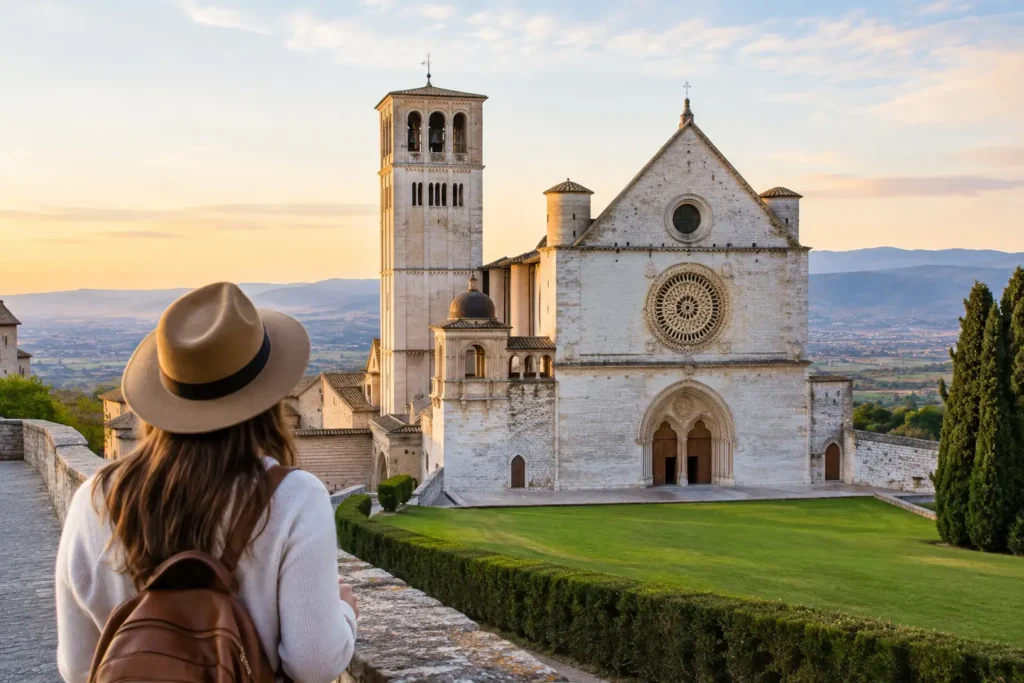
Assisi is not a place to rush between monuments. The town rises in pale stone above the Umbrian plain, and its religious landmarks are woven into steep lanes, quiet piazzas, and everyday life. This Assisi religious sites guide helps you choose where to spend your time, understand what you are seeing, and experience the city beyond its most famous basilica.
For many visitors, Assisi is a day trip from Florence or Rome. That can work, but the town rewards a slower pace. Its churches tell a connected story: of St. Francis, St. Clare, medieval pilgrimage, powerful religious orders, and an artistic legacy that shaped Italy. A well-planned visit lets the major sites feel meaningful rather than overwhelming.
The Basilica of St. Francis is Assisi’s spiritual and artistic heart. Built soon after Francis’s death in 1226, it was designed to welcome pilgrims to the resting place of a saint whose message of humility and simplicity reached far beyond Umbria.
The building is actually two churches, one above the other, with the saint’s tomb below. The Lower Basilica is intimate and dimly lit, its painted vaults and side chapels creating a contemplative atmosphere. Descend further to the crypt to visit the tomb of St. Francis, marked by a simple stone altar. Even for travelers who are not religious, this is a moving place because the setting reflects the Franciscan ideal of modesty.
The Upper Basilica feels very different. It is filled with light and contains one of Italy’s great cycles of medieval frescoes. The scenes traditionally associated with Giotto recount episodes from the life of St. Francis with unusually direct human feeling: friendship, doubt, joy, grief, and care for those on society’s margins. Art historians continue to debate the exact role of Giotto and his workshop, but the importance of the frescoes is beyond doubt.
Allow at least an hour and a half here, and more if art is a priority. Dress respectfully, speak quietly, and remember that this is an active place of worship, not simply a museum. Morning is often the best time for a calmer visit.
The Basilica of St. Francis is essential, but it is only one chapter. A thoughtful Assisi religious sites guide should also follow the physical route of Francis’s life, beginning with the places tied to his youth and conversion.
Near Piazza del Comune, Chiesa Nuova stands on the traditional site of the house of Pietro di Bernardone, Francis’s father. The church itself dates from the 17th century, so it does not recreate medieval Assisi in a literal sense. Its value lies in the story it preserves: Francis was born into a comfortable merchant family before renouncing wealth and choosing a life of radical poverty.
A small underground room is traditionally identified as the place where his father imprisoned him after his conversion. Whether you approach it as faith, history, or local tradition, the site offers useful context before visiting the grander basilicas.
A short uphill walk brings you to the Cathedral of San Rufino, dedicated to Assisi’s patron saint. Francis and Clare were both baptized here, making it one of the town’s most significant churches. Its Romanesque facade, decorated with carved animals, saints, and symbolic figures, is among the finest in Umbria.
Step inside to see how the building has changed over centuries. The interior is more Baroque than the exterior suggests, while the museum and archaeological area reveal earlier layers of the site. This is a good stop for visitors interested in Assisi before the Franciscan movement transformed its international importance.
The Basilica of St. Clare sits at the eastern edge of the historic center, with broad views across the valley. Clare was a young noblewoman from Assisi who followed Francis’s example and founded the Poor Clares, a community committed to poverty, prayer, and service.
Inside, look for the Crucifix of San Damiano. According to tradition, Francis was praying before this painted cross when he heard Christ’s call to “repair my house.” The original cross was later cared for by Clare and her sisters at San Damiano, then moved here after her death. The crypt contains St. Clare’s remains, while the open square outside offers one of the most peaceful pauses in town.
San Damiano lies below Assisi’s walls, surrounded by olive groves and countryside. It is a manageable walk downhill from the center, though the return climb is steep. A taxi may be the better choice for visitors with limited mobility, young children, or a full day of sightseeing.
This modest sanctuary is among the most personal places associated with Francis. Here he received the call that gave direction to his life, and here Clare established her community. The refectory, dormitory, cloister, and small chapel convey the scale of daily monastic life more clearly than a grand church can.
San Damiano is especially rewarding in the late afternoon, when many day visitors have left Assisi and the countryside becomes part of the experience. It is not the place for a rushed photo stop. Take time to sit quietly in the cloister or walk back through the olive trees.
At the foot of the hill, in the modern town of Santa Maria degli Angeli, stands the immense Basilica of Santa Maria degli Angeli. It was built around the tiny Porziuncola chapel, one of the most sacred places in the Franciscan world.
The scale is striking: a monumental basilica shelters a chapel so small that visitors can walk around it in moments. Yet the contrast makes sense. The Porziuncola was central to Francis’s community, where he gathered his first companions and where he wished to die. Nearby is the Chapel of the Transitus, marking the place of his death in 1226.
This site is easy to reach by train, bus, or car, and it works well at the beginning or end of an Assisi day. If you are arriving by train, visit it before heading uphill to the historic center. If you have a car, it can be more convenient to stop here before navigating Assisi’s restricted traffic zones and parking areas.
If you have only a few hours, prioritize the Basilica of St. Francis and either the Basilica of St. Clare or Santa Maria degli Angeli. The right choice depends on your interests. St. Clare’s is easier to include while walking through the historic center; Santa Maria degli Angeli offers the deepest connection to Francis’s early community and is particularly worthwhile if you arrive by train.
With a full day, add San Rufino, Chiesa Nuova, and San Damiano. Keep in mind that Assisi is steep and paved with stone, so comfortable shoes matter more than an ambitious checklist. Churches may also adjust access during services, feast days, or special celebrations. Respectful clothing is expected, particularly in the major basilicas.
A local official guide can make a real difference here. Frescoes, relics, architectural changes, and Franciscan traditions can otherwise blur together, especially on a first visit. Umbria.tours offers guided experiences that place the monuments within the wider story of Assisi, while leaving room to notice the small details that make the town memorable.
Assisi’s religious heritage is not limited to Francis and Clare. As you walk, notice the smaller churches, convent entrances, votive images, and bells marking the rhythm of the day. The Church of Santa Maria Maggiore, near Piazza del Comune, is historically significant as the place where Francis publicly renounced his inheritance. Nearby, the Roman temple facade of the Minerva stands as a reminder that Assisi was an important town long before Christianity reshaped its streets.
This layering is what makes Assisi exceptional. Roman stone, medieval faith, Renaissance additions, and modern pilgrimage exist side by side. The town can be deeply spiritual, visually magnificent, and very human at once.
Leave a little unplanned time after your church visits. Find a bench overlooking the valley, order a coffee in a side street, or wander toward the quieter edges of the center. In Assisi, the most lasting impression often comes not from checking off another landmark, but from letting the landscape and the stories settle into place.