Related Posts
Assisi Wheelchair Access for a Better Visit
11-10-2026
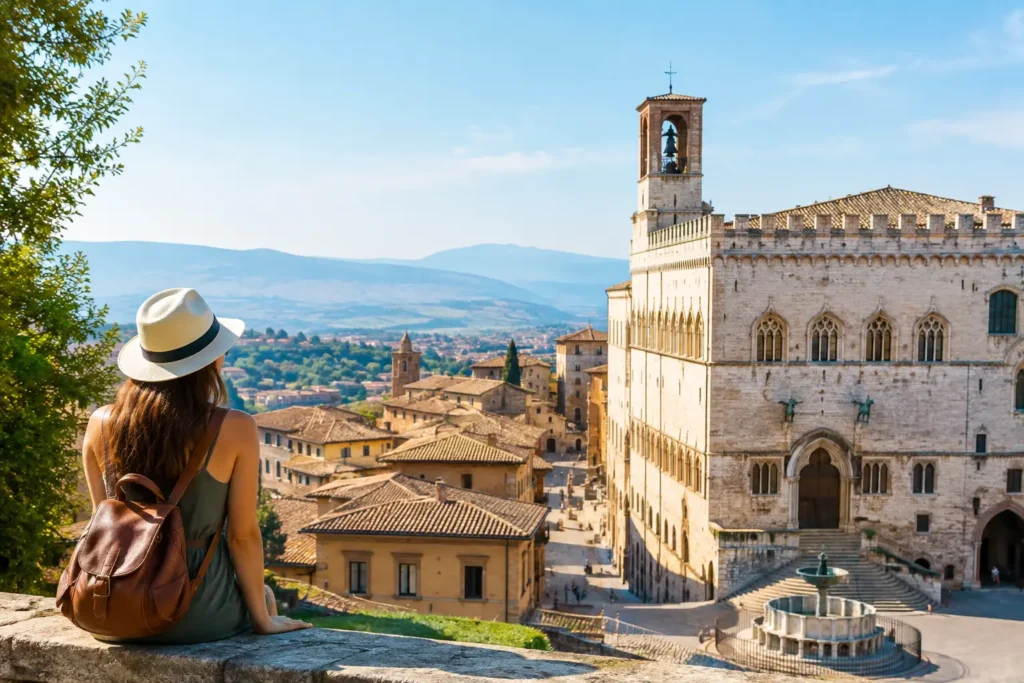
The first surprise in Perugia is that the city seems to have more than one level. Escalators rise from modern streets into a medieval center, while the underground Rocca Paolina reveals lanes and buildings swallowed by a 16th-century fortress. So, is Perugia worth visiting? For travelers who want Italian art, ancient history, excellent food, and a lived-in city rather than a perfectly polished postcard, the answer is a confident yes.
Perugia is Umbria’s capital and university city, which gives it an energy that many smaller hill towns do not have. It can feel busy, steep, and slightly unruly at first. That is also its appeal. Behind the grand squares are Etruscan walls, quiet churches, family-run food shops, and views across the Umbrian hills.
Perugia rewards travelers who enjoy looking closely. Its history stretches back well before Rome, when it was one of the principal Etruscan cities. The impressive Etruscan Arch, built in the 3rd century BC, still forms one of the entrances to the historic center. It is not tucked away in a museum – it is part of the everyday city.
From there, walk toward Corso Vannucci, Perugia’s elegant main street. This is where the city gathers for an evening stroll, an espresso, a shop window, or an aperitivo. At its center lies Piazza IV Novembre, one of the most memorable squares in central Italy. The pink-and-white marble Fontana Maggiore stands before the Gothic Palazzo dei Priori and Perugia Cathedral, creating a scene that feels ceremonial without being remote.
The Palazzo dei Priori is home to the National Gallery of Umbria, a major reason to allow proper time in Perugia. Its collection follows the region’s artistic story from the Middle Ages into the Renaissance, with works by Perugino, Pinturicchio, Fra Angelico, and Piero della Francesca. Even visitors who do not plan their trips around museums often find the setting compelling: richly decorated rooms, religious panels full of detail, and art that gives context to the churches and landscapes seen elsewhere in Umbria.
Perugia also has a more complicated history than its handsome façades suggest. The Rocca Paolina was commissioned by Pope Paul III after a rebellion in 1540. To build it, entire neighborhoods were demolished and incorporated into a vast papal stronghold. Today, the remaining underground passage is a practical route from the lower city to the center, but it is also an extraordinary walk through Perugia’s political past. A local guide can make this hidden city especially meaningful, explaining what is original, what was rebuilt, and why the fortress still matters to Perugians.
Perugia is not as immediately picture-perfect as Spello, nor does it offer Assisi’s concentrated spiritual atmosphere or Orvieto’s dramatic cathedral. It is a working regional capital, with traffic, university life, offices, and neighborhoods beyond the historic core. Travelers seeking a tiny, tranquil hill town may prefer to stay elsewhere and visit Perugia for the day.
But for many visitors, that everyday character is precisely why Perugia is worth visiting. Students from Italy and abroad bring life to its cafes and bars. Residents use the same streets visitors come to admire. Markets, exhibitions, concerts, and seasonal events keep the city from feeling preserved under glass.
The urban layout does demand a little patience. Perugia is built on a hill, and some streets are steep or paved with uneven stone. The escalator system and small public elevators make the center more accessible than it first appears, especially from parking areas and the train station. Comfortable shoes are essential, and travelers with limited mobility should plan routes carefully rather than assuming every historic lane will be easy.
Perugia has long been associated with chocolate, most famously through Baci Perugina, the chocolate-and-hazelnut treats created here in the early 20th century. Chocolate lovers may want to time a visit for Eurochocolate, usually held in autumn, when tastings, displays, and confectionery stalls fill the city. It is lively and fun, though it also brings crowds and higher demand for accommodations.
Outside festival season, Perugia is a good place to understand Umbrian food beyond the familiar dishes of wider Italy. Look for savory torta al testo, a griddled flatbread often filled with cured meats, greens, or cheese; strangozzi pasta with truffle or tomato-based sauces; local pecorino; and pork preparations that reflect the region’s rural traditions. The city is also a convenient base for exploring olive oil, Sagrantino wine, and farm-to-table cooking in the surrounding countryside.
Do not expect Perugia to be a destination where every meal is a grand spectacle. Its pleasures are more local: a glass of Umbrian wine in a small enoteca, a casual lunch on a side street, pastries with morning coffee, and a table that fills up with residents after 8 p.m. Ask for seasonal dishes and regional ingredients rather than relying only on menus aimed at visitors.
A full day is enough to see the essential center at a pleasant pace. Begin at the Rocca Paolina, emerge onto Corso Vannucci, spend time in Piazza IV Novembre, visit the National Gallery of Umbria, and leave room for a long lunch or an aperitivo. With a focused private walking tour, the layers of Etruscan, medieval, Renaissance, and modern Perugia become much easier to read.
An overnight stay is better if you want the city after day-trippers have left. Early morning is quiet around Piazza IV Novembre, while evenings reveal a sociable side of Perugia that a day visit misses. Two nights make sense for travelers using it as a base for nearby destinations such as Assisi, Gubbio, Lake Trasimeno, Bevagna, Montefalco, or Spello.
Perugia works particularly well as part of a wider Umbrian itinerary. It has stronger transport connections and more dining choices than many villages, while the countryside is never far away. Umbria.tours can help travelers pair a guided introduction to the city with food, wine, or walking experiences that bring the wider region into view.
Spring and early fall are excellent for walking the city’s slopes and spending time outdoors. April through June brings green countryside and generally comfortable temperatures, though rain is always possible. September and October offer harvest flavors, warm light, and a more relaxed rhythm after the peak summer period.
Summer can be very rewarding, particularly during Umbria Jazz, when international music fills the streets and squares. The trade-off is heat, crowds, and busier accommodations. If you visit in July, reserve popular restaurants and tours in advance, and plan museum visits or underground sites during the hottest hours.
Winter is quieter and can feel atmospheric, especially around Christmas. Some travelers will find the weather gray and the shorter days limiting, but those who prefer museums, long lunches, and fewer crowds may find it an appealing time.
Perugia is a strong choice for couples, curious independent travelers, art lovers, and families with older children who can manage the walking. It is also ideal for visitors returning to Italy who want something beyond the most obvious route between Florence, Rome, and Venice.
It may be less suitable for travelers whose priority is easy driving, flat promenades, or a resort-style break. Parking is generally outside the historic center, and the charm of Perugia lies in wandering streets that were never designed for cars. Give yourself time, use the escalators without hesitation, and accept that a wrong turn may lead to an unexpected viewpoint or a quiet medieval corner.
Arrive with comfortable shoes and an appetite for layers rather than landmarks alone. Pause in Piazza IV Novembre when the light begins to soften, then follow the sound of conversation toward dinner. Perugia tends to reveal itself gradually, and that is a very good reason to stay long enough to listen.