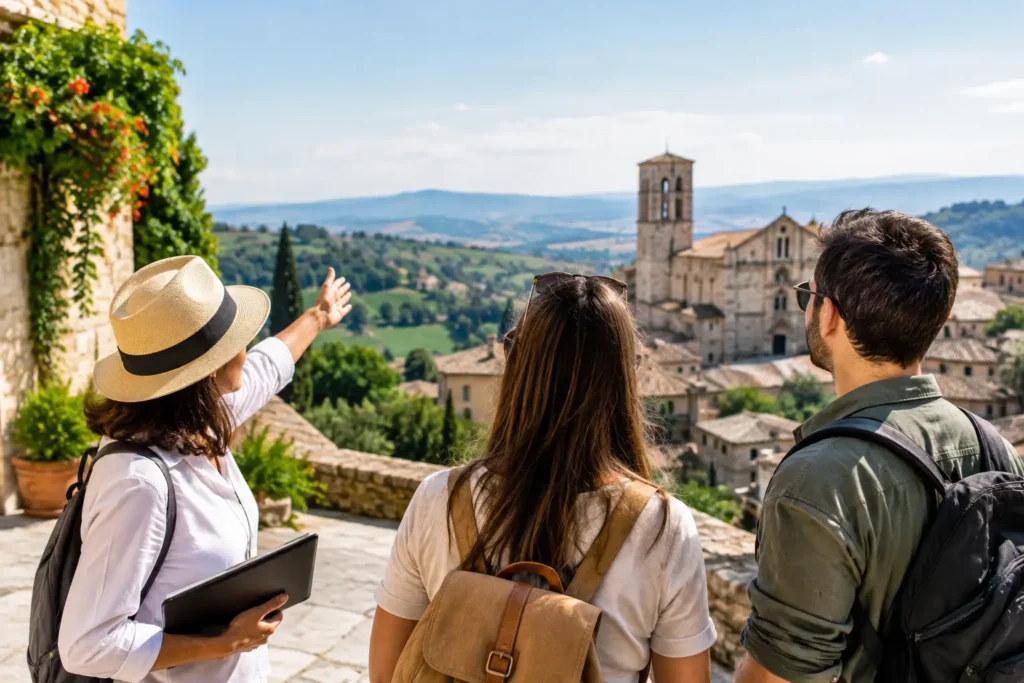
Guided Tour Versus Self-Guided in Umbria
You are standing beneath Assisi’s pink-and-white stone Basilica of Saint Francis, looking at frescoes that have shaped Western art for centuries. Or perhaps you have reached the quiet lanes behind Perugia’s main streets, where an Etruscan wall appears beside a family-run food shop. These are the moments when the choice of guided tour versus self-guided travel becomes more than a practical question. It shapes what you notice, what you understand, and how much of Umbria you carry home with you.
There is no single right answer. Umbria rewards independent travelers with compact historic centers, beautiful drives, and villages that invite an unhurried afternoon. Yet its greatest stories are not always printed on a signboard. A guide can turn a cathedral facade, a medieval fountain, or a glass of Sagrantino into a richer encounter with the people and history of this region.
Guided Tour Versus Self-Guided: The Real Difference
A self-guided visit gives you control. You decide when to stop for coffee in Spello, linger in Orvieto’s cathedral, or change plans because a hilltop view has caught your attention. For travelers who enjoy researching before departure and following their curiosity, that freedom is part of the pleasure.
A guided experience gives you context and direction. An official local guide does not simply point out the famous landmarks. They explain why Assisi became a spiritual destination, how Perugia’s urban layers connect Etruscan, medieval, and Renaissance life, or where to look for details that most visitors pass without seeing. They can also set a sensible pace, help you make the most of limited time, and adapt a private visit to your interests.
The distinction is especially clear in places with dense history. In an Umbrian town, the narrowest lane may lead to a Roman arch, a frescoed church, a medieval guild symbol, or a panoramic terrace. You can certainly find many of these places independently. The value of a guide is knowing which ones matter most to you, and why.
When Self-Guided Travel Is the Better Choice
Self-guided exploration works beautifully when your priority is atmosphere rather than interpretation. Montefalco, Bevagna, and Spello are particularly rewarding for a relaxed day of wandering. Their historic centers are walkable, their pleasures are close at hand, and an unplanned pause at a wine bar or artisan shop can become the highlight of an afternoon.
It also suits travelers who have several days in one area. If you are staying near Lake Trasimeno or in the countryside outside Perugia, you can return to a town at different times of day, follow local rhythms, and leave room for a long lunch. With time on your side, getting slightly lost is rarely a problem.
Independent travel can be a good fit for repeat visitors, too. Perhaps you have already seen the principal monuments and now want to revisit favorite places at your own pace. In that case, a map, a little advance reading, and a willingness to explore can be enough.
Still, self-guided does require more preparation than many travelers expect. Opening hours can vary by season, churches may close during the middle of the day, and small towns can feel quiet when you arrive between lunch and early evening. Driving also deserves realistic planning. The distance between villages may look short, but winding roads, parking restrictions, and steep approaches can affect the day.
What a Local Guide Adds to an Umbrian Visit
The best guided tours do not remove spontaneity. They make room for the moments that are worth slowing down for. A knowledgeable guide can explain an artwork in clear, engaging language, then leave space for you to absorb the setting. They can tailor the conversation for a family, a group of art lovers, or travelers more interested in food and local life than in dates and dynasties.
In Assisi, for example, a guide can connect Saint Francis’s life to the town’s streets, basilicas, and landscapes beyond the walls. In Orvieto, the cathedral is remarkable at first sight, but its sculpted facade, chapels, and relationship with the city’s volcanic rock reveal far more with expert interpretation. In Perugia, underground passages and grand piazzas make greater sense when someone helps you read the city’s changing layers.
Food and wine experiences benefit from the same local knowledge. An olive oil tasting is more memorable when you understand harvest timing, local cultivars, pressing methods, and how to recognize quality in the glass. At a winery near Montefalco, the story behind Sagrantino – its intensity, patience, and place in the landscape – adds meaning to every pour.
There is a practical advantage as well. A guide can help organize a short stay around your priorities. If you have one morning in Spoleto before continuing to Rome, or only an afternoon available in Gubbio, a well-planned guided walk can make that time feel generous rather than rushed.
Choose by Destination, Not Just by Travel Style
Some destinations naturally favor a guide on a first visit. Assisi, Perugia, Orvieto, Spoleto, and Gubbio have major monuments and layered histories that benefit from explanation. A private or small-group walking tour can provide a strong introduction, leaving you confident to explore independently afterward.
Other places are ideal for a blended day. Start with a guided walk in Bevagna to understand its Roman and medieval character, then stay for a leisurely lunch and browse on your own. Visit Spello with a guide to appreciate its art and ancient origins, then return to its flower-filled lanes with no agenda. This approach gives you both insight and freedom.
For outdoor activities, consider your confidence and the logistics. Marked walking routes can be satisfying for experienced hikers with appropriate maps, weather awareness, and transportation arrangements. A guided outing is often preferable when you want local knowledge of terrain, seasonal conditions, rural traditions, or less obvious viewpoints. It can also remove the concern of navigating unfamiliar country roads after a full day of sightseeing.
Consider Your Time, Group, and Interests
Your itinerary is the deciding factor more often than your personality. A couple spending a week in Umbria may prefer one or two guided experiences, with open days in between. A family traveling through central Italy on a tighter schedule may get more value from a guide who can keep the visit engaging and focused. A small private group with different interests can benefit from an itinerary shaped around art, religious heritage, village life, or regional flavors.
Budget matters, too, but it is useful to think about value rather than price alone. A self-guided day may cost less upfront, particularly if you are happy with simple wandering. A guide becomes more worthwhile when it prevents missed highlights, brings difficult history to life, or turns a few hours into a personal connection with a place.
Language is another consideration. Many museums and monuments offer basic information in English, but interpretation is rarely as detailed as a conversation with a professional English-speaking guide. If art, architecture, or local culture are central reasons for your trip, that difference can be substantial.
A Practical Way to Combine Both
For many visitors, the most rewarding answer is not either-or. Choose a guided tour early in your stay, preferably in the destination that interests you most. Let it give you a foundation: key historical periods, local customs, useful orientation, and recommendations for what to revisit. Then reserve time afterward to wander without a schedule.
You might begin in Assisi with a guided introduction to Franciscan heritage, spend the next day exploring the countryside and small villages independently, and add an olive mill or wine experience later in the trip. With a focused selection of local experiences, travelers can enjoy both the confidence of expert guidance and the quiet pleasure of making their own discoveries.
Umbria.tours can be a helpful starting point for visitors who want official local guides and bookable experiences across the region, whether you are planning a private walk through a major heritage town or a food-focused outing in the countryside.
The best Umbria itinerary leaves room for both understanding and surprise. Let an expert reveal the stories behind the stones, then give yourself time to follow the scent of a bakery down a side street, sit in a sunlit piazza, and see where the day leads.