Audio Guide or Local Guide for Your Umbria Trip?
Standing before the rose-and-white stone facade of Orvieto Cathedral, you can read a great deal from a screen. You can identify the mosaics, learn dates, and listen to a polished narration while moving at your own speed. But an audio guide or local guide creates two very different kinds of travel day. The right choice depends on what you want from Umbria: complete independence, deeper conversation, practical direction, or a little of each.
For visitors who have limited time in Italy’s green heart, this is not simply a question of budget. It is a question of how you want to encounter a place shaped by Etruscan foundations, medieval rivalries, Franciscan spirituality, family workshops, vineyards, and hilltop views that rarely fit neatly into a script.
Audio guide or local guide: the essential difference
An audio guide delivers information on demand. It is usually self-paced, private, and easy to fit around a spontaneous itinerary. You press play at a monument, pause for coffee, skip a stop that does not interest you, and linger wherever the atmosphere catches you. For travelers who enjoy researching independently and are happy navigating historic centers, that freedom can be appealing.
A local guide makes the visit responsive. An official guide does more than recite facts: they read the group, answer questions, adjust the rhythm, and connect what is in front of you with the stories, customs, and details that give it meaning. In a compact town such as Spello or Bevagna, the difference may be a quiet lane you would not have chosen, a Roman inscription at eye level, or an explanation of why a church facade looks unexpectedly unfinished.
Neither format is automatically better. An audio guide can be ideal inside a museum when you have time and prefer silence between stops. A guided walk is often more rewarding when the destination itself is a living historic center, where the most memorable details are found between the headline monuments.
When an audio guide is the better choice
Audio guides work particularly well for travelers who want a low-commitment visit. Perhaps you are spending a full afternoon in Perugia and would like to wander from the Rocca Paolina to the medieval streets without keeping to a meeting time. Perhaps your family prefers frequent breaks, or you have already visited the town and only want context for a few major sights.
They can also be a sensible way to manage costs. If you are traveling alone, paying an entrance fee for an audio guide may be considerably less expensive than arranging a private tour. You will have a clear route and basic interpretation without needing to organize a group.
The trade-off is that recorded commentary cannot notice what interests you. It cannot explain an unfamiliar festival poster in a piazza, recommend the best moment to enter a church, or alter the route when one member of your party is fascinated by ceramics and another is captivated by medieval warfare. It also tends to focus on formal stops. In Umbria, some of the region’s character lies in the spaces beyond them: the olive groves below Trevi, the working rhythm of a market, the view that opens as you leave Gubbio’s stone lanes.
Audio guides are also only as useful as their practical setup. Battery life, headphones, signal, downloads, and an unfamiliar interface can interrupt a visit. This is a small inconvenience, but it matters when you have just arrived in a new town and want to spend your time looking around rather than troubleshooting a device.
Best for independent museum visits
Choose an audio guide if you enjoy setting your own pace, are confident with maps, and mainly want an introduction to a single site. It is especially useful for a return visit or a quiet morning when you would rather absorb a place privately than join a scheduled activity.
What a local guide adds in Umbria
Umbria rewards curiosity. Assisi is far more than a checklist of Franciscan landmarks, and a local guide can explain how Saint Francis still shapes the town’s identity, art, and landscape. In Orvieto, the cathedral is extraordinary, but so are the layers beneath the streets and the stories behind the city’s long relationship with wine and volcanic tufa. In Perugia, an expert can make sense of the city’s changing levels, Etruscan gates, papal power, and lively university atmosphere in one coherent walk.
That context matters because Umbrian history is often visible in fragments. A carved coat of arms, an archway, a fountain, or a change in paving stones may look decorative until someone explains its purpose. Official local guides know how to turn these fragments into a story without overwhelming you with dates.
A guide also brings the human dimension. Ask why a particular olive oil tastes peppery, what makes Sagrantino distinctive, or how residents experience a religious procession, and you can have a real conversation rather than receive a pre-recorded answer. For couples, families, and small groups, that exchange often becomes the moment they remember most.
There is a practical advantage as well. Historic Italian towns are beautiful precisely because they are not arranged like modern visitor centers. Their streets rise, narrow, fork, and occasionally lead to a breathtaking viewpoint instead of the sight you expected. A guide can build a route that suits your available time, mobility needs, and interests, while helping you avoid spending half the morning backtracking.
Private tours and small groups offer different benefits
A private local guide is the strongest choice when you have specific interests or a short window. You might focus on Assisi’s art, seek a food-centered walk through Perugia, or combine Spoleto’s Roman remains with its medieval streets. The experience can move at your pace, with time for questions and a route shaped around your priorities.
A small-group tour is a good middle ground. It gives you professional interpretation and an organized plan while keeping the atmosphere personal. You may also enjoy hearing the questions of other travelers, especially when visiting a place for the first time.
At Umbria.tours, experiences are led by official local guides who pair the major landmarks with the details that make each town distinct. That expertise is especially valuable if this is your first visit to the region or if you want to make one precious holiday morning count.
Consider the destination, not only the format
The best answer changes from town to town. In Assisi, a guided visit can add enormous value because the basilicas, frescoes, and Franciscan history are closely intertwined. In Gubbio, where the town rises dramatically up Mount Ingino, a guide can reveal stories behind its civic buildings and traditions while helping you understand the geography.
For a relaxed afternoon in Montefalco, you may prefer a combination: explore the small historic center independently, then join a winery or olive oil experience where a host can explain the region’s produce. In Spello, an audio guide may cover the main attractions nicely, but a local guide can show how Roman remains, flower-filled lanes, and Renaissance art belong to the same compact place.
Think, too, about who is traveling with you. Children and teenagers may engage more readily when they can ask questions. Travelers with a serious interest in art or religion will gain more from tailored interpretation. On the other hand, a confident solo traveler with a free day may genuinely prefer the unhurried pleasure of wandering alone.
A simple way to choose
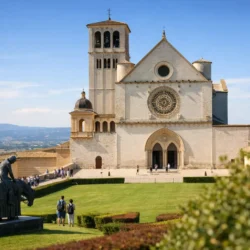
Start with the one thing you do not want to miss. If it is understanding the Basilica of Saint Francis, the Duomo of Orvieto, or the hidden history of Perugia, book a local guide. If it is the pleasure of getting lost among stone streets with no timetable, begin independently and use an audio guide where available.
You can also mix the two. Reserve a guided walk for your most important destination, then leave another town open for wandering. This approach protects time for meaningful interpretation while preserving the spontaneity that makes an Umbrian holiday feel personal.
Before you choose, consider your available hours, the size of your party, your confidence navigating, and whether you want answers tailored to your interests. A recording can tell you where you are. The right local guide can help you understand why the place stays with you long after the journey home.