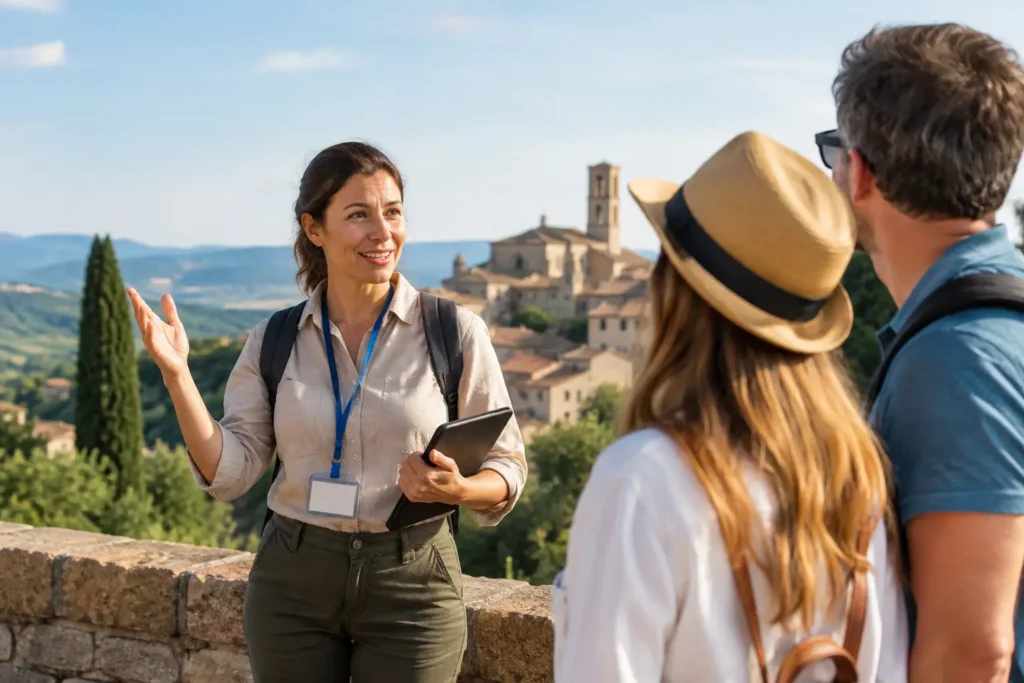
Are Local Guides Licensed in Italy and Umbria?
A fresco high above a chapel door, an Etruscan inscription set into a medieval wall, a quiet alley that once connected two powerful families: these are the details that can turn a walk through Umbria into a real encounter with the region. But they also raise a sensible question when choosing a tour: are local guides licensed, and does it make a difference to your day?
In Italy, the answer is more nuanced than a simple yes or no. “Local guide” is a broad phrase used by travelers, hotels, tour companies, and online listings. It may describe a fully qualified professional tourist guide, a passionate resident sharing personal recommendations, or a tour leader coordinating logistics. Those roles are not the same. If you are booking a cultural visit to Assisi, Perugia, Orvieto, or another historic Umbrian town, knowing the distinction helps you choose with confidence.
Are local guides licensed in Italy?
Professional tourist guiding in Italy is a regulated profession. An official tourist guide has completed the qualifications required under Italian rules and is authorized to interpret and explain cultural heritage to visitors. The precise framework has changed over time as national and regional regulations have evolved, so credentials may look different depending on when and where a guide qualified.
What matters most to a visitor is that an official guide can demonstrate recognized professional authorization. This is usually supported by an identification badge or card and formal documentation. Official guides are trained to work with the places that define an Italian itinerary: churches, archaeological sites, museums, historic centers, monuments, and works of art.
The word “local,” however, does not automatically mean “licensed.” A local resident may know a village intimately, tell wonderful stories, and recommend an excellent family-run trattoria. That knowledge can be valuable. Yet local familiarity alone is not the same as professional qualification to guide a cultural tour inside heritage sites or to provide authoritative historical interpretation.
For travelers, the practical rule is straightforward: if a tour is centered on art, history, religious heritage, or monuments, look for an official tourist guide rather than relying only on the phrase “local guide.”
Why official credentials matter in Umbria
Umbria rewards close attention. Assisi is not simply a beautiful hill town. It is a place shaped by Saint Francis, Roman remains, medieval civic life, and the extraordinary painted cycle of the Basilica of Saint Francis. Orvieto’s cathedral is not just a photogenic façade: its mosaics, chapels, and urban setting open onto centuries of faith, politics, craftsmanship, and rivalry.
A qualified guide brings structure to all of this. They know how to make a church visit meaningful without reducing it to a list of dates, and how to connect a small architectural detail to the larger story of the town. They also understand the responsibilities that come with guiding in places of worship and protected heritage sites, including site rules, respectful behavior, access arrangements, and timing.
Credentials are not a guarantee that every guide will share the same style. One may be scholarly and detail-focused; another may be especially good with children or private groups. The best guides combine professional knowledge with the ability to read the room. They know when to pause for a view across the Umbrian valley, when to explain a fresco, and when a guest would rather ask about daily life, local food, or the traditions behind a festival.
That blend of expertise and warmth is especially valuable on a short visit. If you have only one afternoon in Perugia or a morning in Spello, a guide who can choose the right route and bring the essential stories to life helps your time feel well spent.
A guide, a tour leader, and a host are different roles
Travel terminology can be confusing because several professionals may be involved in the same trip. A tour leader or tour escort may manage schedules, transport, meeting points, and group coordination. They can be indispensable, particularly on a multi-stop itinerary, but their role is different from that of the person interpreting a cathedral, museum collection, or archaeological area.
A host may welcome you to an olive mill, winery, cooking class, or family farm. In these settings, firsthand knowledge is often exactly what makes the experience memorable. The producer can explain the harvest, the pressing process, or the character of a particular wine better than anyone else.
For a well-rounded Umbrian day, these roles can work beautifully together. An official guide might reveal the history and art of Montefalco before a local producer introduces you to Sagrantino wine. In Bevagna, a cultural walking tour may be followed by a food experience led by the people who make the region’s ingredients part of everyday life. The point is not that one role is better than another. It is that each should be clear about what it offers.
How to check whether a guide is official
You do not need to interrogate someone before booking. A few clear questions will usually tell you what you need to know. Ask whether the person leading the cultural portion of the tour is an official tourist guide, whether they are authorized to guide in the sites on your itinerary, and whether they will be the same person you meet on the day.
A professional operator should answer directly. It should be easy to understand the tour format, duration, meeting point, language, what is included, and whether entrance fees are separate. If a listing promises a deep visit to major monuments but is vague about who will guide you, it is reasonable to request clarification before you book.
You can also look for the language used in the description. Terms such as “official guide,” “licensed tourist guide,” or “qualified guide” are useful signs, but they should be supported by transparent information rather than used as empty marketing. Reviews can help here too. The most revealing comments often mention specific learning moments: a guide explaining Giotto’s frescoes in Assisi, making Orvieto’s complex history understandable, or showing a hidden corner of Gubbio that guests would have walked past on their own.
Does every Umbria experience require a licensed guide?
No. It depends on the experience and on what you hope to gain from it. You can enjoy a self-guided stroll through Spoleto, shop at a market in Perugia, or visit a vineyard with its owner without needing a professional tourist guide. Independent wandering is one of Umbria’s pleasures, particularly in smaller towns where an unplanned stop for coffee can become the highlight of the afternoon.
A licensed guide becomes most valuable when the story of a place is central to the experience. Consider booking one for an in-depth visit to Assisi’s basilicas, Orvieto’s cathedral and underground spaces, Perugia’s layered historic center, or a private walking tour where you want the route shaped around your interests. Families may appreciate a guide who can make a complicated history engaging. Art lovers may want more context. First-time visitors often value the reassurance of having a knowledgeable local professional set the pace.
There is also a trade-off to consider. A guided visit is less spontaneous than wandering alone, and a private guide costs more than following a map. In return, you gain context, efficient routing, and the chance to ask questions as they arise. For many travelers, one well-chosen guided tour early in a trip makes the rest of their exploration richer.
What to expect from an official local guide
An excellent guide does more than recite facts. They help you see why a city was built where it was, how a saint influenced a community, why one town became known for ceramics and another for textiles, or how Umbrian cooking reflects the landscape around it.
They should also adapt to the real conditions of travel. Summer heat, religious services, uneven stone streets, museum crowds, and a child who has reached their limit all affect the ideal itinerary. In a private or small-group setting, a thoughtful guide can adjust the rhythm while protecting the substance of the visit.
At Umbria.tours, guided cultural experiences are led by official local guides who pair professional credentials with close knowledge of the region. That means travelers can book with a clear understanding of what their experience includes: a person qualified to interpret the landmarks, stories, and quieter details that make Umbria so distinctive.
When you are standing beneath the vaulted ceiling of a basilica or looking over olive-covered hills from a medieval piazza, the right guide will not crowd the moment with information. They will give it meaning, then leave space for you to enjoy it.