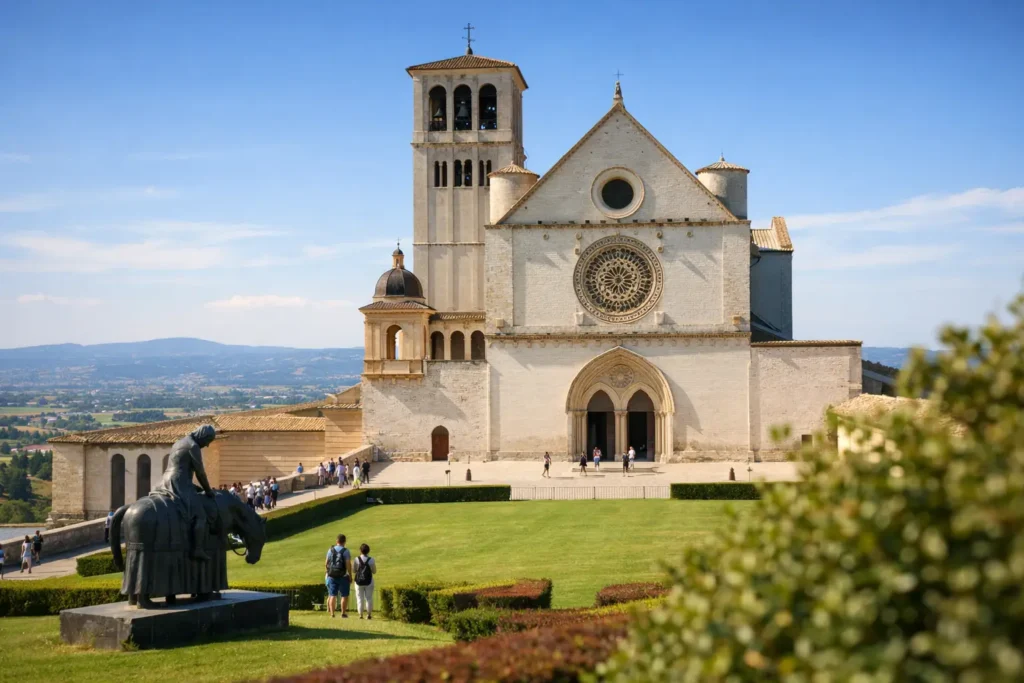
Assisi Basilica: What to See and How to Visit
The Assisi basilica is not a monument to rush through between lunch and the next hill town. Built into the western edge of Assisi beneath the open sky of Mount Subasio, the Basilica of Saint Francis holds the story of a man whose life reshaped medieval Europe. Its two churches, one bright and soaring, the other quiet and shadowed, contain some of Italy’s most moving art and one of Christianity’s most important pilgrimage sites.
For visitors, the experience can be unexpectedly powerful whether they arrive for faith, art history, or the pleasure of wandering an extraordinary Umbrian town. A little context makes all the difference. These walls tell stories through painted color, worn stone, chapels, and the steady movement of pilgrims toward Saint Francis’s tomb.
Why the Assisi Basilica Matters
Saint Francis died in 1226, and the first stone of the basilica was laid only two years later. The speed of its construction reflects his immense following and the determination of the Franciscan order to create a place worthy of his memory. Yet the basilica was never conceived as a triumphal palace. It was built on the slope below the town, a deliberate position that speaks to Francis’s humility while allowing the church to become a visible landmark for those approaching Assisi.
The complex is unusual because it is effectively two churches stacked one above the other. The Lower Basilica is low, atmospheric, and richly decorated, with vaults that draw the eye into a hushed interior. Above it, the Upper Basilica rises in a flood of light, its high Gothic nave covered with frescoes that transformed the way sacred stories could be told.
Together, they mark a turning point in Western art. Medieval painting had often favored formal, symbolic figures. Here, faces grieve, embrace, look outward, and occupy believable architectural settings. The result is not simply beautiful decoration. It is storytelling designed to make the life and ideas of Francis immediate to every visitor.
What to See Inside the Assisi Basilica
The Upper Basilica and the life of Saint Francis
Most visitors begin in the Upper Basilica, where the famous fresco cycle recounts episodes from the life of Saint Francis. The scenes are traditionally associated with Giotto, although art historians continue to discuss the extent of his direct involvement and the contribution of his workshop. That debate need not lessen the impact of what you see.
Look for the human details rather than trying to identify every scene at once. Francis removes his fine clothes before the bishop and his father. He speaks to birds. He meets the Sultan in Egypt. He receives the stigmata on Mount La Verna. Across the walls, buildings create depth, crowds react to events, and individual faces carry emotion. These were revolutionary visual choices in the late 13th and early 14th centuries.
The Upper Basilica also rewards visitors who look up. Its luminous stained-glass windows and painted vaults create a sense of height and openness that contrasts sharply with the spaces below. After the 1997 earthquake caused devastating damage to part of the vaulting, a lengthy restoration returned the church to view. The reconstruction is part of the basilica’s modern history and a reminder that this is a living place of worship, not a frozen museum.
The Lower Basilica and the tomb
Descending to the Lower Basilica changes the mood completely. The light softens, the ceilings lower, and the painted surfaces seem to gather around you. This church contains works associated with major medieval masters, including Cimabue, Pietro Lorenzetti, and Simone Martini. Even visitors without a background in art will notice a different emotional register here: richer colors, more intimate chapels, and a slower pace.
The Chapel of Saint Martin is especially memorable for its frescoes by Simone Martini. Its elegant figures, detailed clothing, and refined architectural settings offer a glimpse of courtly life within a profoundly spiritual building. Nearby, the Chapel of Mary Magdalene contains frescoes linked to Giotto’s circle and a vivid cycle centered on repentance, devotion, and redemption.
Below the Lower Basilica lies the crypt containing the tomb of Saint Francis. It is a plain, solemn space where pilgrims often pause in silence. The contrast with the painted splendor upstairs is intentional. Francis’s message was rooted in poverty, fraternity, and a close relationship with the natural world. The tomb brings the visit back to the person behind the images.
The piazza, cloister, and view across Umbria
Do not leave immediately after the churches. Step outside into the broad piazza in front of the basilica and look across the valley. The Umbrian landscape, with its patchwork fields and distant hills, helps explain why Assisi feels inseparable from its setting. Francis’s love of creation is not an abstract idea here. It is present in the olive groves, stone farmhouses, and changing light beyond the town.
The nearby cloister and surrounding convent complex also deserve time if accessible during your visit. Details such as inscriptions, doorways, and quiet corners often reveal the centuries of Franciscan life that continue around the basilica.
How to Plan Your Visit to the Assisi Basilica
The basilica is free to enter, but it is an active religious site. Modest clothing is expected, and visitors should speak quietly, particularly near the tomb and during services. Photography rules can vary by area and may change for conservation or worship needs, so follow the instructions displayed on the day.
Morning is often the most rewarding time to visit, especially if you want to experience the Upper Basilica before larger groups arrive. Late afternoon can also be beautiful, when the piazza and valley take on warmer light. If Assisi is part of a day trip, allow more time than you think you need. The basilica alone can take an hour for a quick visit, but two hours or more allows space to look carefully, pause in the Lower Basilica, and appreciate the setting.
The main trade-off is between independent wandering and guided interpretation. Visiting alone offers freedom to stay with a painting or chapel that moves you. But the frescoes can feel overwhelming without someone to connect the scenes to Francis’s life, the politics of medieval Assisi, and the artistic changes happening before your eyes. An official local guide can also help place the basilica within the wider town, from the Roman Temple of Minerva to the places associated with Saint Clare and the early Franciscan community.
For travelers arriving by car, remember that Assisi’s historic center sits on a hillside and involves steep streets. Parking is generally outside the core, so comfortable shoes are essential. Visitors with limited mobility should plan their route carefully, as the basilica complex and the town’s medieval lanes include slopes and steps. It is possible to have a rewarding visit, but it helps to choose a manageable itinerary rather than trying to cover every landmark in a few hours.
See the Basilica as Part of Assisi
The Basilica of Saint Francis makes most sense when it is not treated as an isolated stop. Walk uphill afterward through Assisi’s pale stone lanes, where laundry hangs from shutters and small squares appear around corners. Visit the Basilica of Saint Clare to see the San Damiano Crucifix, the image before which Francis heard his call to rebuild the Church. Continue toward the Rocca Maggiore for wide views, or slow down over a glass of Sagrantino and a plate of local Umbrian flavors.
Assisi is deeply spiritual, but it is not solemn in only one way. It is also a working town of residents, artisans, gardens, bells, and seasonal light. A guided walk with Umbria.tours can bring those layers together, giving the basilica its rightful place within the larger story of the town and region.
When you stand in the Upper Basilica, resist the urge to photograph every fresco and move on. Choose one scene, notice the gestures and expressions, then carry that attention into the streets outside. Assisi has a way of rewarding travelers who leave room for stillness.