Assisi or Perugia Itinerary for 1 to 3 Days
Assisi asks you to slow down. Perugia rewards you for looking up, down, and behind the next medieval archway. When planning an Assisi or Perugia itinerary, the real question is not which town is better. It is what kind of day you want: a moving encounter with Franciscan history and quiet stone lanes, or an energetic city break filled with Etruscan remains, grand piazzas, underground passages, and excellent Umbrian food.
The good news is that the two destinations are close enough to combine. Assisi and Perugia are around 30 minutes apart by car, so travelers staying in central Umbria can enjoy both without changing hotels. Your available time, transport, and interests should decide whether you give one town a full day or create a longer itinerary around both.
Assisi or Perugia: Choose the Right First Stop
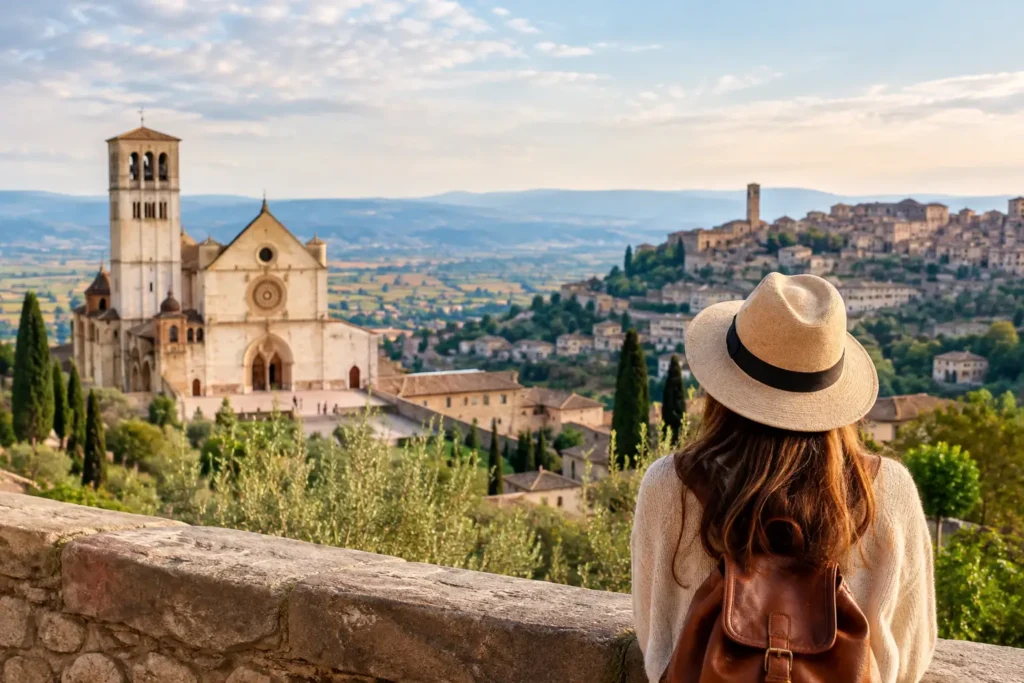
Choose Assisi first if religious heritage, early Italian art, and a more intimate historic atmosphere are central to your trip. The town climbs the slopes of Mount Subasio in pale pink-and-white stone, with wide valley views opening below. Its landmarks are world-famous, but Assisi still feels deeply personal when explored at an unhurried pace.
The Basilica of St. Francis is the essential visit. Giotto’s fresco cycle in the Upper Basilica is among the great achievements of Western art, while the Lower Basilica has a more contemplative character, rich with chapels, painted vaults, and the tomb of St. Francis. This is not a place to rush through between coffee and lunch. Allow time to absorb the art, the architecture, and the story of the young man from Assisi whose ideas transformed Christian Europe.
Perugia is the better first stop for travelers who want a lively urban day with layers of history. Umbria’s regional capital is larger, more varied, and particularly rewarding for art lovers, food-minded visitors, and families with teenagers who may prefer a city’s energy to a quieter pilgrimage destination. Its historic center sits high above the surrounding hills, reached by escalators and medieval streets that feel like a journey through different centuries.
At its heart is Piazza IV Novembre, home to the richly carved Fontana Maggiore and the striking cathedral of San Lorenzo. Nearby, the Palazzo dei Priori holds the National Gallery of Umbria, where works by Perugino, Pinturicchio, and other masters give context to the artistic world that shaped central Italy. Below the streets, Rocca Paolina reveals another Perugia entirely: an underground route through the remains of a Renaissance fortress and an older neighborhood absorbed into its foundations.
A One-Day Assisi or Perugia Itinerary
With only one day, avoid trying to see both towns in full. You can visit their headline sights, but you will miss the pleasure of wandering, pausing for lunch, and noticing the local details that make Umbria memorable.
One day in Assisi
Start in the Basilica of St. Francis in the morning, when your concentration is fresh and the town is generally quieter. An official local guide can make a remarkable difference here, connecting the frescoes to the lives of St. Francis and St. Clare, the politics of medieval Italy, and the artists who worked in the basilica.
From the basilica, walk toward Piazza del Comune. The route passes shops, small squares, and views that shift as the town rises. In the piazza, look for the Roman Temple of Minerva, whose remarkably preserved columns stand beside the medieval buildings. Lunch is best enjoyed slowly, perhaps with a glass of Sagrantino or a simple Umbrian dish featuring local olive oil, lentils, truffles, or seasonal vegetables.
Spend the afternoon at the Basilica of St. Clare, where the Crucifix of San Damiano is kept, then continue to the Cathedral of San Rufino. If you have energy for one last climb, the Rocca Maggiore offers broad views across the Umbrian plain. It is an especially fine place near late afternoon, when the stone walls take on a warmer color.
One day in Perugia
Begin in Piazza IV Novembre and give yourself time to understand the square before moving on. The Fontana Maggiore is not simply a beautiful landmark. Its reliefs tell stories of the months, the zodiac, biblical scenes, and the daily life of the medieval world.
Continue through Corso Vannucci, Perugia’s elegant central promenade, then visit the National Gallery of Umbria if art is a priority. Even visitors who do not usually plan museum-heavy vacations often find this collection approachable with the right context. The paintings help explain why Perugia was a powerful artistic center long before it became known internationally for chocolate.
For lunch, choose a traditional trattoria in the historic center and try local pasta, cured meats, or a dish with black truffle. In the afternoon, descend through Rocca Paolina, explore the Etruscan Arch, and wander the quieter lanes around Porta Sole. Perugia has a talent for revealing dramatic viewpoints without warning, so leave room in the schedule for detours.
A Two-Day Assisi and Perugia Itinerary
Two days is the ideal minimum if you want to experience both destinations well. Dedicate one full day to each town rather than treating Assisi as a quick excursion from Perugia, or Perugia as an add-on after the basilica.
On day one, begin with Assisi. Its spiritual and artistic sites deserve your best attention, and the town’s smaller scale makes it easy to cover on foot. Book a guided walk in the morning, then leave the later afternoon open for independent exploration, a relaxed aperitivo, or a visit to Santa Maria degli Angeli on the plain below Assisi. Inside stands the Porziuncola, the small chapel closely connected to St. Francis and the early Franciscan community.
On day two, make Perugia your focus. A guided historic-center walk is particularly useful because the city’s Etruscan, medieval, papal, and modern layers are not always obvious at first glance. After the major monuments, allow time for the city’s food culture. Perugia is a good place to pair sightseeing with a wine bar, a chocolate tasting, or a meal that highlights Umbrian ingredients.
This order works well for many visitors because Assisi sets a reflective tone, while Perugia brings a livelier finish. Reverse it if you arrive in Perugia by train or are staying in the city. Practicality matters more than an idealized route.
Add a Third Day for the Umbrian Landscape
A three-day Assisi and Perugia itinerary gives you the freedom to experience the countryside that connects the two. This is where Umbria becomes more than its headline monuments: olive groves, vineyards, hill towns, and family-run producers fill the spaces between the cities.
You could spend the third day in Spello, a flower-filled hill town known for Roman traces, beautiful lanes, and frescoes by Pinturicchio in the Baglioni Chapel. Or choose Montefalco, often called the balcony of Umbria, for vineyard views and the chance to taste Sagrantino wines. Bevagna is another excellent option for visitors drawn to Roman remains and a gentler, less visited village atmosphere.
For a food-focused day, an olive mill visit or tasting adds a meaningful local dimension, especially during the harvest season in autumn. Umbrian extra virgin olive oil is a point of regional pride, and understanding the landscape, varieties, and production methods makes every meal that follows more interesting. Umbria.tours can help pair guided heritage visits with these local experiences, especially for private groups who prefer a flexible pace.
Getting Between Assisi and Perugia
A rental car offers the most flexibility, particularly if you plan to add Spello, Montefalco, or rural food and wine experiences. Parking is generally outside the historic centers, so be prepared to walk or use local escalators and buses. Do not attempt to drive into restricted traffic zones without checking the rules.
Public transportation is possible, though it requires more planning. The train station for Assisi is in Santa Maria degli Angeli, below the hill town, while Perugia’s main station is also below its historic center. Local connections can bridge the final stretch, but they may add time. If you have one or two days only, a private transfer or organized excursion can preserve valuable sightseeing hours.
Wear comfortable shoes whichever option you choose. Both towns involve hills, uneven paving, stairways, and streets where the most rewarding corners are often reached on foot.
When Assisi and Perugia Are Most Enjoyable
Spring and fall are excellent for an Assisi or Perugia itinerary. Temperatures are usually more comfortable for walking, the countryside is especially appealing, and outdoor meals feel like part of the trip rather than a break from the heat. Autumn also brings harvest flavors, new olive oil, mushrooms, truffles, and wine events.
Summer has long evenings and a festive atmosphere, but midday heat and crowds can make Assisi’s main sites feel busy. Start early, reserve the hottest hours for a museum or a long lunch, and return to the streets later in the day. Winter is quieter and can be wonderfully atmospheric, although opening hours and countryside activities may be more limited.
Give Assisi the time to speak softly, and let Perugia surprise you around the next corner. That balance of great art, living faith, generous food, and everyday Umbrian character is what turns a short itinerary into a stay you will remember long after you leave the green heart of Italy.