A Meaningful Assisi Pilgrimage Itinerary
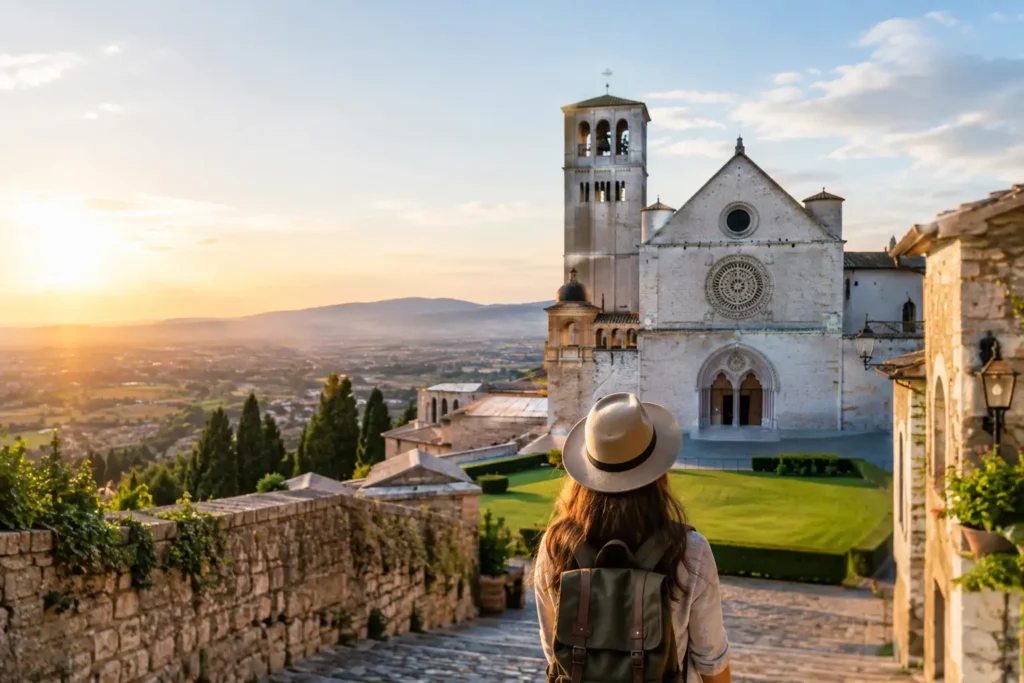
The first sight of Assisi is already part of the pilgrimage. The pale stone town rises above the Umbrian plain, its rooftops climbing toward the Basilica of Saint Francis and the open slopes of Mount Subasio. A well-paced Assisi pilgrimage itinerary should leave room for that first moment of arrival, as well as for the churches, frescoes, paths, and quiet pauses that give this small city its lasting spiritual force.
Assisi can be visited in a few hours, but a pilgrimage deserves more time. Three days allow you to encounter the life of Saint Francis and Saint Clare in their own landscape: the public spaces where Francis was born and began his conversion, the humble sanctuaries outside the walls, and the woodland where prayer and solitude still feel natural. This is not about checking off every church. It is about following a meaningful thread through the places that shaped two of Christianity’s most enduring figures.
A three-day Assisi pilgrimage itinerary
Day one: Saint Francis, the basilica, and the heart of Assisi
Begin at the Basilica of Saint Francis, ideally early in the morning before the busiest visitor hours. The complex is both a major work of Italian art and a living place of worship. In the Lower Basilica, descend to the crypt and the tomb of Saint Francis. The atmosphere is subdued, inviting visitors to slow down rather than move immediately to the next sight.
The Upper Basilica tells a different part of the story. Its luminous interior and fresco cycle traditionally associated with Giotto narrate the life of Francis in scenes that make his ideals unusually tangible: the rejection of wealth, service to people on the margins, reconciliation, and a profound respect for creation. A guide can help distinguish devotional tradition from historical context while drawing attention to details that are easy to miss in a crowded church.
From the basilica, walk through the medieval streets toward Piazza del Comune. This was the civic center of Francis’s youth, when Assisi was a lively, contested town rather than the serene pilgrimage destination it can appear today. See the Temple of Minerva, later transformed into the Church of Santa Maria sopra Minerva, and pause in the square for coffee or a simple lunch.
In the afternoon, visit the Cathedral of San Rufino. Saint Clare was baptized here, and the church connects the Franciscan story to the older Christian identity of Assisi. Nearby, the Basilica of Saint Clare holds the Crucifix of San Damiano, the image before which Francis is said to have heard Christ ask him to rebuild the Church. End your first day in this quieter quarter, when the lanes begin to empty and the town’s stone facades catch the late-afternoon light.
Day two: Saint Clare and the early Franciscan community
The second day moves beyond the grand basilicas to places of greater simplicity. Start at San Damiano, just below Assisi’s walls. The walk there is gentle but downhill, and the setting rewards an unhurried approach. Olive groves and views across the valley make clear why Francis and his companions sought spaces outside the town.
San Damiano was central to both Francis and Clare. Francis prayed here during the early years of his conversion, while Clare later founded her community in the adjoining convent. The small chapel, choir, refectory, and courtyard retain an intimate scale. This is a place to listen, read, pray, or simply sit quietly. Because the rooms are modest, it is worth allowing time rather than expecting a spectacular visual experience.
Continue toward the Sanctuary of Rivotorto, associated with the earliest Franciscan brothers and their life of poverty. The modern church protects the remains of a simple shelter, traditionally linked to the first community. Whether you approach it as a believer, a student of history, or a traveler interested in Franciscan ideals, Rivotorto offers useful perspective. The movement that spread across Europe began with a few men living without comfort or status on the edge of a small Umbrian town.
Return to Assisi for the evening. This is a good time for a meal built around Umbrian ingredients: local olive oil, seasonal vegetables, cured meats, handmade pasta, and Sagrantino or Grechetto wine if you drink. Pilgrimage and pleasure need not be opposites. In Umbria, the table is often another expression of gratitude for the land.
Day three: The Carceri and Santa Maria degli Angeli
For your final day, begin high above Assisi at the Eremo delle Carceri, the hermitage in the woods of Mount Subasio. Francis and his followers came here for prayer and retreat. The name refers not to a prison but to secluded cells, and the wooded setting still conveys a sense of withdrawal from ordinary life.
Reaching the hermitage requires transportation or a sustained uphill walk, so plan according to your fitness and the weather. The paths and steps are part of the experience, but they may not suit everyone. Once there, the sound of birds, the shade of the oaks, and the narrow passages around the chapel create a strong contrast with Assisi’s busy streets. Keep your visit quiet and respectful, especially during religious services.
In the afternoon, travel down to Santa Maria degli Angeli at the foot of the hill. Inside its vast basilica is the Porziuncola, the tiny chapel that became the spiritual home of the early Franciscans. Here Francis understood his vocation more fully, welcomed companions, and died nearby in 1226. The contrast between the enormous basilica and the humble chapel at its center is striking. It expresses a central Franciscan tension: a global religious legacy rooted in a deliberately poor and small place.
If time permits, visit the Chapel of the Transit, where Francis spent his last hours. Then step outside into the broad piazza. Looking back toward Assisi on the hillside, you can see how the journey has connected town, plain, woodland, and sanctuary into one landscape.
How to shape your Assisi pilgrimage well
A meaningful itinerary depends on your purpose. Travelers seeking art history may devote longer to the Basilica of Saint Francis and its frescoes. Those coming for prayer may prefer fewer churches, more time at San Damiano and the Carceri, and attendance at Mass. Families often find that alternating major monuments with short walks, gelato stops, and open views keeps the experience rewarding for every generation.
A few practical choices make a real difference:
- Stay in Assisi for at least two nights, so you can experience the town early in the morning and after day visitors leave.
- Wear supportive walking shoes. Assisi is steep, with uneven medieval paving and many steps.
- Check opening times and liturgical schedules shortly before visiting, particularly on Sundays, feast days, and during Easter or the Feast of Saint Francis on October 4.
- Arrange transport for the Carceri and Santa Maria degli Angeli if you do not want to cover long uphill and downhill stretches on foot.
An official local guide is especially valuable in Assisi because the places are layered with art, faith, civic history, and tradition. A guided walk can give structure to the first day, leaving later visits free for personal reflection. Umbria.tours can help travelers pair Assisi’s major landmarks with the less obvious stories that make the city feel lived in rather than simply visited.
There is no single correct way to make this pilgrimage. Some visitors will carry a prayer book, others a sketchbook or camera, and many will arrive with only curiosity. Give Assisi enough time to become quiet around you, and the route from Francis’s birthplace to the Porziuncola may feel less like an itinerary and more like a conversation with the place itself.