12 Best Umbrian Churches to Visit in Italy
A church in Umbria is rarely just a church. It may hold a painted crucifix that changed the course of a saint’s life, frescoes by the great masters of the Renaissance, or a Roman column reused by medieval builders. The best Umbrian churches reveal the region’s faith, artistic ambition, and long memory, often within a short walk of a lively piazza, a family-run trattoria, or a quiet lane of stone houses.
For visitors planning a cultural itinerary, the challenge is not finding beautiful sacred places. It is choosing where to spend unhurried time. These are the churches worth building into a journey through Umbria, from celebrated basilicas to smaller landmarks that reward curiosity.
What makes Umbrian churches so special?
Umbria’s religious heritage is unusually varied. Assisi offers the spiritual world of St. Francis and St. Clare, expressed through vast pilgrimage basilicas and humble chapels. Orvieto presents one of Italy’s most dramatic Gothic cathedrals. In Spoleto and the Clitunno Valley, early medieval buildings preserve traces of the Longobards, while Perugia and Spello reveal quieter layers of Romanesque and Renaissance art.
The most famous sites can be busy, especially from Easter through October. Yet many of the most moving visits happen early in the morning, late in the afternoon, or in a smaller church where you may have the space almost to yourself. Opening hours can change for services, religious holidays, and restoration work, so flexibility is useful.
12 best Umbrian churches for art, history, and atmosphere
Basilica of St. Francis, Assisi
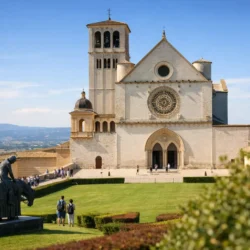
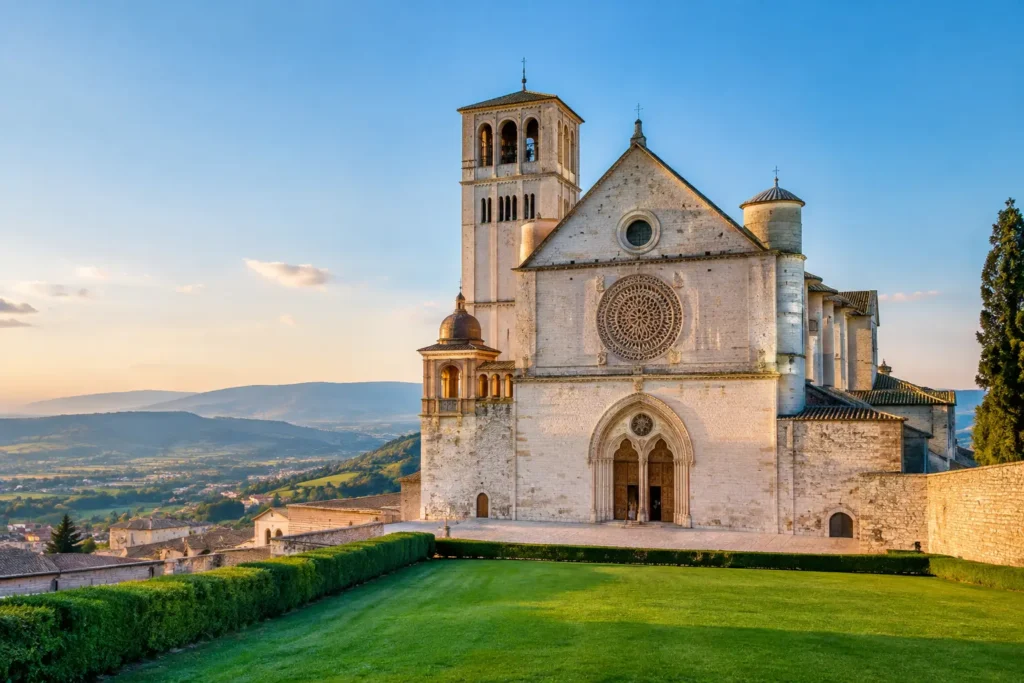
The Basilica of St. Francis is the essential starting point for understanding Assisi and one of Italy’s great religious monuments. Built above the saint’s tomb, it consists of two very different churches: the shadowy Lower Basilica and the luminous Upper Basilica. Their walls carry extraordinary fresco cycles associated with artists including Cimabue, Giotto, Simone Martini, and Pietro Lorenzetti.
Do not rush through it as a checklist stop. The art tells the story of Francis, but it also marks a turning point in Western painting, with human emotion, space, and narrative becoming newly vivid. Dress respectfully and allow at least an hour, longer if art is a priority.
Basilica of St. Clare, Assisi
A short walk from the main square, the Basilica of St. Clare has a striped pink-and-white stone facade and a more intimate feeling than St. Francis. Inside is the Crucifix of San Damiano, the painted cross before which Francis heard the call to “rebuild my church.”
The crypt contains the remains of St. Clare, Francis’s close companion and founder of the Poor Clares. Visit toward the end of the day if possible, when the stone streets around the basilica begin to quiet down and the views across the Umbrian plain become especially beautiful.
San Damiano, Assisi
Below Assisi’s walls, San Damiano feels deliberately modest after the grandeur of the basilicas. This was the little church Francis restored with his own hands, and later the convent where Clare and her sisters lived. The original crucifix is now in St. Clare’s Basilica, but the setting still carries enormous spiritual force.
The cloister, small chapel, and garden make this an excellent pause on a walk between Assisi and the countryside. It is particularly rewarding for travelers interested in Franciscan history beyond the major landmarks.
Cathedral of Orvieto
Orvieto’s cathedral rises at the end of the town’s main street like a jeweled screen of mosaics, marble, gold, and sculpture. Its facade alone deserves time, but the real surprise is inside the Chapel of San Brizio. Luca Signorelli’s powerful frescoes of the Last Judgment are bold, dramatic, and startlingly modern in their treatment of the human body.
This is one of the best Umbrian churches for travelers who love art as much as architecture. The cathedral is at its best when you arrive early, before day visitors fill the square, then continue into Orvieto’s lanes for lunch and a glass of local white wine.
Church of San Giovenale, Orvieto
San Giovenale offers the opposite experience to Orvieto Cathedral. It is quieter, older in atmosphere, and reached through the town’s less crowded medieval streets. The church is traditionally linked to the site of an earlier place of worship, and its interior has a restrained Romanesque character.
Its appeal is not spectacle but continuity. This is a good choice for visitors who enjoy noticing worn stone, fragments of fresco, and the way sacred buildings accumulate centuries of change.
Cathedral of San Rufino, Assisi
The Cathedral of San Rufino is often missed by visitors moving between St. Francis and St. Clare, which is precisely why it deserves attention. Its Romanesque facade is richly carved with biblical scenes, animals, and symbolic figures. Inside, the baptismal font recalls the baptism of both Francis and Clare.
The cathedral also has a museum and archaeological area that help place Assisi’s Christian story within its Roman past. It is a valuable stop for anyone who wants to understand the city as more than a pilgrimage destination.
Tempietto del Clitunno, near Spoleto
Small enough to overlook and important enough to make a special trip, the Tempietto del Clitunno stands near the springs of the Clitunno River. This early medieval chapel draws on classical Roman forms, with columns and a temple-like facade that make it unlike almost any other church in Umbria.
It is part of the UNESCO-listed Longobards in Italy sites. Pair it with a drive through the olive-covered hills around Campello sul Clitunno, especially in spring or during the autumn olive harvest.
Spoleto Cathedral
Spoleto Cathedral, formally the Cathedral of Santa Maria Assunta, occupies a grand piazza below the Rocca Albornoz fortress. Its facade is elegant rather than overwhelming, while the interior leads to a remarkable apse fresco cycle by Filippo Lippi, completed shortly before his death.
The broad steps outside are part of the experience. Come in the early evening, when locals gather in the square and the cathedral facade catches the changing light. During the Festival dei Due Mondi, the area becomes one of Spoleto’s most animated cultural stages.
Basilica of San Salvatore, Spoleto
The Basilica of San Salvatore is another UNESCO Longobard landmark, though its origins reach back to late antiquity. Its exterior incorporates classical decorative forms, while the interior has a solemn, almost archaeological beauty. There is little theatrical decoration to distract from the building’s structure and age.
It sits outside Spoleto’s historic center, so it works best with a car, a taxi, or a guided itinerary. For travelers drawn to early Christian and medieval architecture, it is one of Umbria’s most distinctive churches.
Church of San Pietro, Spoleto
Just below the old town, San Pietro is known for its magnificent Romanesque facade. Look closely at the relief panels: they depict biblical stories with a lively, almost narrative energy. The building has changed over centuries, but the facade remains a memorable example of Umbrian medieval sculpture.
This church is easy to combine with a walk through Spoleto’s lower streets before heading uphill toward the cathedral and fortress. It rewards a guide’s explanation, since many of its carved details are easy to miss at first glance.
Santa Maria Maggiore, Spello
Spello is famous for flower-lined streets and Roman remains, but Santa Maria Maggiore contains one of its greatest treasures. The Baglioni Chapel was frescoed by Pinturicchio, whose richly colored scenes include an elegant Annunciation and a lively Adoration of the Shepherds.
The church is compact, so the experience feels personal rather than monumental. Give yourself time afterward to wander Spello without a fixed route. The town’s lanes, views, and small food shops are a perfect complement to the chapel’s refined Renaissance art.
Basilica of Sant’Ubaldo, Gubbio
High above Gubbio, the Basilica of Sant’Ubaldo is dedicated to the town’s beloved patron saint. The saint’s body is preserved in a glass shrine, and the church is closely tied to the Festa dei Ceri, Gubbio’s extraordinary May celebration in which enormous wooden structures race up the hill.
Even outside festival time, the journey up is worthwhile for the panoramic view over the town and valley. This is a church where local identity is as important as artistic fame, making it especially memorable for visitors who want to understand Umbrian traditions.
Planning a meaningful church itinerary in Umbria
A first visit to Umbria can easily include Assisi, Orvieto, Spoleto, and Spello, but trying to see every major church in a few days can turn a rich experience into a hurried one. Choose according to your interests. Assisi is essential for Franciscan spirituality and medieval frescoes; Orvieto for Gothic architecture and Renaissance painting; Spoleto for early medieval history; and Spello for an intimate art stop.
Modest clothing is expected in active places of worship, and silence matters, particularly during Mass or prayer. Photography rules vary, with flash frequently prohibited. A local official guide can add real value in churches filled with layered symbolism, where a small detail in a fresco or facade can transform what you are seeing. Umbria.tours offers guided experiences that place these landmarks within the stories, streets, landscapes, and food traditions around them.
Leave room in the day for the moments between churches: a coffee beneath Assisi’s walls, olive groves near the Clitunno springs, or sunset over the rooftops of Orvieto. In Umbria, sacred art is never far from everyday life, and that is what makes these visits stay with you.