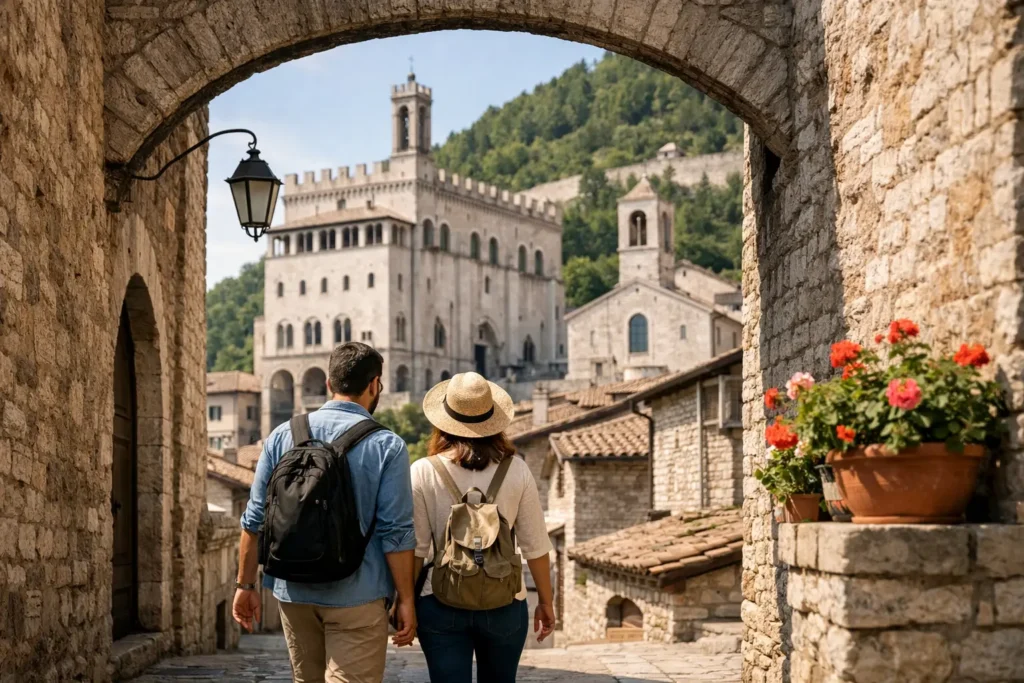
Gubbio Walking Tour Through Medieval Streets
Gubbio does not reveal itself all at once. Its gray limestone houses rise steeply from the valley, medieval lanes bend toward unexpected arches, and a grand civic square seems to hover above the town. A Gubbio walking tour gives this extraordinary setting its context, connecting the Roman remains below with the powerful medieval town above and the traditions that still shape local life.
For visitors staying in Umbria, Gubbio is one of the region’s most memorable day-trip destinations. It feels more dramatic than many hill towns, yet it remains warmly lived-in: shutters open onto narrow streets, workshops sit beneath stone vaults, and the scent of local cooking drifts from small trattorias. With an official local guide, the town becomes much more than a beautiful place to photograph. It becomes a story of ancient Iguvium, medieval independence, noble patronage, faith, craftsmanship, and one very beloved patron saint.
Why Gubbio Is Best Seen on Foot
Gubbio was built for walking, although it asks visitors to slow down and accept its hills. The historic center is compact, but its streets climb sharply from the Roman Theater toward Piazza Grande and the upper town. Walking is the only way to notice the details that give Gubbio its character: carved doorways, small religious images, old water channels, family crests, and passages that would be missed from a car or coach.
The town’s stone is part of the experience. Unlike the pale brick of other Umbrian destinations, Gubbio is known for its solid, silvery local limestone. Depending on the light, the streets can look cool and austere in the morning, then warm and soft by late afternoon. A guide can point out how the town’s architecture was shaped by its geography, as well as the practical reasons its grand public buildings were placed where they are.
Gubbio is also a place where the layers of history sit close together. Roman engineering, medieval civic ambition, Renaissance art, and religious devotion are not separated into distant districts. They appear along the same walk.
The Essential Stops on a Gubbio Walking Tour
Begin with Roman Gubbio
The Roman Theater, just outside the medieval walls, is a fitting place to begin. Built in the 1st century BC, it once held thousands of spectators and remains one of the most impressive Roman monuments in Umbria. Its scale immediately changes the way visitors see the town. Before Gubbio became a medieval stronghold, it was already an important settlement with a civic life of its own.
From here, the route rises toward the historic center. This transition from open Roman remains to enclosed medieval streets is one of the pleasures of the visit. It also explains why a guided walk is valuable: the town’s chronology is not always obvious from a map. A guide can bring together the major eras without turning the experience into a lecture.
Piazza Grande and the Palazzo dei Consoli
Piazza Grande is Gubbio’s great theatrical moment. Set high above the lower streets, the broad square opens onto far-reaching views over roofs, hills, and the valley. Its dramatic position was no accident. This was the civic heart of medieval Gubbio, designed to show the confidence and authority of the commune.
The Palazzo dei Consoli dominates the square with its formidable Gothic façade. Built in the 14th century, it is one of the finest examples of medieval civic architecture in Italy. Its strong lines and elevated setting are striking, but the stories behind it are just as compelling: rival families, public ceremonies, the organization of city life, and the determination of Gubbio’s citizens to make their town visible from afar.
This is often the point where visitors understand why Gubbio feels different from a conventional Tuscan hill town. It is not polished into sameness. Its beauty is more muscular, more vertical, and deeply tied to its history.
Medieval Lanes, Churches, and Everyday Details
Beyond Piazza Grande, a good route continues into the quieter streets where Gubbio’s everyday texture emerges. Via dei Consoli and the surrounding lanes are full of medieval facades, small squares, and churches that reward a closer look. The Cathedral of Gubbio, with its restrained exterior and atmospheric interior, adds another chapter to the town’s religious and artistic history.
These are the moments when local knowledge matters most. A guide may draw attention to a detail that appears ordinary at first glance: a coat of arms above a doorway, a medieval fountain, or the layout of a neighborhood shaped by guilds and noble households. The aim is not to rush from landmark to landmark, but to understand how the town worked and how it continues to live.
Gubbio is also associated with traditional ceramics, particularly distinctive glazed pieces in vivid colors. If time permits, ask about local artisan traditions and where they can still be seen. This is a worthwhile addition for travelers interested in bringing home something connected to the place rather than a generic souvenir.
Saint Ubaldo and Gubbio’s Living Traditions
No visit to Gubbio is complete without hearing about Saint Ubaldo, the town’s patron saint. His presence is felt throughout Gubbio, especially during the Festa dei Ceri, held each May. In this remarkable celebration, three enormous wooden structures topped with statues are carried at speed through the streets and up toward Mount Ingino. It is part religious devotion, part civic identity, and entirely Gubbio.
Even visitors outside festival season can appreciate how much this tradition means to the town. The Basilica of Saint Ubaldo, high on Mount Ingino, is closely connected to the celebration and offers a destination for those who want to extend their day. Reaching it involves an uphill journey, so it works best as an optional addition rather than an automatic part of every walking route.
The famous open-air cable car, or funivia, is another way to reach the mountain. Its small standing cages are an experience in themselves, with wide views over Gubbio and the Umbrian landscape. It is a wonderful choice for confident travelers who do not mind heights. For anyone uneasy with exposed rides, a road transfer or a gentler itinerary may be preferable.
How Long Should You Allow?
For the main historic center, allow around two hours for a focused private guided walk. This gives enough time for the Roman Theater, Piazza Grande, key streets, and the principal stories without making the day feel overplanned. A longer experience can include additional churches, artisan stops, a museum visit, or time on Mount Ingino.
It depends on your interests and your pace. Art lovers may want extra time inside churches and civic buildings. Families may prefer a shorter route with frequent pauses and a gelato stop. Travelers arriving from Perugia, Assisi, or the Lake Trasimeno area should also factor in transfer time, especially if they want a relaxed lunch in town.
Gubbio’s slopes deserve honest consideration. The route can be adapted, but some inclines and uneven paving are unavoidable in the oldest areas. Wear comfortable shoes with a good grip, carry water in warmer months, and let your guide know in advance if mobility is a concern. A private tour is especially useful here because the pace and route can be adjusted around the group.
When to Visit Gubbio
Spring and early fall offer the most comfortable conditions for walking, with clear light and pleasant temperatures for climbing through the upper streets. May is especially exciting because of the Festa dei Ceri, though accommodations and transport require more advance planning. The atmosphere is unforgettable, but it is not the quietest time for a first visit.
Summer mornings are usually best, followed by a leisurely lunch and a slower afternoon in the shade. In winter, Gubbio has a quieter appeal, with fewer visitors and a more intimate feeling in the stone streets. The town is also known for its seasonal Christmas displays and its giant illuminated tree on Mount Ingino, which can make a winter stay particularly special.
Make Gubbio Part of a Richer Umbrian Day
Gubbio works beautifully as a standalone destination, but it also complements the rest of an Umbrian itinerary. After Assisi’s Franciscan heritage or Perugia’s urban energy, Gubbio offers a more rugged medieval perspective. Its food reflects the territory too, with truffles, cured meats, handmade pasta, and hearty dishes well suited to the mountain setting.
For travelers who want the town to feel personal rather than simply impressive, a guided experience with Umbria.tours can bring its monuments, viewpoints, and lesser-known corners into focus. The right guide does more than lead the way uphill. They help you recognize the pride, faith, and quiet persistence that have kept Gubbio distinct for centuries.
Leave a little unplanned time after your walk. Sit in Piazza Grande, watch the changing light on the stone, and let Gubbio’s remarkable setting do what it has done for generations: make you look up.