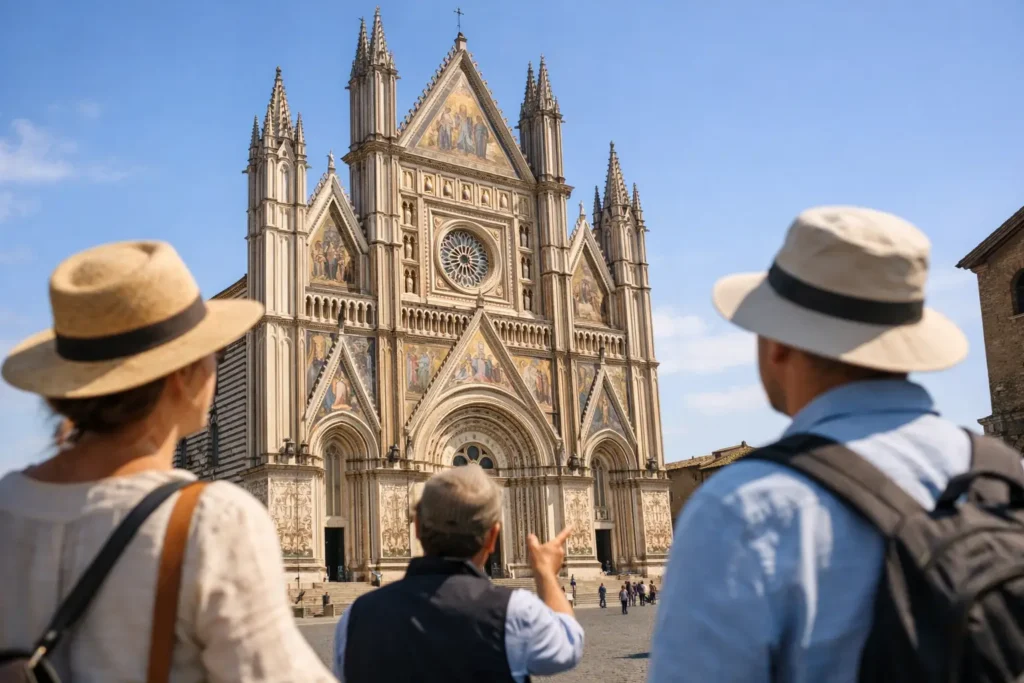
A Guided Orvieto Cathedral Tour Worth Taking
Orvieto rises above the Umbrian countryside on a dramatic cliff of volcanic tuff, but its true showstopper waits at the heart of the old town. A guided Orvieto Cathedral tour turns a visit to the Duomo from a beautiful photo stop into a close encounter with medieval ambition, religious devotion, political power, and some of Italy’s most unforgettable art.
The cathedral is richly detailed, and that is precisely why it rewards time and context. Its glittering façade can be admired in a few minutes, yet the stories behind its mosaics, sculptures, chapels, and relics reveal a building shaped over centuries. With an official local guide, you can slow down, notice the details that are easy to miss, and understand why Orvieto Cathedral remains one of central Italy’s great monuments.
Why Orvieto Cathedral deserves more than a quick visit
Construction began in 1290, following what tradition describes as the miracle of Bolsena. During a Mass in the nearby town, a consecrated host was said to have bled onto the corporal cloth held by the priest. Pope Urban IV had already established the feast of Corpus Christi, and Orvieto became closely connected to the event when the sacred linen was brought to the city.
The Duomo was conceived as a magnificent home for this relic. What visitors see today is the result of generations of architects, sculptors, mosaic artists, and painters working across more than 300 years. That long history explains the cathedral’s distinctive character: it is unified in its grandeur, but full of changing artistic ideas.
From Piazza del Duomo, the façade immediately draws the eye. Bands of pale travertine and dark basalt create a strong visual rhythm, while golden mosaics catch the light above elaborate marble reliefs. It can feel almost theatrical, especially on a sunny morning when the square is still quiet. A guide helps distinguish decorative beauty from visual storytelling, showing how the façade communicates Biblical events, salvation, judgment, and the human drama of faith.
What you will see on a guided Orvieto Cathedral tour
A well-paced visit begins outside, because the exterior is not simply an introduction. It is one of the cathedral’s great works of art. The lower façade contains sculpted panels associated with the Sienese artist Lorenzo Maitani, whose work gives physical form to stories from Genesis, the life of Christ, and the Last Judgment.
These reliefs are exceptionally expressive. Look closely and you will find scenes of creation, temptation, violence, hope, and divine justice. Without explanation, it is easy to see a dense sequence of carved figures and move on. With a guide, the scenes become readable, and their position on the cathedral begins to make sense.
Inside, the scale changes. The richly striped nave is more restrained than the façade, creating a quieter setting for worship and reflection. Your guide can point out the relationship between the architecture, the side chapels, the altar area, and the ceremonial role of the cathedral in Orvieto’s civic and religious life.
The Chapel of San Brizio
For many art lovers, the Chapel of San Brizio is the defining moment of the visit. Its fresco cycle was begun by Fra Angelico and Benozzo Gozzoli in the 1440s, then completed decades later by Luca Signorelli. Signorelli’s dramatic vision of the end of the world, the resurrection of the dead, heaven, hell, and the Antichrist is startlingly vivid.
The painted bodies are energetic and intensely human. Some figures rise from the earth; others are swept into confusion, fear, or joy. The scenes were admired by later artists, and Michelangelo is often connected to Signorelli’s powerful treatment of the nude figure and final judgment themes.
A guide gives this chapel the time it needs. Rather than trying to absorb every painted scene at once, you can focus on the key episodes, the artistic hand of Signorelli, and the historical anxieties that shaped this extraordinary late Renaissance work. It is not a cheerful chapel, nor is it meant to be. Its purpose is to provoke thought about mortality, choice, and redemption.
The Chapel of the Corporal
The Chapel of the Corporal holds another essential part of Orvieto’s identity. Here, the sacred cloth connected with the miracle of Bolsena is preserved in an elaborate reliquary. The chapel’s frescoes and decorative program deepen the story, linking a local event to the wider Catholic world and to the importance of Corpus Christi.
This is where a local explanation is particularly valuable. The miracle is not only a religious tradition: it influenced the cathedral’s construction, Orvieto’s ceremonies, and the city’s place on the map of medieval pilgrimage. Visitors of every background can appreciate how belief, art, and public life were woven together in medieval Italy.
The details that make the visit memorable
The Duomo is full of moments that reward looking twice. The rose window, created by Andrea Orcagna, is a masterpiece of Gothic stonework. The façade mosaics have been repaired and renewed over time, a reminder that preserving a cathedral is an ongoing responsibility rather than a finished task. Even the alternating stone bands inside speak to a wider architectural language shared with other medieval towns in central Italy.
An official guide can also bring Orvieto itself into the story. The cathedral was built in a city with a strategic position, a strong civic identity, and longstanding ties to the papacy. Its grandeur was a statement of faith, certainly, but also of confidence and prestige. This context changes how you see the building. It is no longer isolated from the town around it.
For families, a guided visit can be adapted around visual details that hold children’s attention: carved monsters, colorful mosaics, dramatic frescoes, and the contrast between the bright piazza and the cathedral’s shadowed interior. For couples and independent travelers, it offers a deeper pause within a day of wandering Orvieto’s lanes, artisan shops, and panoramic viewpoints.
How much time should you allow?
For the cathedral alone, allow at least an hour with a guide. Around 90 minutes is ideal if you want to explore the exterior in detail and spend meaningful time in both major chapels. If art history is a central interest, you may prefer a longer private experience that connects the Duomo with Orvieto’s medieval streets, underground spaces, or the city’s Etruscan past.
The best choice depends on your itinerary. If Orvieto is a day trip from Rome or Florence, a focused cathedral tour can make limited time feel well spent. If you are staying in Umbria, it is worth allowing a slower half-day or full day. Begin in the piazza, visit the Duomo with your guide, then continue through the historic center for lunch and a glass of local Orvieto Classico wine.
Morning visits often offer a calmer atmosphere, particularly outside peak holiday periods. Later in the day, the façade can be especially beautiful as the changing light warms its gold and colored surfaces. Cathedral opening hours and access can vary for religious services, special celebrations, and conservation needs, so confirming the practical arrangements before your visit is always wise.
Choosing the right guide in Orvieto
Orvieto Cathedral is accessible enough to admire independently, but it is not a monument that explains itself quickly. A knowledgeable guide helps you make connections between the miracle of Bolsena, the façade’s visual program, Signorelli’s frescoes, and the town’s wider history. The experience becomes more personal, too, because you can ask questions and follow the aspects that interest you most.
A private tour is a strong option for travelers who want flexibility, whether that means moving at a relaxed pace, spending longer in the Chapel of San Brizio, or combining the cathedral with food, wine, and local history. A small-group tour suits those who enjoy a social experience while still benefiting from clear, expert interpretation.
Umbria.tours works with official local guides who know how to make Orvieto’s layered heritage approachable without reducing it to a list of dates. The aim is not to rush you through a checklist. It is to help you leave the piazza seeing the cathedral, and the city around it, with sharper eyes.
When you stand beneath the Duomo’s façade after a guided visit, the details remain with you: a gleam of mosaic, a carved Biblical figure, a painted body rising into the light. Give this remarkable cathedral the attention it asks for, and Orvieto will stay with you long after your Umbrian journey ends.