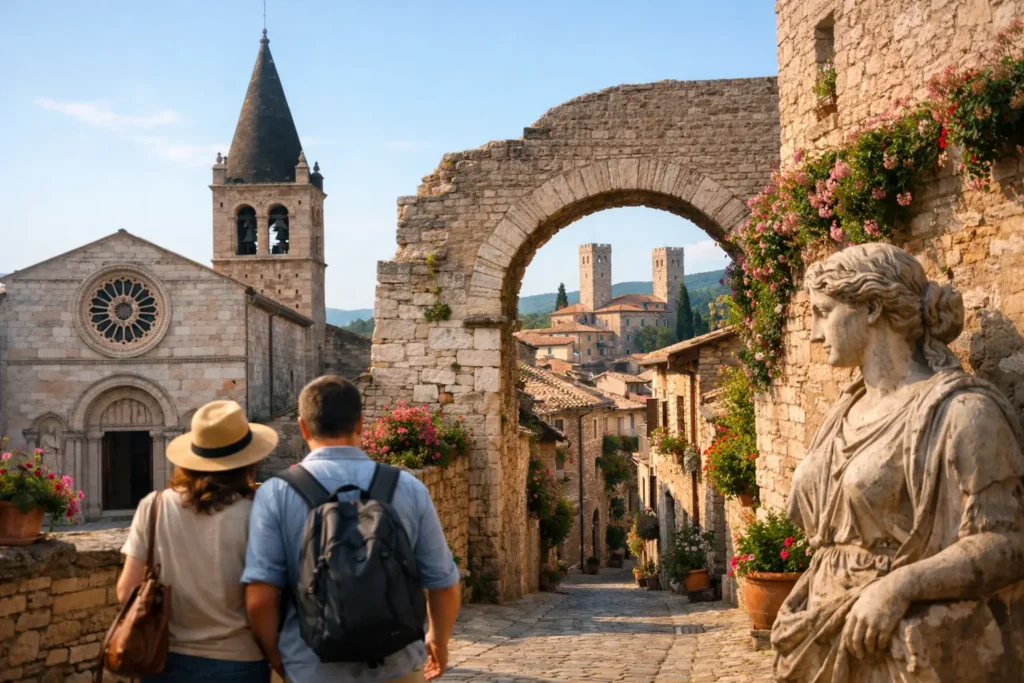
A Spello Walking Tour Through Art and History
Spello does not reveal itself all at once. Its honey-colored stone walls, Roman gates, quiet lanes, and broad views over the Umbrian Valley reward a slower pace and a curious eye. A Spello walking tour is the best way to understand how an ancient Roman town became one of Umbria’s most captivating hill villages, with layers of history tucked behind flowerpots, archways, and unassuming doorways.
Compact enough to explore on foot yet rich in details that are easy to miss, Spello is ideal for visitors who want more than a quick photograph from a panoramic terrace. With an official local guide, the town becomes a story of Roman engineering, medieval power, Renaissance art, faith, and the seasonal traditions that still bring its streets to life.
Why Spello Is Made for Walking
Known to the Romans as Hispellum, Spello rises gently on the lower slopes of Mount Subasio, between Assisi and Foligno. The historic center is enclosed by remarkably well-preserved walls, and its gateways provide a natural introduction to the town’s long life. You can still enter through Roman portals and follow streets that have been shaped, repaved, and inhabited for more than two thousand years.
The pleasure of Spello is in its scale. There is no need to rush from major monument to major monument. A short walk can move from a Roman inscription to a medieval tower, then to a Renaissance chapel filled with color. Along the way, terraces open toward olive groves and vineyards on the plain below, while small stone houses carry pots of geraniums, rosemary, and climbing vines.
That intimacy does come with a practical consideration. Spello is a hill town, so expect cobbled lanes, steps, and occasional inclines. Comfortable shoes are essential, especially in warm weather when the pale stone reflects the afternoon sun. Visitors with limited mobility can still enjoy selected areas, but a private itinerary can be adapted to choose gentler routes and allow more time for pauses.
What You See on a Spello Walking Tour
A well-planned walk usually begins near one of the town’s historic entrances, where the Roman past is immediately visible. Porta Consolare is among Spello’s most recognizable gateways, crowned with statues that give it a distinctive ceremonial character. It is more than an attractive arrival point: it sets the scene for a town that was important enough in antiquity to receive the favor of Emperor Augustus.
From there, the route naturally follows the old urban fabric uphill. Your guide can point out fragments that many independent visitors pass without noticing: reused Roman stone in later buildings, symbols carved above doors, stretches of defensive wall, and small architectural changes that reveal the transition from Roman settlement to medieval commune.
Roman gates and medieval streets
Porta Venere, flanked by its elegant medieval towers, is another essential stop. The gateway combines different eras in a single view, making it a fine example of why Spello feels so layered. Nearby streets retain the close, winding character of a medieval town, but the Roman foundations are never far away.
Walking these lanes is not simply about checking landmarks off a list. It is about understanding why towns such as Spello were built where they were. Its hillside position offered protection, air, and command over the valley, while the road connections below linked it with the wider Roman and later medieval world.
Pinturicchio’s Renaissance masterpiece
For many art lovers, the artistic high point of Spello is the Baglioni Chapel inside the Church of Santa Maria Maggiore. Here, frescoes by Pinturicchio bring the chapel walls to life with richly detailed scenes from the life of the Virgin. Look closely and you will find luminous colors, carefully observed interiors, expressive faces, and decorative details that show the confidence of the Italian Renaissance.
This is where expert interpretation changes the experience. The chapel is beautiful at first glance, but a guide can explain the Baglioni family’s role, the visual storytelling within each scene, and the techniques that helped Pinturicchio create such a refined sense of space and atmosphere. It is a small place with a major artistic presence, and it deserves time rather than a hurried stop.
The church itself also holds surprises, including works and furnishings that speak to Spello’s religious history. As in much of Umbria, sacred art here was not made for museums. It belongs to the living fabric of the town, where churches remain places of worship as well as extraordinary cultural sites.
Panoramas, quiet corners, and local character
Spello’s upper lanes offer some of its most memorable views. From the terraces and edges of the historic center, the Umbrian Valley stretches toward Assisi, Montefalco, and the distant Apennines. Morning light is especially clear, while late afternoon gives the stone walls a warmer glow.
Yet the quieter corners often stay with visitors longest. A narrow lane hung with laundry, an ancient well, a small shrine, or a doorway framed by flowers can be as evocative as a famous monument. An experienced guide knows when to pause at these details and when to let the town’s natural rhythm speak for itself.
The Infiorata: When Spello Becomes a Floral Artwork
If your visit falls around Corpus Christi, Spello offers a completely different spectacle. The Infiorata transforms streets and piazzas into immense floral carpets, made from petals, leaves, seeds, and other natural materials. Local residents spend months designing the images and long hours assembling them, often through the night before the religious procession.
It is one of Umbria’s most cherished traditions, but it is also one of the busiest times to visit. Hotels, restaurants, and tours should be arranged well ahead, and the town can feel crowded during the main days of the event. For travelers who value atmosphere and ceremony, the energy is unforgettable. For those seeking a quieter walk, spring or early autumn often offers the best balance of pleasant weather and peaceful streets.
Even outside Infiorata season, Spello’s flower-filled character remains part of its appeal. Residents take evident pride in balconies, windowsills, and tiny communal corners, adding softness and color to the pale local stone.
How Long to Allow for Your Visit
A focused guided walk through Spello’s historic center can be deeply satisfying in about two hours. This suits travelers combining Spello with Assisi, Bevagna, Montefalco, or a winery visit in the same day. It is enough time to see the principal gates, important churches, the main streets, and a selection of viewpoints with meaningful commentary.
Allow half a day if you would like to move more slowly, spend extra time in Santa Maria Maggiore, browse local shops, or enjoy lunch after the tour. Spello is particularly rewarding when paired with Umbrian flavors: extra virgin olive oil, cured meats, cheeses, handmade pasta, and wines from the nearby Montefalco area all fit naturally into a day in this part of the region.
Families can enjoy Spello as well, particularly when the walk is shaped around visual stories, gates, towers, and the chance to spot details in the walls. The route should be paced according to children’s ages and interest in art. For private groups, flexibility is one of the real advantages: more time for frescoes, views, photographs, or a relaxed coffee stop can turn a good visit into a personal one.
Why a Local Guide Makes the Difference
Spello is easy to enter, but not always easy to read. Its most significant details are often modest in scale, and the difference between a Roman remnant, a medieval alteration, and a later restoration is rarely obvious without context. A professional guide brings together the art, architecture, legends, and daily life that make the town more than a beautiful backdrop.
A guided experience also helps you use limited vacation time well. Rather than searching for entrances, wondering what deserves priority, or leaving a major fresco without understanding its importance, you can follow a route that has been shaped around the town’s strongest stories. Umbria.tours offers local, guide-led experiences designed to make those stories accessible without losing the pleasure of wandering.
Arrive with comfortable shoes, a bottle of water in summer, and enough room in your schedule to linger after the walk. Spello is at its best when you leave the final viewpoint without checking the time, carrying the sense that one small Umbrian town has opened a much larger history.