Umbria Cycling Routes for Culture, Hills, and Wine
Umbria cycling is rarely about chasing the flattest road or ticking off the greatest number of miles. It is about a climb that ends beneath the walls of Montefalco, a pause for coffee in a stone piazza, and the pleasure of arriving hungry enough to appreciate a local lunch. This is Italy’s green heart at bicycle pace: quieter than Tuscany in many areas, deeply rural, and full of towns whose towers seem to appear just when the road turns upward.
The region rewards curious riders. A route may pass olive groves, vineyards, woodland, and fields in the same morning, then lead into an old town where Roman stones sit beneath medieval facades. The hills are real, however. Planning a cycling holiday in Umbria means choosing routes that suit your fitness, your bicycle, and the kind of days you want to have.
What makes Umbria cycling so rewarding
Umbria is compact enough to combine riding with the things that make an Italian holiday memorable: art, religious heritage, family-run food producers, and time in beautiful historic centers. The landscape has variety without requiring long transfers. Around Lake Trasimeno, the terrain is gentler and more open. In the wine country around Montefalco and Bevagna, rolling roads lead through vines and olive trees. East of Perugia, the ground becomes steeper as the Apennines rise toward Assisi, Spello, and the Valnerina.
For many visitors, that variety is the main appeal. You can cycle a scenic loop in the morning and spend the afternoon with an official guide in Assisi or Orvieto, rather than treating the bicycle as the only reason to travel. A well-planned itinerary leaves room for the Basilica of St. Francis, Perugia’s historic center, Orvieto’s extraordinary cathedral, or a tasting that gives context to the countryside you have just crossed.
It is also a region where quieter roads remain possible. That does not mean every road is traffic-free, and cyclists should never assume so. But once outside the main approaches to larger towns, routes often feel remarkably peaceful, particularly in the wine areas and around smaller villages such as Bevagna, Spello, and Gubbio.
Choose the right area for your riding style
The best base depends less on a single “must-ride” route than on the balance you want between hills, culture, and ease of logistics.
Lake Trasimeno for relaxed days
Lake Trasimeno is a sensible choice for leisure riders, families with confident older children, and anyone arriving in Umbria after a busy city break. The roads and cycle paths around the lake offer broad views across the water, and the landscape is generally more forgiving than central or eastern Umbria. Castiglione del Lago makes an appealing stop, with its lakeside setting and historic fortress.
There are still undulations, especially if you leave the shore and head into the surrounding hills, but this is one of the best areas for a gentler introduction. It also works well for e-bikes, allowing mixed-ability groups to stay together without turning the day into a test of endurance.
Montefalco and Bevagna for wine-country riding
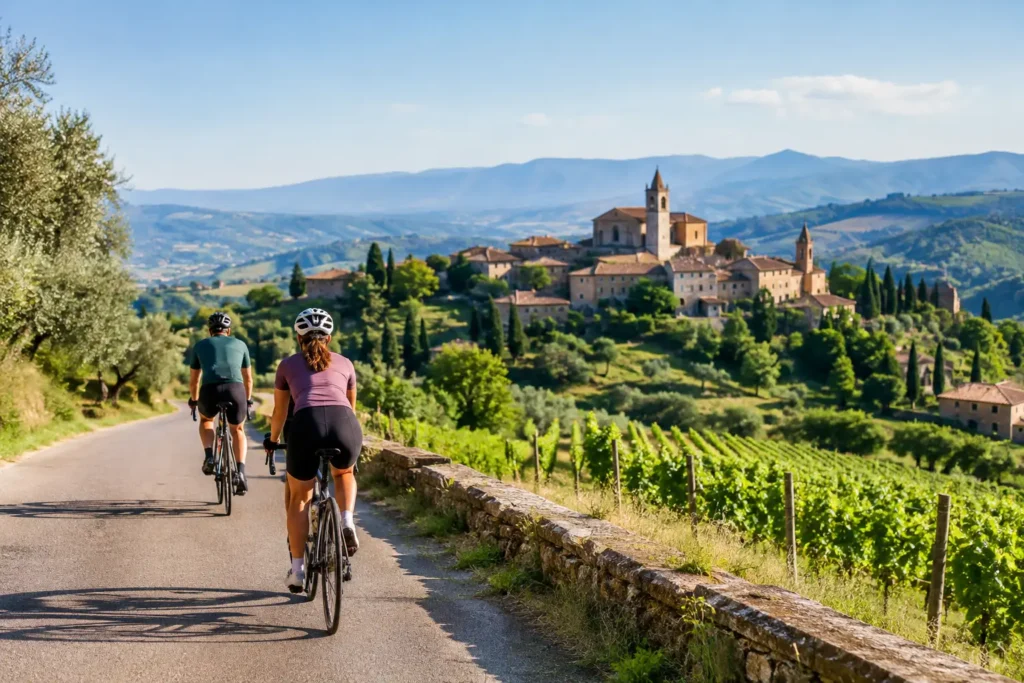
The roads around Montefalco and Bevagna deliver the Umbrian picture many travelers imagine: neat vineyards, silvery olive trees, farmhouses, and medieval hill towns in the distance. Montefalco sits high above the plain, so an ascent is part of the experience. The reward is a wide view over the valley and a town closely associated with Sagrantino wine.
Bevagna, lower and flatter, can make a more relaxed starting point. From there, riders can shape a day according to appetite. A short route might link Bevagna with nearby villages and a lunch stop. Stronger cyclists can include Montefalco, perhaps continuing toward Trevi or Foligno. Be realistic about carrying wine purchases on a bike, though. Arrange collection or delivery where possible, and keep your panniers for water, layers, and essentials.
Assisi and Spello for history with climbs
Assisi and Spello are magnificent bases for travelers who do not mind working uphill. Both towns rise above the Umbrian valley, and their approaches can be demanding, particularly in warm weather. An e-bike changes the calculation dramatically, making it possible to enjoy the ascent without arriving too tired to appreciate the art and atmosphere.
This area is ideal for visitors who want a day to feel layered rather than purely athletic. Ride through the plain below Assisi, stop among the olive groves near Spello, then walk into town for a guided visit. Cycling gives you the changing landscape; a local guide can reveal the frescoes, architecture, saints, rivalries, and small details that are easy to miss on your own.
The Valnerina for experienced riders
The Valnerina, the valley of the Nera River, has a more secluded character. Here, wooded slopes close in around the road, villages appear tucked into the mountains, and the terrain can be more demanding. It is particularly appealing to experienced road cyclists and riders who enjoy dramatic scenery over town-to-town convenience.
Road conditions and gradients vary, and some stretches require more confidence in traffic than dedicated cycling routes around a lake. For the right rider, that is part of the attraction. For first-time visitors looking for an easy-going holiday, the central valley or Lake Trasimeno may be a better fit.
Plan for hills, heat, and historic centers
The most common mistake on an Umbrian cycling trip is underestimating the relationship between distance and elevation. A 30-mile route can be wonderfully manageable on an e-bike or for regular cyclists, yet feel strenuous if it includes repeated climbs, summer heat, and a late lunch. Look at elevation gain, not only mileage, and allow more time than a route planner suggests.
Historic centers require their own kind of planning. Many are built on slopes, with cobbled lanes, stairways, restricted traffic zones, and limited parking near the center. Cycling to a town is often easy; cycling through every part of it may not be. Lock the bike where permitted and explore on foot. You will see much more, and you will avoid the frustration of trying to navigate narrow lanes designed long before bicycles existed.
Water matters from late spring through early fall. Carry more than you think you need, especially on rural routes where bars may be closed between lunch and late afternoon. A small snack, basic repair kit, charged phone, sunscreen, and a light rain layer are equally useful. Weather can change quickly in the hills, particularly in spring and fall.
When to cycle in Umbria
April through June and September through October are usually the most comfortable months for cycling. Spring brings green fields, wildflowers, and cooler riding temperatures, though rain is possible. Fall offers vineyard activity, olive harvest atmosphere, and warm colors across the hills. Both seasons can be busy around major events and weekends, so book accommodation and special experiences early.
July and August suit riders who are comfortable starting early. The mornings can be glorious, but midday heat makes steep routes less enjoyable and increases the need for water. A good summer rhythm is to ride before lunch, rest during the hottest hours, and return to town for an evening stroll and dinner.
Winter can be peaceful and clear, especially in lower areas, but daylight is shorter and some rural businesses operate on reduced hours. It is better for flexible travelers who value empty roads and cultural visits over guaranteed warm-weather riding.
Road bike, gravel bike, or e-bike?
A road bike is excellent for riders who enjoy smooth paved routes, long climbs, and linking towns efficiently. A gravel bike opens more possibilities on white roads and farm tracks, but do not assume every unpaved line on a map is suitable. Surface quality can change after rain, and remote tracks may be rougher than expected.
For many visitors, an e-bike is the most practical choice. It does not remove the landscape or the satisfaction of reaching a hill town. It simply gives you more freedom to stop for photographs, take a detour to a winery, or ride alongside a partner with different fitness levels. Battery range still needs attention: use assistance thoughtfully, check charging arrangements at your accommodation, and avoid beginning a long hilly day with a partially charged battery.
Build cultural stops into the route
A cycling itinerary becomes more rewarding when it has a purpose beyond the next hill. Pair Montefalco with a wine experience, Spello with its flower-filled lanes and Roman traces, or Assisi with time to understand its Franciscan heritage. In Perugia, it often makes more sense to leave the bicycle outside the historic center and explore its Etruscan, medieval, and Renaissance layers on foot.
This is where guided experiences add real value. Rather than rushing through a landmark with tired legs and a quick glance at a guidebook, reserve time for the stories behind it. Umbria.tours can help travelers connect a ride with official local guiding, food experiences, and the places that give the landscape meaning.
The most satisfying day may be a modest route, an unhurried lunch, and one well-chosen cultural visit. In Umbria, there is no prize for racing past the very places you came to see.