Related Posts
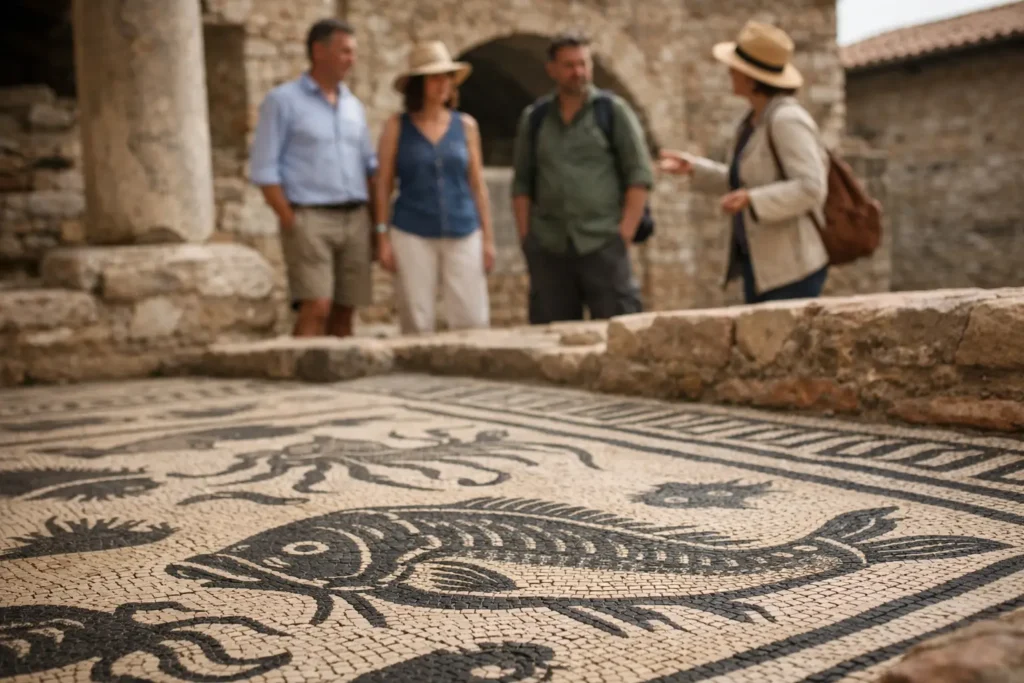
A Bevagna Roman mosaics guided visit begins with an unexpected change of scale. Above ground, Bevagna feels like a remarkably intact medieval market town, with stone lanes, quiet piazzas, and the Romanesque church of San Michele. Below one unassuming street, however, lie the remains of Roman baths and mosaic floors that reveal a much older chapter of the town’s life.
This is not a large archaeological park with grand entrances and crowds. That is precisely its appeal. Visiting the mosaics with an official local guide gives context to details that could otherwise seem fragmentary: a patterned floor, the outline of a room, a system built to carry heat. Within a short walk of Bevagna’s medieval landmarks, you can move back nearly two thousand years and see how Roman Mevania once functioned.
Bevagna was the Roman town of Mevania, a settlement of real importance in the Umbrian valley. Its position near the ancient Via Flaminia connected it to Rome and to the towns of central Italy, while the surrounding plain supported agriculture and trade. The Roman traces that remain today are woven into the later town rather than set apart from it.
The thermal complex preserves part of this everyday Roman world. Baths were not merely places to wash. They were social spaces, where residents met, relaxed, conducted business, and spent time as part of the rhythm of urban life. The surviving mosaic floors bring that domestic, human scale into focus. Their geometric decoration is refined without being theatrical, and it is all the more striking because it has endured beneath a living town.
A guide helps visitors read the site as an interconnected space. You may see the different levels and rooms associated with bathing, as well as elements of the heating system that once warmed the hot rooms. The mosaics are the visual highlight, but the real story is the engineering, habits, and prosperity they suggest.
The visit is intimate and observation-led. Access to the archaeological remains can be more limited than at a major museum, and arrangements may depend on opening schedules, preservation needs, and the size of your party. For that reason, a guided visit is especially worthwhile for travelers who want to avoid arriving at a closed door or viewing a site without explanation.
Your guide will place the baths within the map of ancient Mevania, then connect the Roman remains to the town you see above ground. This creates one of Bevagna’s most satisfying contrasts: the orderly Roman fabric beneath the medieval streets, and the centuries of change that followed.
Expect a close look rather than a long route. The value is in the details. A black-and-white motif, a surviving portion of flooring, or the space beneath a heated room can explain far more when someone points out what you are seeing and why it mattered. English-speaking visitors often find this particularly useful, since the best parts of small archaeological sites are not always fully interpreted in English on site.
The terrain in Bevagna’s historic center is generally walkable, though it includes cobbled streets and uneven surfaces. The archaeological space itself may involve steps or tighter access points. Travelers with limited mobility, young children, or strollers should ask about current access before confirming their plans. A private guide can often adapt the walking pace and build a route around your interests.
It is easy to admire a mosaic as decoration. It is more rewarding to understand it as evidence. The patterns were designed for rooms used by real people, and the remains point to choices about comfort, status, water, heat, and public life in a Roman town.
A knowledgeable guide can also explain what is original, what has been conserved, and what archaeologists can reasonably infer from the surviving structure. That distinction matters. Archaeology is not a finished picture. It is a careful reading of material evidence, and the most compelling visits leave room for both certainty and curiosity.
The Roman baths are an excellent reason to visit Bevagna, but they are not the only reason to stay. The town is compact enough to enjoy at a gentle pace, making it ideal for a half-day cultural outing or a relaxed stop between larger Umbrian destinations.
After the mosaics, walk into Piazza Silvestri, one of Umbria’s most atmospheric squares. Here, the Church of San Michele Arcangelo and the Church of San Silvestro create a memorable medieval setting, while cafés and small shops keep the town connected to everyday life. The transition from an underground Roman site to a sunlit piazza takes only minutes, yet it spans centuries.
Bevagna also rewards travelers who enjoy food as part of place. The surrounding countryside produces olive oil, wine, grains, and seasonal ingredients that appear on local tables. Depending on your schedule, a guided town visit can be paired with a leisurely lunch, a tasting, or an olive oil experience in the nearby hills. It is a natural combination for couples and small groups who would rather understand a destination than rush through a checklist.
If you are visiting in late June, the town’s Mercato delle Gaite brings medieval crafts, taverns, and historical reenactment to its streets. It is a wonderful period to experience Bevagna’s community spirit, although it is also busier than usual. Travelers seeking quiet views and easier photography may prefer a spring or autumn weekday.
Bevagna sits conveniently between several favorite Umbrian destinations. It can work beautifully alongside Montefalco for wine-country scenery, Spello for flower-filled lanes and Roman remains, or Assisi for a fuller day of art and history. The right pairing depends on your pace. Add too many towns and Bevagna’s quiet character can be lost; give it time, and it becomes one of the most memorable stops in the region.
Morning visits are often pleasant, particularly in warmer months, when the historic streets are still cool and the town is waking up. An afternoon visit followed by dinner can be equally appealing if you want to linger in the piazza. Summer temperatures can be high, so bring water, comfortable walking shoes, and a light layer for indoor or underground spaces.
For a private group, booking ahead is the sensible choice. Small archaeological sites may have restricted entry times, while advance planning allows a guide to coordinate the mosaics with the rest of your itinerary. At Umbria.tours, guided experiences are designed around the region’s history, local character, and the practical realities of travel, so you can choose a visit that fits your available time rather than forcing the day around a generic tour schedule.
The mosaics are particularly rewarding for travelers who like archaeology, Roman history, and places that feel genuinely local. They suit families with curious older children, couples looking for a quieter alternative to the headline sights of Italy, and repeat visitors who have already seen the better-known cities.
If your priority is monumental Roman architecture, a larger archaeological destination may offer more dramatic ruins. Bevagna offers something different: a concentrated encounter with the hidden layers of an inhabited town. Its strength lies in atmosphere and interpretation, not scale.
Take the time to look closely when you are there. In Bevagna, a few surviving stones and a mosaic underfoot can make ancient Umbria feel far closer than a grand ruin ever could.