10 Best Assisi Experiences for a Meaningful Visit
Assisi is not a place to rush between photo stops. The best Assisi experiences reward visitors who slow down long enough to notice a worn stone doorway, a fresco’s quiet gesture, or the changing light over the Mount Subasio slopes. This compact hill town holds some of Italy’s most significant religious art, but its appeal reaches beyond pilgrimage: it is also a living Umbrian town of family kitchens, small workshops, country paths, and enduring local traditions.
For a first visit, give Assisi at least a full day. Two days allow a more relaxed rhythm, especially if you would like to combine the town with its countryside and regional food. Here are the experiences that reveal its character most fully.
1. See the Basilica of St. Francis with a local guide
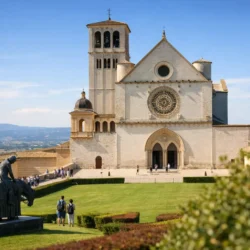
The Basilica of St. Francis is Assisi’s essential visit, yet it is easy to underestimate from the outside. Its two churches, built one above the other, contain radically different atmospheres: the lower basilica is intimate, candlelit, and deeply devotional, while the upper basilica opens into a luminous painted space that changed the course of Italian art.
The fresco cycle traditionally associated with Giotto tells the life of St. Francis in direct, human scenes. Even travelers who do not come for religious reasons often find the storytelling unexpectedly moving. A knowledgeable official guide helps distinguish the art, architecture, and history from the many simplified stories that surround the basilica. It also gives context to Francis himself: the son of a prosperous merchant who chose poverty, reconciliation, and a new way of relating to the natural world.
Allow time for the crypt, where St. Francis is buried. It is a place of prayer, so a respectful, unhurried visit matters more than trying to see every detail at once.
2. Walk Assisi’s medieval center beyond the main street
Assisi’s central streets can be busy, particularly from late spring through early fall. Turn into the lanes rising above Piazza del Comune, however, and the town becomes quieter. Stone houses, tiny chapels, flowerpots, and views across the Umbrian plain make even a short walk feel rewarding.
A guided walking tour is especially useful here because much of Assisi’s history is not announced by large signs. It appears in Roman fragments built into medieval walls, old tower houses, civic symbols, and the layout of former noble quarters. You also gain a clearer sense of Assisi as a medieval commune, shaped by rivalry with Perugia as much as by its later spiritual fame.
This is one of the best Assisi experiences for visitors with limited time. In two or three hours, a well-planned route can connect the town’s major monuments with the details most independent visitors pass without noticing.
3. Pause in Piazza del Comune and visit the Roman Temple
Piazza del Comune remains Assisi’s civic heart. Cafes spill onto the square, locals pass through on daily errands, and the Temple of Minerva rises with remarkably intact Roman columns. Built in the first century BC, the temple was later transformed into the Church of Santa Maria sopra Minerva, an extraordinary example of how Assisi has layered new life over ancient foundations.
Look up at the façades around the piazza and you will see the town’s shifting identity in one frame: Roman architecture, medieval public buildings, and the later elegance of the Palazzo del Capitano del Popolo. It is a fine place for a coffee break, but it is even better when you understand what you are looking at.
4. Visit Santa Chiara and meet Assisi’s other great saint
St. Clare was not simply a companion in Francis’s story. She founded the Order of Poor Ladies, later known as the Poor Clares, and led a community that gave practical form to the Franciscan ideal of poverty and faith.
The Basilica of Santa Chiara, built in pink and white local stone, is calmer than the Basilica of St. Francis and offers one of the town’s most beautiful views toward the plain. Inside, visitors can see the crucifix said to have spoken to Francis at San Damiano, as well as relics associated with Clare.
The walk to Santa Chiara also opens up a different side of Assisi. It passes residential streets and small shops, making it easy to combine sacred heritage with the ordinary rhythm of town life.
5. Walk to San Damiano in the quieter hours
Below the historic center, the Sanctuary of San Damiano is set among olive trees and gardens. It was here, according to tradition, that Francis heard Christ’s call to “repair my church,” and where Clare established her community.
The route downhill takes roughly 25 to 35 minutes, depending on pace, and returns uphill, so comfortable shoes are essential. The effort is worthwhile for those who want a more contemplative experience than the busy basilicas can provide. Arrive early or later in the afternoon when possible, and leave time to sit in the cloister or garden rather than treating it as another quick stop.
Visitors with mobility concerns may prefer to arrange transport rather than attempt the steep return walk. Assisi is beautiful but undeniably hilly, and planning around its inclines makes the day far more enjoyable.
6. Follow the path to Eremo delle Carceri
For a stronger connection to the landscape that shaped Francis, head above Assisi to Eremo delle Carceri. This hermitage lies in woodland on Mount Subasio, where Francis and his followers withdrew for prayer and solitude. The word “carceri” refers not to prisons in the modern sense, but to secluded cells.
The air is cooler here, the trees muffle the sound of the town, and the setting makes clear why this place has remained meaningful for centuries. It is best reached by car, taxi, or a planned excursion, although confident walkers may take the uphill paths. Bring water and allow for changing weather, especially outside summer.
This experience suits travelers who value nature as much as art. It is not about ticking off another monument. It is about understanding that Assisi’s spiritual heritage is inseparable from its hills, woods, and open horizons.
7. Taste Umbrian olive oil and local flavors
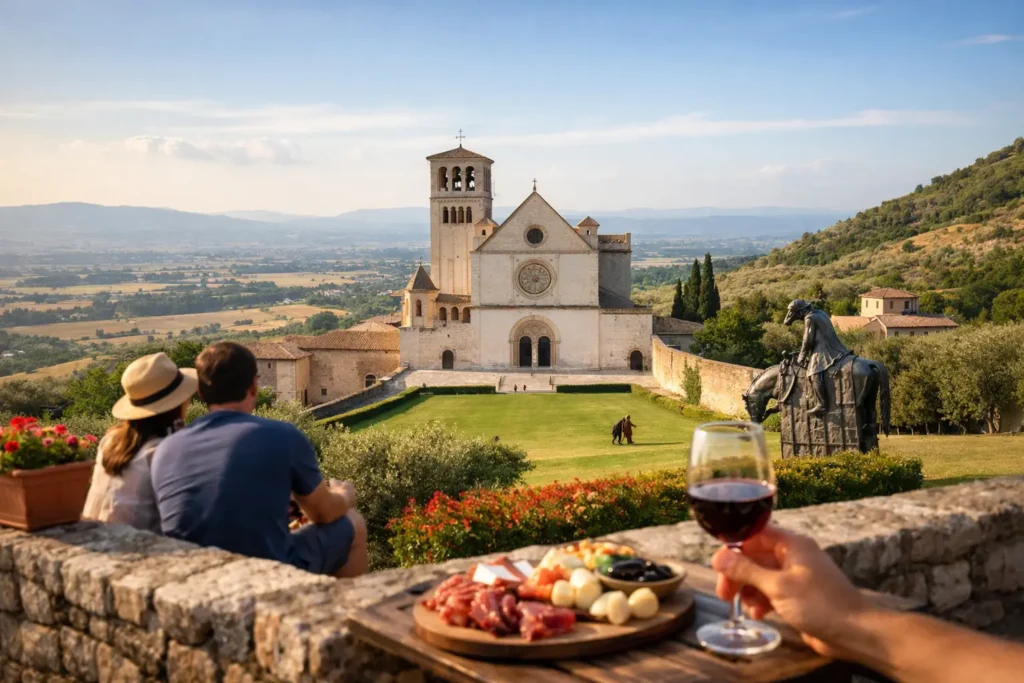
Assisi is surrounded by olive groves, and fresh extra-virgin olive oil is one of the clearest expressions of the local landscape. A tasting introduces the differences between oils: grassy, peppery, almond-like, or more delicate, depending on variety and harvest. Good oil is not merely a souvenir. It is central to Umbrian cooking.
Pair it with local bread, cheeses, cured meats, legumes, and seasonal vegetables. In colder months, look for dishes built around lentils, chickpeas, truffles, mushrooms, and slow-cooked meats. In warmer weather, a simple plate of bruschetta with new-season oil can be just as memorable.
An olive-mill visit is particularly rewarding in harvest season, generally from late October into November, when the countryside is active and the aromas are at their most vivid. At other times of year, a tasting still offers an excellent introduction to regional produce without taking a full day away from sightseeing.
8. Watch the sunset from Rocca Maggiore
Rocca Maggiore, the fortress above Assisi, offers the town’s broadest panorama. From its walls and terraces, the view reaches across the valley toward Perugia and the distant Apennines. It is a powerful reminder that Assisi was once strategically important, not only spiritually renowned.
The climb is steep, but sunset is the moment to make it. The basilica roofs soften in the fading light, and the plain changes from green to gold to blue. Check seasonal opening times before setting out, since the fortress may close before the latest summer sunset. If timing does not work, visit in late afternoon and enjoy the view on the descent.
9. Make time for Santa Maria degli Angeli
At the foot of the hill, Santa Maria degli Angeli shelters the tiny Porziuncola chapel, one of the most important Franciscan sites. The scale is startling: a vast basilica built around a humble little church where Francis gathered his early companions.
Because it lies outside the historic center, some visitors skip it. That is a mistake if you want to understand the Franciscan story as a whole. It is easy to reach by local transport or car, and it combines well with an arrival or departure day, particularly if you are staying near the train station.
10. Let a private guide shape the day around your interests
Assisi can be approached through art history, faith, medieval politics, family-friendly storytelling, food, or the surrounding landscape. There is no single right route. A visitor who has studied Giotto may want longer in the basilica, while a family may prefer a shorter historic walk with space for gelato and the fortress. Someone traveling in a small group may combine Assisi with Spello, Montefalco, or an olive-oil experience.
A private or small-group experience with an official local guide brings flexibility without losing substance. Umbria.tours can help turn a list of famous places into a day with a clear rhythm, local insight, and time to enjoy what you came to see.
Assisi asks for attention rather than speed. Choose two or three places that genuinely interest you, leave room for an unplanned lane or a long view, and let the town reveal itself one quiet detail at a time.