
Related Posts
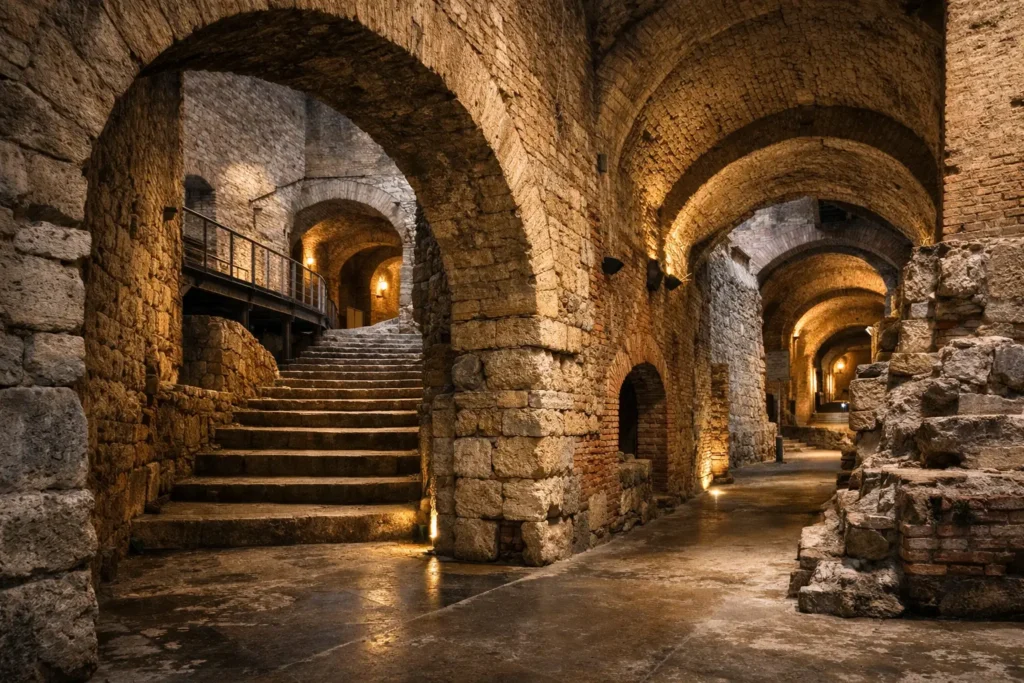
A descent through Rocca Paolina feels like entering a different Perugia. One moment, you are near Piazza Partigiani, with buses, traffic, and the practical rhythm of a modern city. A few escalators later, stone vaults, passageways, and the outline of a lost neighborhood surround you. The Rocca Paolina underground passage history is not the story of a hidden medieval tunnel. It is the remarkable afterlife of a papal fortress built to control Perugia, then largely torn down by the people it was meant to intimidate.
For visitors, it is also one of the most useful and memorable ways to reach Perugia’s historic center. The passage links the lower part of town with Piazza Italia, close to Corso Vannucci and many of Perugia’s principal sights. Yet it is worth slowing down rather than treating it only as a convenient shortcut. The underground route holds a powerful chapter in the city’s long struggle for independence.
In the 16th century, Perugia was formally within the Papal States, but its citizens and noble families had a strong tradition of self-rule. The relationship with Rome was rarely simple. In 1540, Pope Paul III imposed a tax on salt, an essential everyday commodity. Perugia resisted, and the dispute became known as the Salt War.
The rebellion did not succeed. Papal troops defeated Perugia, and Paul III chose to make the city’s submission visible in stone. He ordered a vast fortress on the southern edge of the historic center, strategically positioned to dominate the city and keep watch over its population.
The project was entrusted to Antonio da Sangallo the Younger, one of the leading military architects of the Renaissance. Construction began in 1540 and moved quickly. The fortress was named Rocca Paolina after the pope himself, a name that still carries the memory of papal power.
This was not a castle added to an empty hilltop. To create it, authorities cleared a substantial part of the medieval Borgo San Giuliano district. Homes, towers, streets, and religious buildings were demolished or absorbed into the new complex. For the families who lived there, the fortress was not merely a military installation. It was an imposed structure built over their neighborhood.
Rocca Paolina was impressive by design. Its upper walls and defensive works rose over Perugia, while its internal spaces incorporated sections of the earlier urban fabric. But its symbolism mattered as much as its military function. The fortress told Perugians that their city was under direct papal control.
That message made it deeply unpopular. During moments of political unrest, the fortress became a target. Perugians damaged and dismantled parts of it more than once, especially during the revolutions of the 19th century, when resistance to papal rule gathered force across central Italy.
The decisive change came after Perugia joined the Kingdom of Italy in 1860. With papal authority over the city ended, the fortress was no longer needed as a seat of control. Much of its above-ground structure was demolished. In its place, the city developed the open area around Piazza Italia, which became one of Perugia’s elegant urban spaces.
The destruction was deliberate, but it was never total. The enormous lower levels of the fortress, together with surviving fragments of the medieval district it had engulfed, remained beneath the city. That survival created the unusual spaces visitors move through today.
The present underground passage is a modern public route through the surviving substructures of Rocca Paolina. It uses escalators, elevators, and walkways to connect Piazza Partigiani with the upper historic center. It is especially welcome on a warm day, in rain, or after parking near the lower bus terminal, but its real appeal is the contrast between function and atmosphere.
As you travel upward, you pass beneath broad brick vaults and through spaces that can feel almost theatrical. Some areas suggest streets and rooms buried by time, while others show the architectural scale needed to support a huge fortress above. The route has been arranged for public access, so it should not be mistaken for an untouched archaeological excavation. Still, it preserves a genuine sense of Perugia’s layered construction.
The key to understanding the passage is that it contains more than one historical moment. There is the medieval neighborhood that existed before the fortress. There is the 1540s papal project that overwhelmed it. Then there is the modern city, which adapted what survived into a practical connection between different levels of Perugia.
That layered quality is one reason the passage has such a strong effect on first-time visitors. Perugia is often described as a hill town, but Rocca Paolina makes the reality physical. The city is not simply built on a hill. It is built in layers, with Etruscan traces, medieval streets, Renaissance interventions, and contemporary life occupying the same compact landscape.
Few Italian landmarks have changed their meaning as completely as Rocca Paolina. It began as an instrument of authority. Today, residents use its escalators on the way to work, students pass through it, and travelers emerge near the heart of the old town without facing one of Perugia’s steepest climbs.
That transformation is part of its significance. The city did not preserve the fortress as a triumphal monument to Pope Paul III. Instead, it reclaimed the surviving structure and made it serve public life. The route now leads toward shops, cafés, galleries, and the broad promenade of Corso Vannucci, rather than toward a guarded stronghold.
During the Christmas season, the underground halls are often associated with Perugia’s seasonal market and festive displays. At other times of year, exhibitions or cultural events may bring additional activity to the spaces. The atmosphere can therefore vary considerably. A quiet weekday morning emphasizes the architecture; a holiday visit may feel livelier and more crowded.
The passage is easy to use independently, but a little context changes the experience. Enter from the Piazza Partigiani side if you want the most dramatic sense of ascent into the city. As the escalators carry you upward, pause where possible and look at the vaults rather than rushing toward the exit.
Once you reach Piazza Italia, take a moment to notice the difference in scale and mood. The open square, lined with 19th-century buildings, sits above a structure that once represented the exact opposite of civic freedom. From there, Corso Vannucci is only a short walk away, as are the Palazzo dei Priori, the Fontana Maggiore, and the cathedral complex.
There are practical trade-offs to consider. The passage is excellent for avoiding the climb from the lower city, but it does not replace a walk through Perugia’s older lanes. If time allows, use Rocca Paolina in one direction and return by wandering through the medieval streets. That way, you experience both Perugia’s hidden architecture and the lively, sunlit city above it.
Visitors with mobility needs will often find the escalators and elevators helpful, though conditions and access points can change during maintenance or special events. If Rocca Paolina is central to your day’s plans, check local opening information shortly before your visit.
Rocca Paolina is most rewarding when viewed alongside the city’s other eras. Perugia’s Etruscan Gate, medieval palaces, Renaissance art, and civic squares can seem separate at first. The underground passage connects them conceptually. It shows that the city’s history includes not only celebrated works of art, but also conflict, demolition, adaptation, and the determination of its citizens.
An official local guide can help make these connections visible, from the politics of the Salt War to the medieval streets incorporated beneath the fortress. On a guided walk of Perugia, Rocca Paolina becomes more than an unusual escalator ride. It becomes a starting point for reading the entire city.
Allow yourself a few unhurried minutes underground before you continue toward the light of Piazza Italia. In Perugia, the shortest route upward can also be the one that takes you deepest into the past.