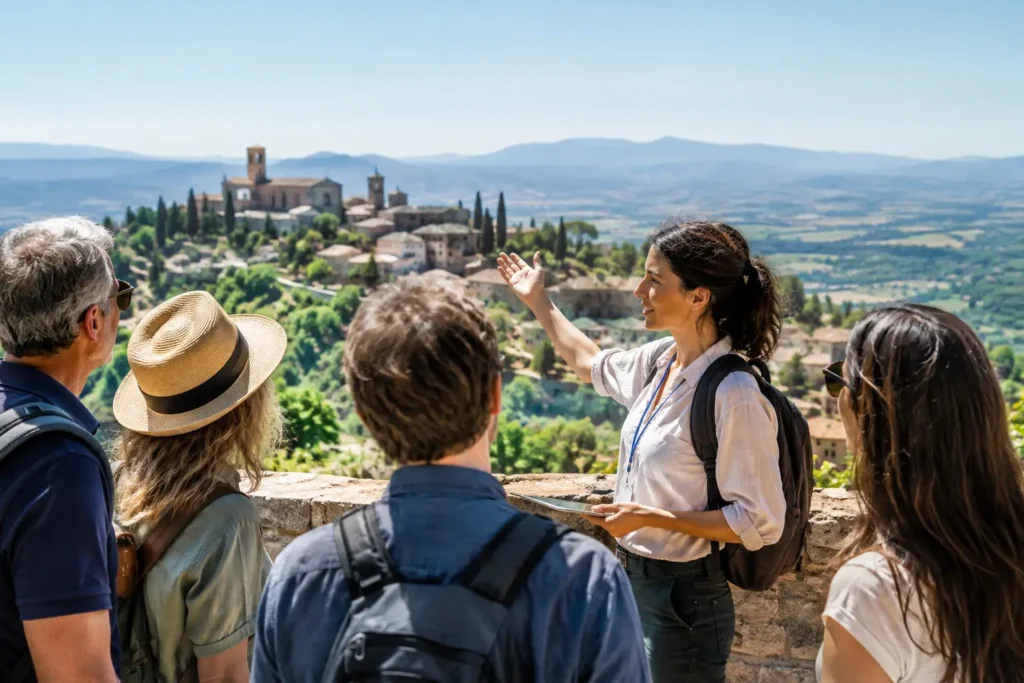
Why Guide-Led Tours Make Umbria More Meaningful
A fresco high above an Assisi chapel wall, a narrow stone lane that suddenly opens onto Perugia’s skyline, the quiet details carved into Orvieto Cathedral’s facade – these are the moments that can easily pass by without context. Guide-led tours turn them into stories you can carry home. Rather than simply moving from one famous sight to the next, you begin to see how saints, merchants, artists, farmers, and powerful medieval families shaped the towns around you.
Umbria rewards travelers who slow down. Its historic centers are compact but layered, its landscapes are beautiful without demanding a packed schedule, and its food traditions are tied closely to the people and places that produce them. A knowledgeable local guide gives those layers shape, helping you spend your holiday time where it matters most.
What guide-led tours add to an Umbrian vacation
A guidebook can tell you that Assisi is the birthplace of St. Francis. An official local guide can explain why his message still feels present in the city’s streets, churches, and views across the valley. They can show you how the Basilica of St. Francis was built to serve pilgrims, point out the visual language in Giotto’s frescoes, and help distinguish the historical Francis from the figure many visitors think they already know.
That is the real value of guided travel in Umbria: interpretation. The region has no shortage of beautiful buildings, but a Roman arch, a medieval fountain, or a Renaissance palace becomes more memorable when you understand who commissioned it and what daily life looked like around it.
Local knowledge also improves the rhythm of a day. A good guide knows when a square is at its most atmospheric, which route avoids unnecessary climbs, where to pause for a view, and how to build in time for a coffee, a wine tasting, or an unhurried lunch. This matters especially in hill towns, where a seemingly short distance on a map can mean steep lanes, steps, and plenty of distractions along the way.
The places where a local guide makes the greatest difference
Assisi: beyond the basilica
Assisi deserves more than a quick visit to its most famous church. Its Roman temple, medieval lanes, fortress, and Franciscan sites reveal a town shaped by faith, civic pride, and centuries of pilgrimage. A guided walking tour helps connect these places rather than treating them as separate stops.
For travelers interested in art and religious heritage, context is essential. The basilica contains extraordinary work, but it can feel overwhelming without an explanation of the scenes, symbols, and historical setting. Families and first-time visitors often appreciate a guide who can make this rich material clear without making the visit feel like a lecture.
Perugia: an old city with hidden levels
Perugia is a city of unexpected contrasts. Elegant piazzas and bustling streets sit above medieval quarters, while the remarkable underground passages beneath the Rocca Paolina reveal a more complicated chapter in the city’s past. It is easy to enjoy Perugia independently, but it is harder to understand its shifting levels and political history without someone who knows how the pieces fit together.
A local guide can move from Etruscan origins to medieval rivalries and modern university life in a way that makes sense on foot. There is also time for the pleasure of the city itself: a panoramic terrace, a small food shop, or a pause to watch daily life unfold in Piazza IV Novembre.
Orvieto: stone, wine, and volcanic ground
Orvieto rises dramatically above the surrounding countryside, and the first sight of its cathedral alone is worth the journey. Yet the city’s appeal goes far beyond its facade. Beneath the streets are wells, caves, and passages cut into volcanic tufa. Above them are churches, artisan workshops, and wine traditions rooted in the fertile land nearby.
This is a destination where combining culture and food works particularly well. A morning focused on the cathedral and historic center can lead naturally into a tasting of local wines or regional products. The best itinerary depends on your interests and available time, but a guide can ensure that the experience feels connected rather than rushed.
Smaller towns, deeper encounters
Gubbio, Spoleto, Bevagna, Montefalco, and Spello each offer a different side of Umbria. Gubbio has an unmistakably medieval character and dramatic hillside setting. Spoleto balances Roman, medieval, and artistic heritage. Bevagna evokes the smaller-scale rhythms of an ancient market town, while Montefalco is closely associated with Sagrantino wine and broad vineyard views. Spello’s flower-filled lanes and Roman remains make it especially inviting for a gentler walk.
These places are often where guide-led experiences feel most personal. Your guide can adapt the pace, draw attention to details you might otherwise miss, and recommend how to continue the day after the tour. For travelers who have already seen Italy’s major cities, these towns can provide the more intimate memories.
Choosing between a private and small-group tour
The right format depends less on the size of your party than on how you like to travel. A private tour offers flexibility. It is particularly useful for families, multigenerational groups, travelers with mobility considerations, or visitors with a focused interest in art, food, archaeology, or religious history. You can ask more questions, set a comfortable pace, and often shape the route around what interests you most.
Small-group tours bring a different pleasure. They are social without being impersonal, usually offer a clear itinerary and per-person pricing, and work well for couples or solo travelers who want expert guidance without arranging a private experience. The conversation among fellow travelers can add to the day, particularly on food and wine activities where shared tasting is part of the enjoyment.
Neither format is automatically better. If you have one morning in Assisi and want a structured introduction, a small group can be an excellent choice. If you are planning a full day around Perugia with grandparents and teenagers in the same party, private guiding may offer the breathing room that makes everyone happier.
How to plan a tour that fits your trip
Start with geography. Umbria may look compact, but hill roads and train connections affect how much can realistically fit into one day. Choose one principal destination, then add a nearby tasting, olive mill visit, or countryside activity if the schedule allows. Trying to cover Assisi, Perugia, and Orvieto in a single day usually means seeing too little of each.
Next, think about the experience you want to remember. If your priority is sacred art, reserve enough time for Assisi. If you are drawn to medieval urban history, Perugia or Gubbio may be the stronger choice. If food and wine are central to your trip, Montefalco, Bevagna, and the olive-growing areas around the region offer rewarding possibilities. A well-chosen tour is not about checking off the most towns. It is about allowing one place to become real.
Practical details matter as well. Check the duration, meeting point, language, inclusions, and whether entrance fees or tastings are part of the experience. Wear shoes suitable for uneven paving and slopes, even on a tour described as an easy walk. In summer, early morning or late afternoon often provides more comfortable temperatures and softer light. During religious holidays and major local events, booking ahead is wise.
At Umbria.tours, experiences are designed around this local approach, with official guides and bookable options that make it easier to match a destination to your available time and interests.
Let the guide shape the story, not just the route
The finest guides do more than recite dates. They notice what catches your attention and build on it. A question about a painted doorway might lead to a story about a local family. A child’s curiosity about a medieval well might open a conversation about water, trade, and life inside city walls. A stop for olive oil can become a window into the landscape, harvest season, and the patient work behind a regional staple.
That human exchange is difficult to plan from an itinerary alone. It is also why guided tours can be worthwhile even for confident independent travelers. You still have freedom to wander afterward, return to a favorite square, or linger over lunch. But you do so with a clearer sense of place.
When you arrive in an Umbrian town, give yourself permission to look up, ask questions, and take the slower street. With the right local guide beside you, even an ordinary corner can become the detail you remember most.