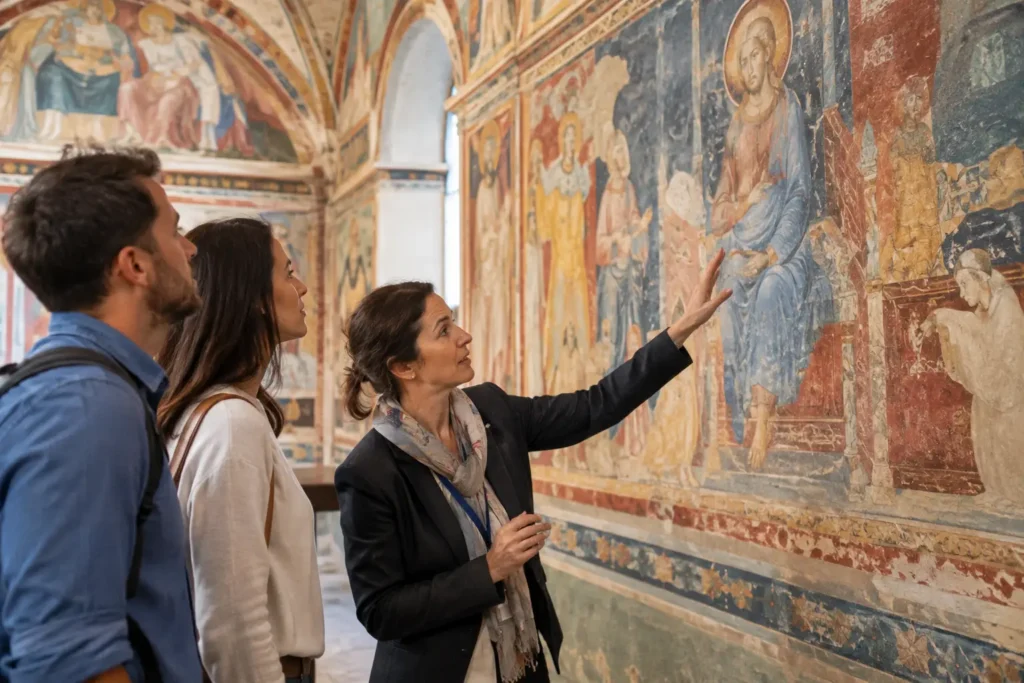
How to Explore Assisi Frescoes With a Guide
The first thing to notice in Assisi is that the frescoes do not behave like paintings in a museum. They surround you: saints look down from vaults, blue skies open above chapels, and stories unfold across entire walls. Knowing how to explore Assisi frescoes means slowing your pace, looking beyond the famous names, and understanding why these images transformed the way Italy told sacred stories.
Start with the Basilica of St. Francis
Assisi’s essential fresco experience is the Basilica of St. Francis, built shortly after Francis’s death in 1226. It is both a major artistic landmark and an active place of worship. That dual role shapes the visit. You are entering a church that has welcomed pilgrims for centuries, not simply a gallery, so allow time for quiet observation and follow the guidance on dress, photography, and areas reserved for prayer.
The basilica has two strikingly different levels. The Upper Church is light, tall, and filled with color. Its broad walls and ribbed vaults create the ideal setting for narrative painting. The Lower Church is more intimate and shadowed, with side chapels that reveal paintings gradually as you move through the building. Beneath it lies the tomb of St. Francis, the spiritual heart of the complex.
Give yourself at least 90 minutes for the basilica alone. Two hours is better if you want to look carefully, pause in the Lower Church, and avoid treating the Francis cycle as a checklist. Opening times can change for religious services and the season, so build a little flexibility into your day in Assisi.
How to explore Assisi frescoes in the right order
Begin in the Upper Church, where the great narrative of St. Francis runs along the lower walls. The cycle is traditionally associated with Giotto and his workshop, though art historians continue to debate individual hands and the precise extent of Giotto’s contribution. That uncertainty is part of what makes the basilica so rewarding: this was not art made by one isolated genius, but an ambitious collaboration of painters, designers, patrons, and craftsmen.
Do not try to decode every scene at once. First, walk the length of the nave and take in the overall effect. Notice how the painted architecture, landscapes, crowds, and interiors create a believable world. Then return to a few scenes that hold your attention.
Look especially for the moments when Francis seems remarkably human. He embraces the leper, renounces his inheritance before the bishop, speaks to birds, and receives the stigmata on Mount La Verna. These episodes are religious stories, but they are also dramas of gesture, emotion, and choice. Faces turn toward one another. Figures react. Buildings frame the action. Compared with earlier, more formal sacred images, the effect can feel surprisingly immediate.
Look from left to right, then look up
The stories of Francis are arranged to be read in sequence, but the basilica rewards a second way of looking. After following the narrative, lift your eyes to the ceilings and upper walls. The decorative program connects Francis’s life to the wider Christian story and to the intellectual culture of the Franciscan order.
This is where many visitors rush. The important detail may be a hand reaching from a crowd, a small painted window that extends the architecture, or the way a hill gives depth to a scene. Step back when you can. Frescoes were designed for viewers standing on the church floor, not for close inspection alone.
Learn to read what is on the wall
A fresco is painted onto fresh, wet plaster. The pigment becomes part of the wall as the plaster dries, which is why the technique has endured for centuries, but it also demands speed and planning. Artists worked in sections, often visible as subtle joins in the plaster. These daily sections are called giornate, and they offer a glimpse into the working rhythm behind a monumental image.
When looking at a scene, ask three simple questions: What is happening? Where does your eye go first? How has the artist made you feel the importance of that moment? The answer may lie in a central figure, a bright robe, a gesture, or an architectural setting that directs attention like a stage set.
Color also carries meaning. The deep blues in Assisi are not merely decorative. Blue was costly and visually powerful, often used to convey the dignity of the heavenly realm and major sacred figures. Gold, when present, catches changing light and creates a different sense of presence from painted color alone.
You do not need an art-history degree to respond to these choices. The strongest visits balance knowledge with attention. Spend time with the scene that moves you, even if it is not the one printed in every guidebook.
Meet the artists beyond Giotto
Giotto is the name most closely linked to Assisi, but the basilica is not a one-artist experience. In the Upper Church, paintings connected with Cimabue are crucial for understanding the transition from the stylized Byzantine tradition toward greater naturalism. His monumental figures still carry a solemn, otherworldly weight, yet their bodies and expressions have a new sense of life.
The Lower Church introduces a different atmosphere and an extraordinary range of later medieval artists. Simone Martini’s refined, elegant painting and Pietro Lorenzetti’s powerful narrative scenes are among the highlights. Their work shows that Assisi was a creative crossroads, attracting artists who helped shape Italian painting well beyond Umbria.
It is worth resisting the temptation to turn every wall into a contest between famous names. Attributions can be complex, and conservation has affected how some works appear today. Instead, compare moods. One chapel may feel intimate and jewel-like; another may feel dramatic, crowded, and physical. The contrast helps you see how many visual languages coexist within the same sacred site.
Make room for the Lower Church and the town
The Lower Church deserves more than a quick descent to the tomb. Its low vaults, painted chapels, and quieter light encourage a slower rhythm. Because the spaces are smaller, it can be harder to take in a whole composition from one spot. Move carefully, then stand still. Let your eyes adjust.
After the basilica, continue through Assisi rather than immediately leaving for the next destination. The city itself gives the frescoes context. Francis grew up among the merchants, churches, and stone lanes of this hill town before choosing a radically different life. A walk toward Piazza del Comune, the Roman Temple of Minerva, and the Cathedral of San Rufino reveals the layers of Roman, medieval, and religious history that shaped his world.
If your itinerary allows, visit the Basilica of Santa Chiara as well. The church is closely connected with St. Clare, Francis’s companion and the founder of the Poor Clares. Its atmosphere is distinct from St. Francis’s basilica, and the visit deepens the story of the early Franciscan community.
Why an official guide makes a difference
The Basilica of St. Francis contains an enormous amount of visual information, and the best details are not always obvious from a distance. An official local guide can connect a single fresco to Francis’s biography, medieval Assisi, the Franciscan order, and the artistic changes taking place in 13th- and 14th-century Italy.
That matters particularly when time is limited. Rather than trying to absorb every chapel, you can focus on the scenes and artists that reveal the larger story. A private or small-group walking tour also makes it easier to connect the basilica with the lanes, viewpoints, and lesser-known details of Assisi outside its doors. Umbria.tours works with official local guides who bring that wider context to a visit without making it feel like a lecture.
A guide is not essential for everyone. Independent travelers who enjoy lingering with a good guidebook may prefer to explore at their own pace. But for first-time visitors, families, or anyone keen to understand what makes Assisi exceptional, expert interpretation can turn a beautiful church into a memorable encounter with art and history.
Arrive with curiosity, leave space in your schedule, and choose just a few scenes to remember. Long after the details blur, you may find that it is one painted gesture, one field of blue, or one quiet chapel that stays with you.