Articoli correlati
Orvieto does not reveal its history all at once. From below, the town appears almost impossible: a compact crown of stone rising from a sheer volcanic rock plateau above the Umbrian countryside. On an Orvieto history walking tour, that dramatic first impression becomes the starting point for a story that moves from Etruscan engineering and papal refuge to medieval commerce, Renaissance art, and the daily life of a town that still feels lived in.
This is a destination best understood on foot. Its historic center is wonderfully compact, but the details are layered: a carved doorway overlooked on the way to lunch, a quiet church with an important fresco, an underground passage beneath a familiar street. A knowledgeable local guide gives these places their context and helps you spend your time on what makes Orvieto truly distinctive.
Orvieto occupies the site of an important Etruscan settlement, likely the ancient city of Velzna. Long before the Romans arrived, this was a powerful center in central Italy. The choice of location was strategic. The high tufa cliff offered natural defenses, while the surrounding valleys provided fertile land and routes for trade.
The Etruscans left more than an idea of the town’s origins. Beneath the streets lies an extraordinary network of caves, wells, cisterns, and tunnels carved into the volcanic rock. Some spaces served practical purposes, including water storage and food preservation; others were linked to workshops, pigeon keeping, or escape routes. Their existence explains something essential about Orvieto: the city above ground has always depended on the city below it.
Roman influence followed, but Orvieto gained particular importance again in the Middle Ages. Its elevated position made it a secure and attractive refuge for popes during periods of tension in Rome. Noble families, church authorities, merchants, and craftspeople all shaped the streets visitors walk today. The result is not a museum-like medieval town. It is a place where narrow alleys open suddenly onto elegant squares, and monumental religious architecture sits beside small family-run shops and homes.
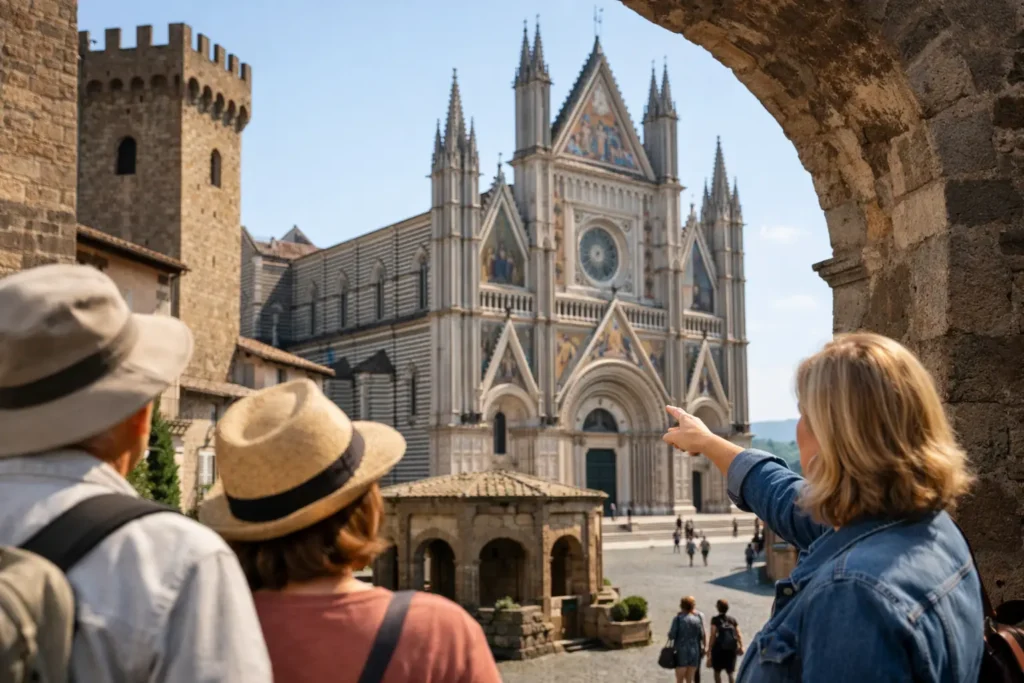
The Cathedral of Orvieto is the visual and spiritual heart of the city. Even travelers who have seen photographs are often struck by the façade in person: a richly decorated screen of mosaics, sculptures, marble, and gold-toned light. Construction began in 1290, following the Miracle of Bolsena, a Eucharistic event closely connected with the establishment of the Feast of Corpus Christi.
A guide can make the façade far more meaningful than a beautiful photo stop. Its sculpted reliefs tell stories of Creation, the Last Judgment, salvation, and human destiny. These are not decorative details added at random. They were intended to teach, inspire, and warn a medieval audience, with imagery that becomes more powerful once you understand where to look.
Inside, the Chapel of San Brizio holds one of Italy’s great fresco cycles. Luca Signorelli’s scenes of the End of the World and the Last Judgment are vivid, unsettling, and remarkably human. The artist’s figures are full of movement, fear, hope, and physical presence. Visitors interested in Renaissance art often find this chapel one of the strongest reasons to linger in Orvieto rather than treating it as a quick stop between Rome and Florence.
Allow time here. Cathedral entry rules, services, and visitor flow can affect how long a visit takes, especially in busier months. A well-planned guided walk can help you pace the day so the Duomo receives the attention it deserves without leaving the rest of the town unexplored.
Leaving the cathedral square, an Orvieto walk becomes a sequence of smaller discoveries. Corso Cavour is the main route through town, useful for orientation and full of activity, but the side streets often hold the greater charm. Look for medieval towers incorporated into later buildings, stone arches, little courtyards, and traces of the powerful families who once competed for influence here.
Piazza del Popolo is one of the town’s key civic spaces. Its imposing palace recalls the communal government of medieval Orvieto, when public buildings expressed both authority and local ambition. This was a city with wealth, political importance, and strong connections across central Italy, not an isolated hill town at the edge of events.
Nearby, the Torre del Moro offers a useful point of reference in the center of Orvieto. The tower has long served as a symbol of civic life, and the surrounding streets make clear how easily the town’s religious, commercial, and political worlds overlapped. On a private tour, the route can be adjusted to favor art, architecture, Etruscan history, or the quieter corners that appeal to travelers who prefer atmosphere over ticking off landmarks.
Orvieto Underground is one of the city’s most memorable experiences, but it is also an example of why planning matters. The subterranean spaces are not simply a curiosity. They reveal the practical intelligence required to live on a volcanic plateau for centuries.
Two sites are especially compelling. The Pozzo di San Patrizio, built in the 16th century for Pope Clement VII, is a masterpiece of engineering. Its double-helix staircase allowed people and animals to descend for water and return without crossing paths, an elegant response to the need for a reliable supply during a possible siege.
The Pozzo della Cava, closer to the historic center, offers another perspective on the layers beneath the town. Its underground route includes Etruscan, medieval, and later features, demonstrating how successive generations reused and reshaped the same spaces. Not every visitor enjoys enclosed stairways or has time for both wells, so the best choice depends on your interests, mobility, and the pace you want for the day.
Orvieto rewards travelers who slow down. The city’s local ceramics are easy to spot in shop windows, often decorated with bright colors and traditional motifs. Wine also belongs to the landscape and history of the area. Orvieto Classico, made in the vineyards below the cliff, has been part of local culture for centuries and can be a pleasant addition to a day focused on heritage.
Food provides another way to understand the territory. Umbrian cooking is direct, seasonal, and tied to the land: olive oil, legumes, cured meats, handmade pasta, mushrooms, and truffles when the season is right. A late lunch after a morning walk is not an interruption to sightseeing. It is part of the experience of being in Orvieto.
If your itinerary permits, step toward the edges of the plateau for views over vineyards, fields, and neighboring hills. These panoramas explain the town’s long-standing importance. Orvieto was never only a dramatic rock and a cathedral. It was also the center of a productive rural territory, connected to the wider routes of Umbria, Lazio, and Tuscany.
Most visitors can appreciate Orvieto’s historic center in two to three hours, but a fuller visit takes longer when cathedral interiors, underground sites, museum collections, shopping, or lunch are included. The town is walkable, although its stone paving and gentle-to-steep slopes make comfortable shoes essential.
Arriving by train is straightforward, but remember that the station is below the old town. The funicular provides the scenic and practical connection up to the historic center. Travelers arriving by car should consider parking outside the restricted central area and walking in from the edges.
Morning is often the best time for a guided visit, particularly in warmer weather and during the busiest travel months. Late afternoon has its own appeal, when the light softens on the Duomo façade and the day-trippers begin to leave. For families, an itinerary that combines the cathedral with one underground site usually creates a better balance than trying to see every church and museum.
An official local guide can turn a short visit into a coherent story rather than a series of impressive sights. With Umbria.tours, travelers can choose a private or small-group experience that suits their schedule and interests, whether the priority is Etruscan Orvieto, sacred art, medieval life, or the town’s hidden underground world.
Leave a little unscheduled time after your walk. Find a quiet table, look back at the cathedral, and let the scale of Orvieto settle in. Few Italian towns make it so easy to feel how many centuries are present in a single afternoon.