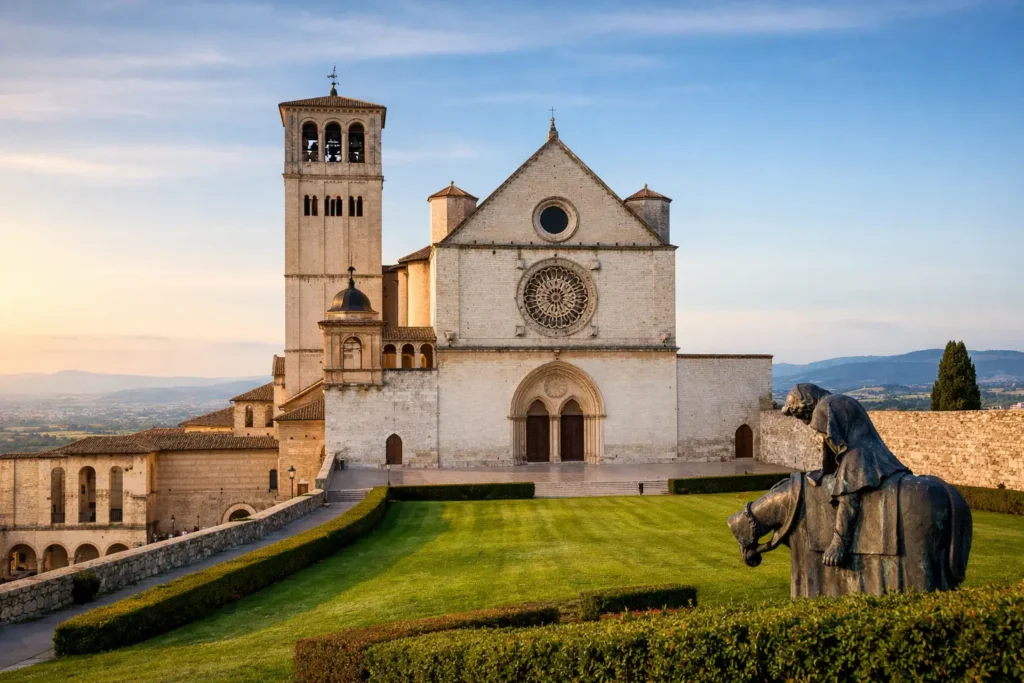
What Is the Basilica of Saint Francis in Assisi?
A pale stone church rises from the western edge of Assisi, facing the broad Umbrian valley below. Yet what is the Basilica of Saint Francis, exactly? It is far more than Assisi’s best-known monument: it is the burial place of St. Francis, a masterpiece of medieval Italian art, and one of the most moving places to understand the man whose message of humility changed the Christian world.
For many visitors, the basilica is the heart of an Assisi itinerary. Its quiet lower church, luminous upper church, frescoed walls, and crypt create a journey through faith, history, and art in a single visit. Allow time to slow down here. This is not a monument to rush through between photographs of the town’s medieval streets.
What Is the Basilica of Saint Francis in Assisi?
The Basilica of Saint Francis is a major Catholic pilgrimage church dedicated to St. Francis of Assisi, founder of the Franciscan Order. It was built soon after his death in 1226 and stands on the hill once known as the Hill of Hell, where public executions were carried out. The name was later changed to the Hill of Paradise – a powerful statement of how Francis’s legacy transformed the place.
Francis was buried here in 1230, only four years after his death. His tomb remains in the crypt beneath the lower church, where pilgrims and travelers alike come to pause beside the simple stone sarcophagus. In 2000, the basilica and other Franciscan sites in Assisi were recognized as a UNESCO World Heritage Site.
The building is unusual because it contains two complete churches, one built above the other, as well as the crypt below. Each space has its own atmosphere and artistic language. The lower basilica is dark, intimate, and solemn. The upper basilica feels taller, brighter, and more open, its walls telling Francis’s story in color.
A Church Built for a New Religious Movement
The basilica was not simply built to honor a beloved local saint. It became the spiritual center of a rapidly growing religious movement. Francis had embraced poverty, preached peace, cared for people on the margins, and encouraged a direct, humble relationship with creation and faith. His followers needed a place that could welcome pilgrims, preserve his memory, and express the importance of the new Franciscan order.
Construction began in 1228, the year Francis was declared a saint. The speed of his canonization reflects the extraordinary impact he had during his lifetime and immediately afterward. The church was consecrated in 1253, though decoration continued over many decades.
Its hillside setting was also practical. From the basilica’s terrace and surrounding approaches, visitors can see the plain below Assisi, with olive groves, farm fields, and distant hill towns. That landscape matters. Francis’s life and teachings are closely tied to the natural world of Umbria – the birds, the fields, the changing light, and the modest rural places around Assisi.
The Lower Basilica: Shadow, Gold, and Devotion
Enter the lower basilica and the mood changes immediately. Low vaulted ceilings, deep blue surfaces, candlelight, and richly painted chapels make it feel almost underground, even before you reach the crypt. This was designed as a place of devotion, where visitors could pray near the saint’s burial place.
The walls hold frescoes by some of the great artists of the 13th and 14th centuries, including Cimabue, Pietro Lorenzetti, and Simone Martini. Their work reflects a turning point in Italian painting. Figures gain emotion, weight, and presence; sacred scenes feel more human and immediate.
One of the most memorable spaces is the chapel decorated by Simone Martini, with elegant scenes connected to St. Martin of Tours. Elsewhere, Pietro Lorenzetti’s paintings bring tenderness and drama to biblical stories. You do not need to identify every artist to feel the difference between the chapels. An official guide can help connect the visual details to the patrons, religious ideas, and political world of medieval Assisi.
Below the lower basilica lies St. Francis’s tomb. The crypt was opened to visitors in the 19th century after the saint’s burial place was rediscovered. Its stripped-back stone setting offers a striking contrast to the decorated churches above. Silence is expected here, and it is worth honoring.
The Upper Basilica and the Story of St. Francis
The upper basilica is the space most closely associated with the famous fresco cycle telling the life of St. Francis. Light enters through stained-glass windows, lifting the eye toward the ribbed vaults and the long sequence of narrative scenes along the walls.
These paintings have traditionally been linked to Giotto, one of the artists often credited with changing the course of Western art. The question of exactly how much Giotto personally painted remains debated among scholars. What is beyond doubt is the importance of the cycle and its workshop tradition: the scenes present Francis as a living person moving through recognizable places, speaking with others, confronting hardship, and choosing a life of radical simplicity.
Look closely at the storytelling. In the scene where Francis renounces his family wealth, his father’s anger is visible, while the bishop shelters Francis beneath his cloak. In another, Francis preaches to the birds, expressing his belief that all creation could praise God. These are not abstract symbols alone. They are scenes filled with gesture, architecture, landscape, and human feeling.
The basilica suffered severe damage during the 1997 earthquake that struck Umbria and the Marche. Part of the upper church’s vault collapsed, tragically causing deaths and damaging frescoes. The restoration that followed was a remarkable international effort, and the reopened church stands as a reminder that cultural heritage needs both care and patience. Visitors today may notice that some restored areas remain visibly different – not a flaw, but part of the building’s continuing story.
How to Visit the Basilica Respectfully
The Basilica of Saint Francis is an active place of worship, not a museum, so a little preparation makes the experience better for everyone. Dress modestly, keep voices low, and do not use flash photography. Photography rules can vary by area, especially around the tomb and during services, so follow the signs and staff instructions.
Plan at least an hour for a first visit, and closer to 90 minutes if you enjoy art or want time for quiet reflection. Mornings can feel calmer, while later afternoon light is especially beautiful around Assisi’s stone streets. Busy weekends, religious holidays, and the period around St. Francis’s feast day on October 4 can bring larger crowds.
There is a practical trade-off to consider. If you visit independently, you can linger at your own pace and return to a favorite chapel. But the basilica’s layers can be difficult to read without context. A guided Assisi walk is especially valuable for first-time visitors because it places the church within Francis’s life, the medieval town, and the wider Umbrian landscape rather than treating it as an isolated landmark.
Beyond the Basilica: Following Francis Through Assisi
The basilica is best understood as the beginning of a Franciscan journey through Assisi. From here, the historic center rises toward the Cathedral of San Rufino and the Basilica of St. Clare, where the saint’s devoted follower is buried. On the eastern side of town, the Basilica of St. Clare preserves the San Damiano Crucifix, associated with Francis’s spiritual calling.
For a deeper connection, travel outside the town walls to sites such as San Damiano, where Francis heard the call to “rebuild” the Church, and the Eremo delle Carceri, a woodland hermitage on Mount Subasio. These places reveal another side of the Franciscan story: less monumental, quieter, and closely bound to the Umbrian countryside.
Assisi can be visited in a few hours, but it rewards a full day or more. Pause for lunch, walk the side streets, and look out over the valley that Francis himself would have known. With an official local guide, visitors can move beyond the familiar images and notice the details that make the town feel real – a worn doorway, a fresco fragment, a Roman stone reused in a medieval wall.
When you leave the Basilica of Saint Francis, do not hurry straight to the next sight. Step onto the terrace, look across the plain, and give the place a few quiet minutes. In Assisi, the most memorable part of a visit is often the space between the landmarks.