Related Posts
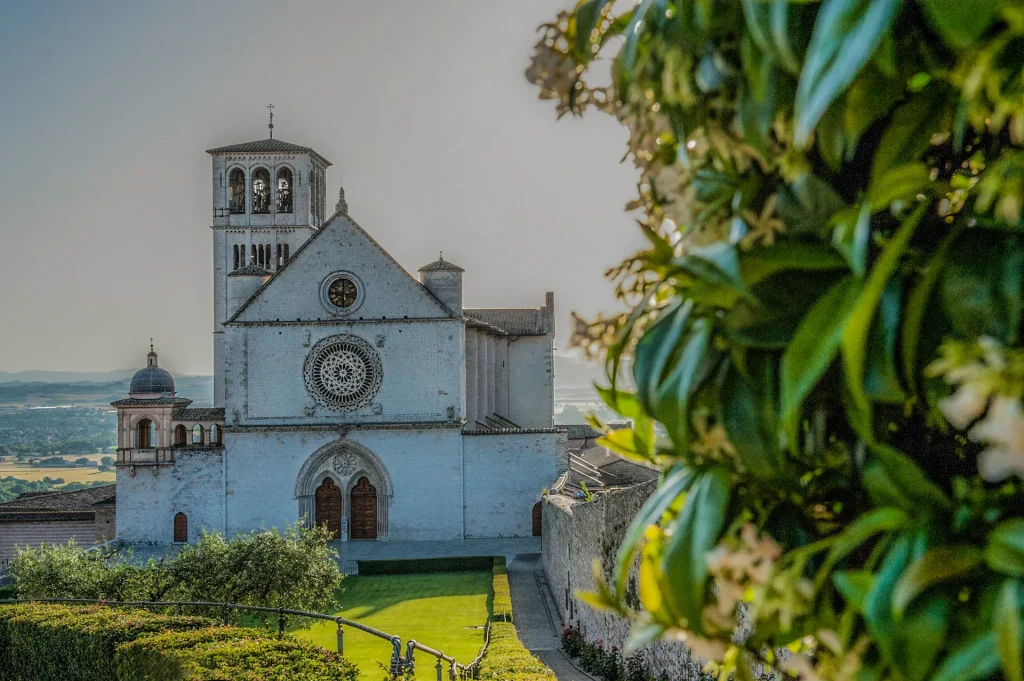
A few steps inside Assisi’s Basilica of St. Francis, the bright Umbrian daylight gives way to a church painted almost from floor to vault. Gold, deep blue, soft earth tones, and expressive faces surround you. The Basilica of St Francis frescoes are not simply decoration for a famous medieval church. They tell the story of a man who rejected wealth, embraced humility, and changed the spiritual imagination of Europe.
For many visitors, this is the artistic highlight of an Assisi stay. Yet the basilica can be difficult to understand at first glance because it is really two churches, built one above the other, with different moods, artistic programs, and centuries of history. Taking time to look closely changes the experience completely.
The basilica was begun shortly after Francis’s canonization in 1228, on the western edge of Assisi. It was conceived as both his burial church and the principal monument of the rapidly growing Franciscan Order. The building had to welcome pilgrims, honor a saint, and communicate Franciscan ideals to people who could not read.
Its painted walls became one of the most ambitious visual programs in medieval Italy. Here, sacred stories are made immediate: people grieve, argue, pray, travel, and respond to extraordinary events with recognizably human emotion. That directness is one reason the frescoes still feel so alive.
The basilica is also central to the history of Italian art. Major painters of the late 13th and early 14th centuries worked here, including Cimabue, Pietro Lorenzetti, Simone Martini, and artists associated with Giotto. Their work marks a decisive movement away from more formal, symbolic figures toward space, volume, drama, and observed human feeling.
The Lower Basilica is dim, intimate, and richly painted. Its low vaults and darker atmosphere encourage a slower pace than the bright Upper Basilica. This is where the tomb of St. Francis lies, in the crypt beneath the main church, and where many visitors feel the strongest connection to the saint’s legacy.
Look up at the transept, where Cimabue’s frescoes are among the basilica’s most historically significant works. Time, smoke, and the aging of pigments have altered their appearance, but their scale and intensity remain powerful. Cimabue was one of the great masters before Giotto, and his work helps explain the artistic transition that took place in Assisi.
The Lower Basilica also contains major fresco cycles by Pietro Lorenzetti, whose scenes have a striking emotional depth. His paintings often reward close observation: a gesture between two figures, the architecture framing a scene, or the way a face turns toward a moment of grief or revelation.
One of the great pleasures of this level is its sense of accumulation. Chapels, tombs, painted vaults, and devotional details show how the basilica developed over generations. It is not a museum arranged in neat chronological order. It is a living Franciscan monument, shaped by faith, patronage, loss, restoration, and pilgrimage.
The Upper Basilica feels very different. Light streams through tall windows, and the walls rise around the visitor in a clear, spacious Gothic interior. Along the nave are the famous scenes from the life of St. Francis, traditionally associated with Giotto.
There are 28 episodes, beginning with Francis as a young man and continuing through his conversion, his encounters with the pope and the sultan, the founding of the Franciscan community, and his death. Even if you know little of Francis’s biography, the sequence is easy to follow when viewed in order.
Several scenes are especially memorable. In the episode of Francis renouncing his worldly goods, he stands exposed before the bishop while his furious father is restrained behind him. The picture is about a theological decision, but it also feels like a family crisis unfolding in public. In another scene, Francis preaches to the birds, a beloved image of his relationship with creation. Elsewhere, he appears before Sultan al-Kamil in Egypt, a reminder that Francis’s life extended beyond the hills of Umbria.
These paintings are often called “Giotto’s frescoes,” and Giotto’s influence is undeniable. However, attribution is more complicated than a single-name label suggests. Scholars continue to debate how much was painted directly by Giotto and how much was executed by skilled collaborators in his workshop or by related artists. For visitors, the useful point is not to solve that debate in front of every panel. It is to notice what is new in the storytelling: solid bodies, convincing buildings, figures who occupy a shared space, and emotions that are readable without explanation.
Do not rush from scene to scene trying to identify every subject. Choose a few panels and look for the small decisions that make them convincing. Notice the architectural settings, which guide your eye through the action. Watch how groups of people respond differently to the same event. Some lean forward, some turn away, some appear uncertain, while others are fully absorbed.
Francis himself is usually recognizable by his simple brown habit and restrained presence. He is rarely presented as distant or grand. That visual humility is essential to the message. The paintings show a saint whose significance came not from power, but from a radical way of living.
The frescoes cannot be separated from the basilica’s vulnerability. On September 26, 1997, an earthquake struck Umbria and caused the collapse of part of the ceiling in the Upper Basilica. Four people lost their lives, and important paintings were shattered into thousands of fragments.
The restoration that followed was painstaking and highly specialized. Conservators recovered and reassembled fragments of the damaged frescoes, while the basilica underwent extensive structural work. The result is a testament to both artistic conservation and the enduring importance of Assisi’s heritage.
When you look up at the restored vaults, you are seeing more than medieval painting. You are also seeing the result of a modern effort to preserve it for future pilgrims and travelers. This history adds another layer to the visit, but it also explains why care and patience are needed in a site of such artistic and religious importance.
The best visit is not necessarily the longest one. For many travelers, 60 to 90 minutes inside the basilica allows enough time to see both levels without turning the experience into a checklist. If art history is a central interest, allow longer, especially if you want to study the fresco cycles in sequence.
Start in the Lower Basilica when it is quieter, then move to the Upper Basilica with the story of Francis already in mind. The contrast between shadow and light becomes part of the experience. Because this is an active place of worship, dress respectfully, keep voices low, and be prepared for occasional access restrictions during religious services or special events.
A knowledgeable local guide can be particularly valuable here. The church is visually overwhelming, and the strongest details are not always the most obvious ones. An official guide can connect the art to Francis’s life, point out the hands of different artists, and help you understand why a seemingly small scene mattered so much to the people who first saw it.
The frescoes are a compelling reason to visit Assisi, but they are best understood as part of the town itself. Walk through the stone lanes toward Piazza del Comune, pause at the Roman Temple of Minerva, and look across the valley that Francis knew. The landscape gives context to the painted stories of poverty, travel, nature, and community.
Assisi rewards an unhurried visit. Come for the Basilica of St Francis frescoes, then give yourself enough time to let their colors, faces, and stories follow you into the streets outside.