Articoli correlati
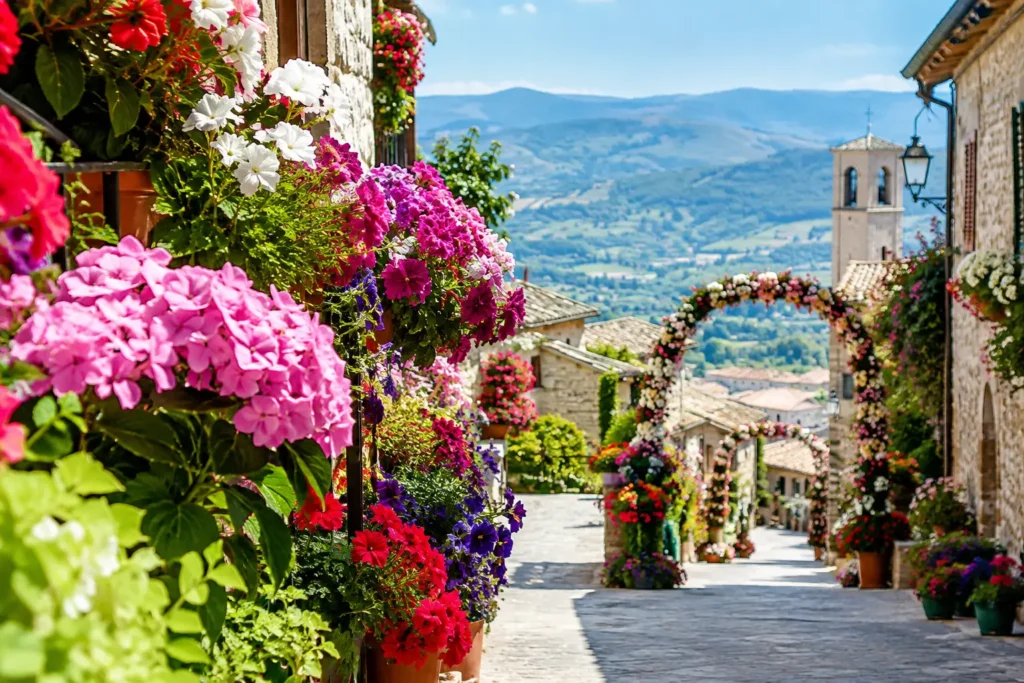
For one remarkable weekend each year, the pale-stone lanes of Spello become an open-air work of art. If you are planning how to visit the Spello Flower Festival, known locally as the Infiorata, expect far more than a pretty display: this is a centuries-old expression of faith, community, patience, and extraordinary local craftsmanship.
The festival takes place around Corpus Christi, usually in late May or June, when teams of residents cover Spello’s streets with elaborate carpets made entirely from flower petals, leaves, seeds, berries, and other natural materials. Medieval arches, tiny piazzas, and steep alleyways provide the setting. Arrive with a little planning, and you can enjoy the flowers while also experiencing one of Umbria’s most memorable hill towns.
The date changes every year because it follows the Catholic celebration of Corpus Christi. Before confirming hotels, trains, or a rental car, check the official dates for that year. The main festival activity is generally concentrated over the weekend, with the flower carpets displayed on Sunday before the religious procession passes through town.
Much of the magic happens before visitors arrive. In the weeks leading up to the event, local groups gather and sort petals, often selecting materials by shade to create subtle gradients, facial expressions, architectural details, and religious scenes. On Saturday night, and into the early hours of Sunday morning, the artists work directly on the streets. By dawn, long stretches of stone pavement have been transformed.
For most travelers, Sunday morning is the best time to see the finished Infiorate in daylight. Come early if you want room to move, time for photographs, and a chance to appreciate the smaller details before the busiest hours. The streets become increasingly crowded later in the morning and early afternoon, particularly around the most famous designs.
There is a trade-off. An early arrival offers the calmest viewing, but some of the energy comes from sharing the occasion with local families, visitors, and the artists who have spent the night at work. If your schedule allows, stay in or near Spello on Saturday night, see the final preparations, then return early Sunday to view the completed carpets.
Spello is compact, but its historic center is steep, cobbled, and not designed for large volumes of traffic. During the Infiorata, access restrictions and diversions are normal. The simplest approach is to arrive early, travel light, and expect to walk.
Spello has a small railway station on the line connecting Foligno and Perugia, making the train a practical option for visitors staying in Perugia, Assisi, or Foligno. From the station, the old town is uphill and roughly a 15- to 20-minute walk, depending on your pace. The route is manageable for many travelers, but it can feel demanding in warm weather or for anyone with limited mobility.
If you are traveling from Rome or Florence, Foligno is often the most convenient rail connection point. From there, Spello is only a short onward journey. Check schedules carefully for Sundays, when services can be less frequent than on weekdays.
A car gives you flexibility for exploring the wider Umbrian countryside, but it is not always the easiest way to enter Spello during the festival. Expect designated parking areas outside the historic center and a walk uphill to reach the flower displays. Follow local signs and instructions rather than relying entirely on navigation apps, as temporary road closures may be in place.
If you are staying outside town, plan to park by midmorning at the latest. Better still, arrive earlier and enjoy a coffee or a pastry before beginning your walk through the decorated streets. Do not try to drive into the centro storico unless your accommodation has given you clear instructions about authorized access.
Spello is especially atmospheric at this time of year, so an overnight stay is worth considering. Small hotels, guesthouses, and agriturismi in the surrounding countryside can fill well ahead of the festival weekend. Booking early also gives you the chance to enjoy Spello after many day visitors have left.
Assisi, Foligno, Perugia, Bevagna, and Montefalco are good alternatives if accommodation in Spello is unavailable. Each offers a different experience: Assisi for major Franciscan heritage, Foligno for rail convenience, Perugia for a lively city base, and Bevagna or Montefalco for a slower wine-country stay.
The Infiorate are not confined to one square. Their charm lies in wandering through the town and finding a new design around the next corner. Some are large, theatrical compositions; others are intimate and intricate, tucked beneath a stone arch or along a narrow lane.
Start near the main entrance to the historic center and allow yourself at least two to three hours. The best route is rarely the fastest one. Pause to look closely at the materials: deep red geranium petals may become a velvet-like background, while pale seeds create highlights and green leaves form precise outlines. From a distance, many carpets resemble paintings. Up close, their handmade character becomes even more impressive.
Respect the barriers and keep children close near the displays. These works are fragile and made to be walked only during the procession. It can be tempting to step closer for a photo, but the artists have often spent months preparing and an entire night assembling each design.
Spello’s permanent landmarks deserve time, too. The Church of Santa Maria Maggiore contains the celebrated Baglioni Chapel, frescoed by Pinturicchio, while the town’s Roman gates, medieval towers, and flower-filled lanes reward a slower walk. During the festival, build in extra time because even a short route can take longer in crowds.
Early summer in Umbria can be bright and hot, while the stone streets can be uneven and slippery in places. Comfortable walking shoes are essential, and sandals without support are rarely ideal for a full morning on cobbles. Bring water, sun protection, and a light layer if you plan to be out early or stay until evening.
A small crossbody bag is easier than a large backpack in narrow streets. If you intend to visit churches, wear clothing that is respectful and covers shoulders when required. Most importantly, bring patience. The Infiorata is a living local celebration, not a timed museum visit, and the occasional delay is part of the day.
Spello works beautifully as one highlight in a longer central Italy trip. Pair it with Assisi for a day of art and spiritual heritage, or explore the Roman mosaics of nearby Villa dei Mosaici di Spello when opening arrangements permit. Food lovers can continue toward Bevagna and Montefalco, where Sagrantino wine, olive oil, and seasonal Umbrian cooking provide a delicious contrast to the festival crowds.
A guided walk can also make the experience more meaningful, especially if this is your first visit to Umbria. An official local guide can help you read the town beyond its most photographed corners, from Roman Spello and Renaissance frescoes to the traditions behind its flower carpets. Umbria.tours offers experiences designed around this deeper local context, with time to enjoy the places rather than simply pass through them.
If you are visiting with young children, consider seeing the displays early and keeping the rest of the day flexible. Couples and photography-minded travelers may prefer an overnight stay, when quieter evening streets reveal another side of the town. For travelers with mobility concerns, a private arrangement with transport close to the center can make a significant difference, though Spello’s hills and cobbles remain part of its character.
The flowers will last only hours, and that is precisely why the Infiorata stays with people. Leave enough space in your day to linger over a detail, speak with a local shopkeeper, and look beyond the carpets to the ancient town that makes this brief burst of color feel so special.