Related Posts
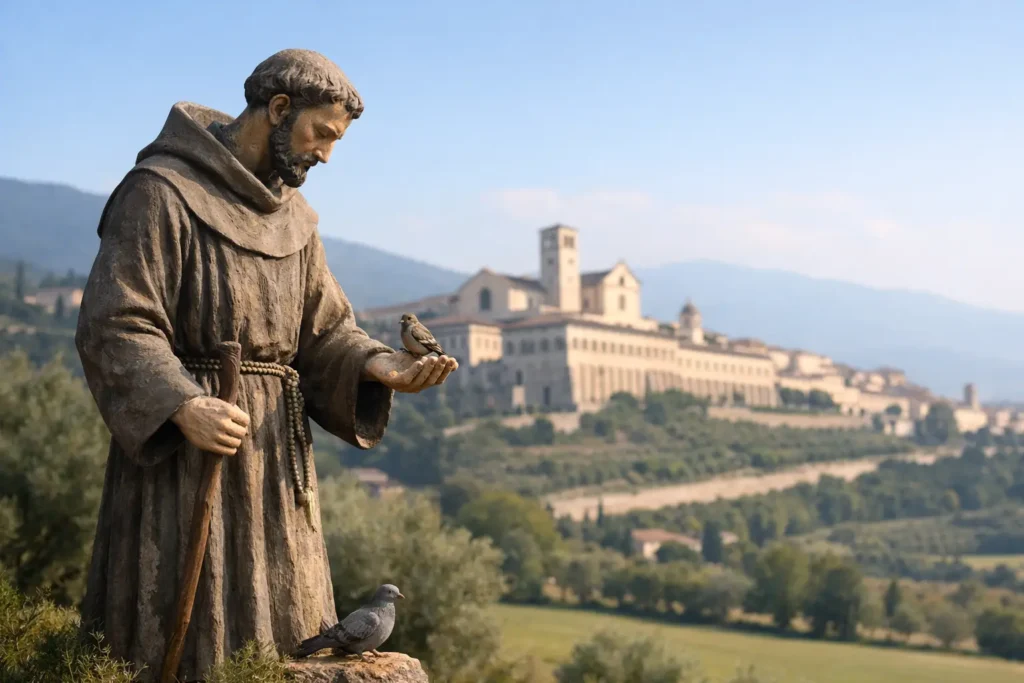
A walk through Assisi makes the significance of St Francis of Assisi feel immediate. It is there in the pale stone streets climbing Mount Subasio, in the quiet of San Damiano, and in the vast Basilica of St. Francis that seems to hold both the town and the valley in view. Francis was born here more than 800 years ago, but his story is not confined to medieval history. It continues to shape how visitors understand Assisi, Umbria, faith, nature, art, and the idea of a meaningful journey.
For travelers, Franciscan Assisi is more than a collection of famous monuments. It is a place where a radical personal choice changed the identity of a town and reached far beyond Italy. Seeing it well means allowing time for its layers: the young merchant’s son, the religious reformer, the friend of the poor, the poet of creation, and the saint whose example still speaks to people of many backgrounds.
Francis was born Giovanni di Pietro di Bernardone in Assisi around 1181 or 1182. His father was a prosperous cloth merchant, and the young Francis enjoyed a comfortable life, music, friendship, and dreams of glory. After illness, imprisonment during conflict with neighboring Perugia, and a gradual spiritual awakening, he chose a different path. He renounced wealth and status, embraced a life of poverty, and devoted himself to prayer, service, and preaching.
This decision was striking in a society where family honor, property, and political power mattered deeply. Francis did not simply withdraw from the world. He moved through it differently, meeting people on the margins, repairing neglected churches, and asking his followers to live simply and fraternally. His message was demanding, but it was also practical: possess less, judge less, care more, and recognize dignity in every person.
That combination helps explain his lasting appeal. Francis belongs firmly to the Catholic tradition, yet his concern for peace, humility, and the natural world has given him a wider resonance. Visitors may come to Assisi for religious reasons, artistic curiosity, or the pleasure of exploring an Umbrian hill town. Many find that his story offers a point of reflection regardless of their beliefs.
Assisi was not merely Francis’s birthplace. Its landscape helped form the geography of his life. The medieval town rises above the broad Umbrian plain, with olive groves and wooded slopes surrounding it. From its terraces, the view opens toward fields, villages, and distant hills. This setting makes Francis’s language of gratitude for the created world feel especially vivid.
The best-known expression of that vision is the Canticle of the Creatures, also called the Canticle of the Sun. Written near the end of his life, it praises God through “Brother Sun,” “Sister Moon,” water, fire, earth, and even death. It is often described as one of the earliest major works of Italian literature. More than a beautiful poem, it presents creation as a family of relationships rather than a resource to be controlled.
This is one reason St. Francis is widely associated with environmental concern. He should not be reduced to a modern ecological symbol, since his understanding of nature was rooted in medieval Christian faith. Still, his reverence for living beings and his insistence on humility before creation offer a powerful perspective for an age increasingly concerned with environmental damage.
A guided walk in Assisi can bring these connections into focus. The route between the Basilica of St. Francis, the town’s Roman remains, the main piazzas, and quieter lanes is not long, but the stories are dense. An official local guide can explain how a Roman settlement became a medieval commune, why Assisi’s stone has its distinctive warm tone, and how Franciscan buildings transformed the town’s skyline.
Just below Assisi’s walls stands San Damiano, a small church connected to one of the defining moments in Francis’s life. According to tradition, while praying before a crucifix here, Francis heard Christ tell him to “rebuild my church.” At first, he understood the words literally and repaired ruined chapels. In time, the meaning became larger: his life and the movement that followed would renew the Church through humility, poverty, and spiritual seriousness.
San Damiano also has a close connection with St. Clare, the young noblewoman from Assisi who followed Francis’s example and founded the Poor Clares. She lived here for many years and died here in 1253. The site therefore reveals that the Franciscan story was never Francis’s alone. Women and men, laypeople and religious communities, all helped carry its ideals forward.
The Basilica of St. Francis is one of Italy’s great artistic and spiritual landmarks. Built soon after Francis was canonized in 1228, it contains two overlapping churches: the Lower Basilica, intimate and richly decorated, and the brighter Upper Basilica. Francis’s tomb lies below, drawing pilgrims from around the world.
Its fresco cycles changed the course of Western art. Artists including Cimabue, Pietro Lorenzetti, Simone Martini, and the workshop traditionally associated with Giotto created images that gave sacred stories new emotional force. The scenes from Francis’s life are especially memorable because they show recognizable places, gestures, architecture, grief, joy, and human encounter. They helped make the saint’s example accessible to people who could not read.
Attribution, dating, and restoration remain subjects of scholarly discussion, particularly around the frescoes linked to Giotto. That uncertainty is part of what makes close looking rewarding. A good visit does not require an art history degree, but it benefits from context. Notice how the basilica uses space, color, and narrative to present Francis not as a distant statue, but as a person moving through the streets and conflicts of his time.
Francis’s life also carries a powerful message about reconciliation. One famous episode tells of his meeting with Sultan al-Kamil in Egypt during the Fifth Crusade. The encounter did not end the war or erase profound differences. Yet it remains significant because Francis crossed a hostile frontier in search of dialogue rather than conquest. For many people today, it represents the possibility of respectful encounter across religious and cultural boundaries.
His relationship with poverty is equally challenging. Francis did not praise suffering for its own sake, nor did he propose that every person live without possessions. His chosen poverty was a way of refusing the illusion that wealth, rank, or control could secure a meaningful life. It enabled him to stand alongside people who had little social power.
This is where interpretation matters. Franciscan simplicity can inspire visitors to travel more attentively, support local communities, and value experiences over accumulation. But it should not become a romantic picture of medieval hardship. Assisi’s beauty is real, yet Francis’s message was also uncomfortable. It asks what we hold too tightly and whom we fail to see.
Assisi is the essential starting point, but Franciscan heritage extends across Umbria. The Basilica of Santa Maria degli Angeli, in the plain below the hill town, shelters the tiny Porziuncola chapel where Francis founded his community. Nearby, the chapel known as the Transito recalls his death in 1226. On Mount Subasio, the Eremo delle Carceri offers a more secluded setting associated with Francis’s prayer and solitude.
Each place creates a different experience. The basilica in the historic center speaks of artistic ambition and global pilgrimage. San Damiano feels quieter and more personal. Santa Maria degli Angeli reveals the humble origins preserved within a monumental church. The hermitage invites a slower pace, especially for travelers who enjoy walking, landscape, and moments away from the busiest streets.
It depends on the time available and the kind of visit you want. A first-time traveler with only a few hours may choose the Basilica of St. Francis and the medieval center. Those with a full day can add San Damiano and Santa Maria degli Angeli. A private or small-group guided experience is particularly valuable here because the story unfolds across multiple sites, and the details connect far more clearly when placed in sequence.
Assisi is also a living town, not a museum set. Take time to notice the local rhythm: residents crossing the piazzas, shopfronts beneath medieval arches, the changing light on Mount Subasio, and the food traditions of the Umbrian countryside. Francis’s legacy is strongest when history is experienced in the place that made it possible.
A thoughtful visit need not seek a single lesson from St. Francis. It may leave you with a sharper appreciation for medieval art, a deeper understanding of Christian history, or simply a renewed habit of looking carefully at people and landscapes. In Assisi, those are not separate experiences. They are part of the same journey.