Articoli correlati
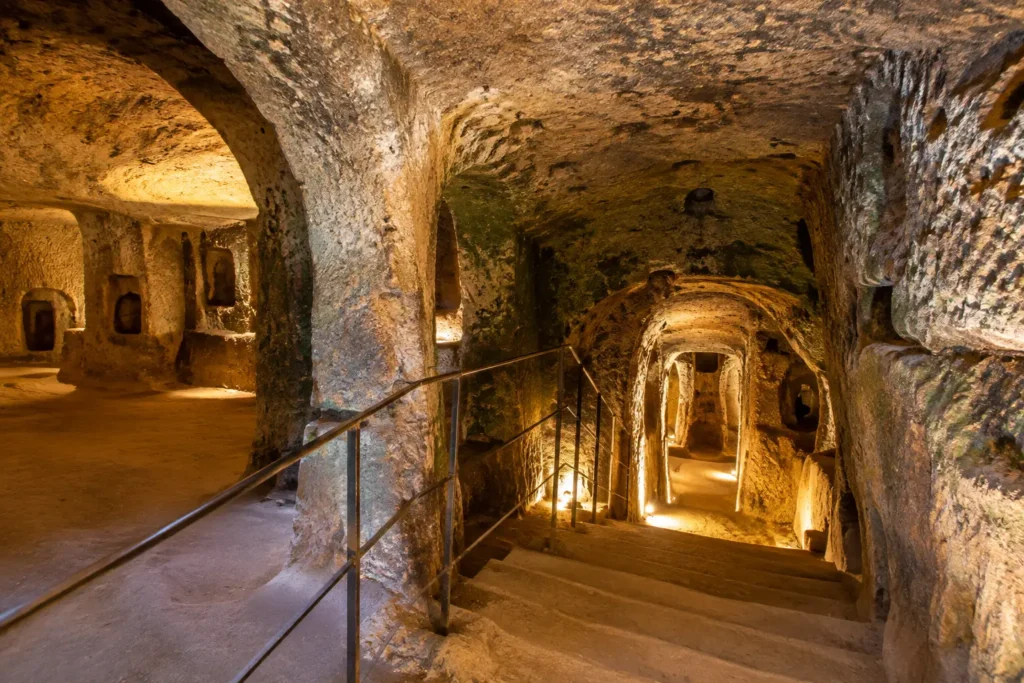
The streets around Orvieto’s cathedral are bright with striped stone, shop windows, and wide views across the Umbrian countryside. A few meters below them, another Orvieto survives in darkness: hand-cut chambers, wells, passages, and workspaces shaped over more than two millennia. This Orvieto underground guide will help you understand what you are seeing, choose the right visit, and make room for it in a well-planned day on the volcanic tufa rock.
Orvieto rises dramatically above the surrounding plain, set on a plateau of volcanic tufa. The rock is soft enough to excavate with hand tools, yet stable enough to form caves, cisterns, and storage rooms. For generations, residents used this natural advantage not as a curiosity, but as a practical part of daily life.
Beneath the historic center lies a vast network of man-made spaces. Archaeologists and local researchers have identified well over a thousand cavities, many created in Etruscan times and adapted repeatedly through the medieval period and beyond. Their uses changed with the needs of the town: water collection, food preservation, olive processing, workshops, refuse disposal, and pigeon breeding all found a place underground.
That continuity is what makes the experience memorable. You are not entering a single buried monument preserved behind glass. You are walking through fragments of a working underground town, where each chamber reveals a different response to life on a high, exposed rock with limited natural water.
The standard underground visit usually follows a guided route through caves beneath the city, often close to the area around Piazza Duomo. Exact access points and the chambers open to visitors can vary, so it is worth confirming the meeting place, language, and duration when arranging your visit.
A knowledgeable guide makes a real difference here. The rooms themselves can appear simple at first glance: a rough-cut wall, a deep shaft, a series of niches. Their importance emerges through explanation. A vertical opening may be part of a water system; a row of small recesses may once have housed pigeons; a heavy stone element may belong to an olive mill.
Water was essential to a settlement positioned high above the countryside. Rainwater was collected and directed into cisterns, while wells reached down through the tufa toward underground water sources. Excavating and maintaining these systems required impressive engineering, particularly before modern machinery.
The underground spaces show why Orvieto’s location was both a strength and a challenge. The cliff-top setting offered defense and commanding views, but it also meant that water could never be taken for granted. Looking down a deep well shaft gives that historical problem a physical scale that is hard to grasp from the surface.
The cool, steady temperature underground made these chambers useful for food-related work and storage. Some spaces were used for pressing olives, while others helped preserve supplies away from summer heat and changing weather. These details connect Orvieto’s medieval past with a living Umbrian tradition: olive oil remains one of the region’s defining products.
Do not expect a polished museum display in every room. The appeal is more immediate and more atmospheric. Tool marks in the tufa, uneven stairs, and working surfaces give a sense of how resourceful residents were with the space beneath their homes.
Among the most distinctive features are the pigeon niches. Hundreds of small openings were carved into walls to raise pigeons, valued historically for both meat and fertilizer. It is a striking sight, and it tells a story that is more domestic than grand: beneath noble palaces and religious buildings, families organized practical systems to feed themselves and cultivate the land.
This is one reason an underground visit complements Orvieto’s famous cathedral so well. The Duomo speaks of civic ambition, faith, art, and wealth. The caves reveal the labor, ingenuity, and everyday routines that supported the town around it.
Orvieto has more than one subterranean attraction, and they offer very different experiences. The underground caves are generally visited on a guided route focused on the city’s hidden spaces and their varied historical uses. St. Patrick’s Well, or Pozzo di San Patrizio, is a monumental Renaissance engineering project that you visit independently by descending its famous double-helix staircase.
The well was commissioned in the 16th century to secure a water supply during a possible siege. Its two separate spiral ramps allowed people and animals carrying water to travel up and down without crossing paths. It is an extraordinary structure, but it is not a substitute for a guided underground tour.
If your schedule allows, see both. Begin with the caves to understand Orvieto’s long relationship with the rock and its hidden water systems, then visit St. Patrick’s Well for the spectacular architectural answer to the same challenge. If you only have time for one, choose the caves for a wider view of daily life across the centuries, or the well for a dramatic, self-paced descent.
For most visitors, the underground route takes about an hour. It fits easily into a full day in Orvieto, but it is best treated as a fixed appointment rather than something to leave until late afternoon. Guided departures may be limited, particularly for English-language visits, and schedules can change with the season.
A good approach is to arrive in the historic center in the morning, visit the cathedral and its surrounding streets, then join an underground tour before lunch or in the early afternoon. The change from sunlight to the cool interior of the tufa creates a welcome pause on a warm day. Afterward, allow time for lunch, a glass of Orvieto Classico wine, and a slow walk toward the views at the edge of town.
Orvieto is easy to reach by train from Rome or Florence, but the station sits below the old town. The funicular provides the convenient connection uphill. Day-trippers should factor this transfer into their plan, especially when booking a timed underground departure.
The caves are generally cool, even during summer, and the ground can be uneven or damp in places. Wear comfortable shoes with a good grip and carry a light layer. The route may include steps, narrow passages, and low ceilings, so it is not always ideal for visitors with limited mobility, severe claustrophobia, or difficulty managing stairs.
Families with curious older children often enjoy the visit because it turns history into something tangible. Very young children may find the darker sections less engaging, and parents should check the route conditions before booking. Photography rules can vary by site, so ask your guide before taking pictures.
There is also a simple trade-off to consider. A self-guided stroll through Orvieto allows plenty of freedom, but the underground city is much harder to interpret alone. Here, the value of a guide is not just access. It is the ability to connect an Etruscan shaft, a medieval mill, and a line of pigeon niches into one story of how a hill town endured and prospered.
Orvieto rewards visitors who look beyond a single landmark. After your underground visit, return to the surface with fresh eyes. Notice how closely houses, lanes, and churches sit on the tufa plateau. Look for wells in courtyards and consider the hidden spaces beneath them. The town’s vertical drama is not only in its cliffs and towers, but in the layers below your feet.
For a richer cultural day, pair the caves with a guided walk through the historic center. An official local guide can place the underground network within the broader story of Etruscan Orvieto, the medieval commune, the cathedral’s construction, and the town’s food and wine traditions. Umbria.tours can help visitors shape this kind of focused experience around the time they have available.
Leave a little unplanned time after the tour. Orvieto is at its best when the history has time to settle: over lunch in a quiet lane, while looking across the valley from the city walls, or during the late-afternoon walk back toward the funicular. Beneath the stone, the town has kept its secrets for centuries. Seeing even a small part of that hidden world changes the way the whole city feels.